Peptide blend protocol
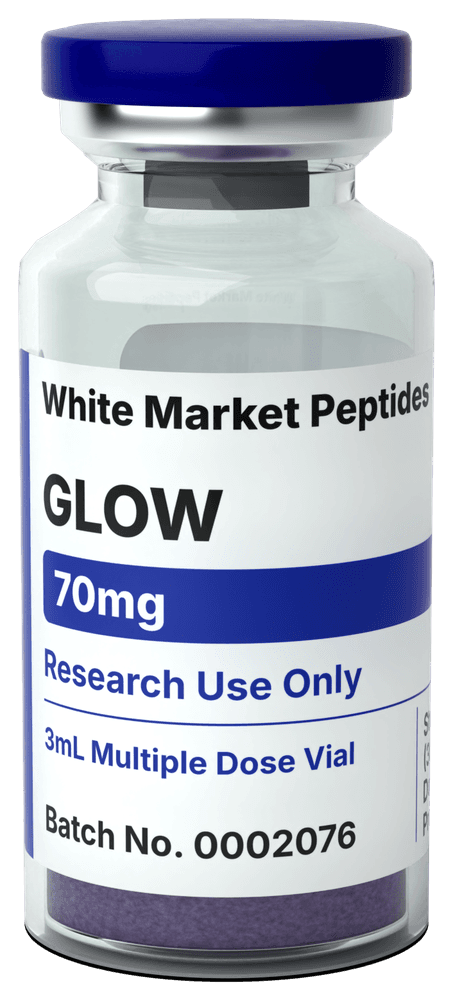
GLOW (70 mg)
GLOW 70mg peptide blend dosage protocol. GHK-Cu + TB-500 + BPC-157 reconstitution, injection schedule, and syringe guide.
- Peptides
- ghk-cu + tb-500 + bpc-157
- Vial
- 70 mg
- Water
- 3 mL
- Concentration
- 23.33 mg/mL
Sponsored
At a Glance
GLOW is a tri-peptide regeneration blend combining GHK-Cu (50 mg), TB-500 (10 mg), and BPC-157 (10 mg) in a 5:1:1 ratio. It pairs GHK-Cu's broad genomic repair foundation with TB-500's systemic cell migration and BPC-157's local FAK-paxillin healing — targeting skin, connective tissue, and musculoskeletal recovery in a single vial.[1][2]
- Reconstitute: Add 3.0 mL bacteriostatic water → 23.3 mg/mL concentration.
- Standard dose: 2,330 mcg (~2.3 mg) once daily subcutaneously.
- Easy measuring: At 23.3 mg/mL on a U-100 syringe, 1 unit = 0.01 mL ≈ 233 mcg. A 2,330 mcg dose = 10 units / 0.10 mL.
- Storage: Lyophilised: freeze at −20 °C; reconstituted: refrigerate at 2–8 °C; use within 4 weeks.
Overview
- Composition: GHK-Cu 50 mg + TB-500 10 mg + BPC-157 10 mg (5:1:1 ratio) in a 70 mg lyophilised vial.
- Goal: Comprehensive tissue repair combining GHK-Cu's genomic repair foundation with TB-500's systemic reach and BPC-157's local healing.[1][2]
- Schedule: Once-daily SC injection for a 4-week cycle; 2–4 weeks off.
- Reconstitution: 3.0 mL BAC water per 70 mg vial → 23.3 mg/mL.
- Storage: Lyophilised at −20 °C; reconstituted at 2–8 °C; use within 4 weeks.
What You’ll Need
Plan based on a 4-week cycle at 2,330 mcg once daily (28 injections, ~65.2 mg total).
- GLOW Vials (70 mg each): ~65.2 mg needed ÷ 70 mg per vial → 1 vial (with ~2 injections to spare).
- Insulin Syringes (U-100, 0.3 mL / 30-unit): 28 injections → 28 syringes.
- Bacteriostatic Water (10 mL bottles): 3.0 mL per vial → 1 × 10 mL bottle.
- Alcohol Swabs: 2 per injection → 56 swabs per 4-week cycle.
How to Reconstitute
- Allow frozen lyophilised vial to reach room temperature (10–15 minutes).
- Draw 3.0 mL bacteriostatic water with a sterile syringe.
- Inject slowly down the inner vial wall to avoid foaming.
- Gently swirl until fully dissolved — do not shake. Solution will have a characteristic blue colour from GHK-Cu's copper chelation; this is normal.
- Label with reconstitution date; refrigerate at 2–8 °C, protected from light. Use within 4 weeks.
Dosing Schedule
| Week | Dose | Units (U-100) | Volume | Frequency | Per Injection |
|---|---|---|---|---|---|
| Weeks 1–4 | 2,330 mcg | 10 units | 0.10 mL | Once daily | ~1,664 mcg GHK-Cu + ~333 mcg TB-500 + ~333 mcg BPC-157 |
Dose a flat 2,330 mcg once daily for the full 4-week cycle — no titration phase. The 5:1:1 ratio prioritises GHK-Cu's broad genomic repair while TB-500 and BPC-157 contribute systemic and local repair. Dose-sensitive users may optionally start at 1,165 mcg (5 units / 0.05 mL) for the first few days and titrate up to the standard 2,330 mcg as a tolerability measure, but the standard schedule is the flat dose from day one. For injuries with a strong local component, inject subcutaneously near the injury site to enhance BPC-157's local FAK-paxillin effects.
Vial duration: At the standard 2,330 mcg/day dose, each 70 mg vial provides 30 injections (0.10 mL each from 3.0 mL total) — enough for a full 4-week cycle.
Protocol Details
- Weeks 1–4 (standard): 2,330 mcg (10 units / 0.10 mL) once daily — flat dose for the full cycle.[2]
- Each standard injection delivers: ~1,664 mcg GHK-Cu + ~333 mcg TB-500 + ~333 mcg BPC-157.
- Injection site: Abdomen, thigh, or upper arm (rotate daily). For injuries with a strong local component, proximity to injury site enhances BPC-157's local effects.
Storage
- Lyophilised: Store at −20 °C (−4 °F) or below; protect from moisture and light.
- Reconstituted: Refrigerate at 2–8 °C. Do not freeze. Use within 4 weeks.
- Blue colour: GHK-Cu copper chelation gives the solution a characteristic blue colour — inspect for clarity but do not expect the colourless appearance of other peptides.
How GLOW Works
GLOW combines three peptides into a single coordinated repair protocol:
- GHK-Cu (50 mg — primary component): Copper tripeptide that modulates 4,000+ repair genes, stimulates collagen synthesis (types I, III, IV), balances MMPs/TIMPs, and delivers bioavailable copper to cuproenzymes (lysyl oxidase, SOD1).[1]
- TB-500 (10 mg): Binds G-actin for systemic cell migration, angiogenesis, anti-inflammatory, and anti-fibrotic signalling body-wide.
- BPC-157 (10 mg): Drives local repair via FAK-paxillin pathway, VEGF upregulation, and NO-pathway normalisation.[2]
The 5:1:1 ratio prioritises GHK-Cu's broad genomic repair foundation while TB-500 and BPC-157 contribute systemic and local repair mechanisms respectively.
Good to Know
- GLOW solution is normally blue — this is expected and indicates intact GHK-Cu copper chelation. Do not discard on this basis alone.
- GLOW is the core regeneration blend; for contexts involving gut inflammation or immune modulation, consider the KLOW blend which adds KPV for mucosal protection.
- WADA-prohibited — TB-500 and BPC-157 are Category S2 non-approved peptides. Athletes under anti-doping rules must not use GLOW.
- Rotate injection sites daily; document dose, site, and any local reactions.
- Genomic repair: GHK-Cu modulates 4,000+ genes; 31/66 chronic disease genes shifted toward healthy phenotypes.[1]
- Musculoskeletal repair: BPC-157 and TB-500 components provide local and systemic tissue repair — same evidence base as the Wolverine Stack.[2]
- Skin and connective tissue: GHK-Cu's collagen synthesis and matrix remodelling make GLOW particularly suited to skin, joint, and connective tissue recovery contexts.
- Blue solution: GHK-Cu's copper chelation produces a characteristic blue colour — document this in protocol notes to avoid confusion.
- WADA status: TB-500 and BPC-157 components are prohibited; GHK-Cu has no explicit WADA prohibition as of 2025 but GLOW as a blend is non-approved.
- For background on GLOW Blend's mechanism, evidence, and safety profile, see What Is GLOW Blend?.
Tips for Best Results
- Maintain adequate dietary protein (1.2–1.6 g/kg) and vitamin C (collagen cofactor) for GHK-Cu's collagen synthesis effects.
- Protect skin from UV exposure during GLOW cycles — new matrix formation increases photosensitivity.
- Avoid NSAIDs during GLOW cycles — they counteract BPC-157's NO-pathway and VEGF repair signalling.
Injection Tips
- Clean the vial stopper and injection site with separate alcohol swabs; allow both to air-dry fully before proceeding.
- Using a 29–31 gauge insulin syringe (5/16″ to 1/2″ needle), draw the calculated dose precisely.
- Pinch a fold of skin and insert the needle at 45° into subcutaneous fat (90° is acceptable with a short needle into a well-pinched fold).
- Inject slowly over 2–3 seconds; do not aspirate. Withdraw the needle, apply gentle pressure, and do not rub the site.
- Rotate injection sites (abdomen, thighs, upper arms) and dispose of each syringe in a sharps container immediately after use.
Related on pep-dose
- Article
What is GHK‑Cu?
What is GHK-Cu? Copper peptide for skin, hair, and tissue regeneration. Mechanism, evidence-based benefits, dosage guide, and risks.
- Protocol
GHK-Cu (100 mg)
GHK-Cu 100mg vial dosage protocol. Reconstitution, recommended doses, syringe units, and injection frequency guide.
- Protocol
GHK-Cu (50 mg)
GHK-Cu 50mg vial dosage protocol. Reconstitution guide, injection schedule, syringe measurements, and copper peptide dosing.
- Article
What Is TB-500?
What is TB-500 (Thymosin Beta-4 Fragment)? Mechanism of action, tissue repair benefits, recommended dosing, and safety considerations.
- Protocol
TB-500 (10 mg)
TB-500 10mg vial dosage protocol. Reconstitution, injection schedule, syringe units, and tissue repair dosing guide.
- Protocol
TB-500 (5 mg)
TB-500 5mg vial dosage protocol. Reconstitution instructions, loading and maintenance dosing, and syringe measurements.
- Article
What is BPC-157?
What is BPC-157? Learn about this healing peptide — mechanism of action, tissue repair benefits, dosing guidelines, and safety profile.
- Protocol
BPC-157 (10 mg)
BPC-157 10mg vial dosage protocol. Reconstitution with bacteriostatic water, injection dosing, syringe units, and schedule.