Single-peptide protocol
GHK-Cu (50 mg)
GHK-Cu 50mg vial dosage protocol. Reconstitution guide, injection schedule, syringe measurements, and copper peptide dosing.
- Peptide
- ghk-cu
- Vial
- 50 mg
- Water
- 3 mL
- Concentration
- 16.67 mg/mL
Sponsored
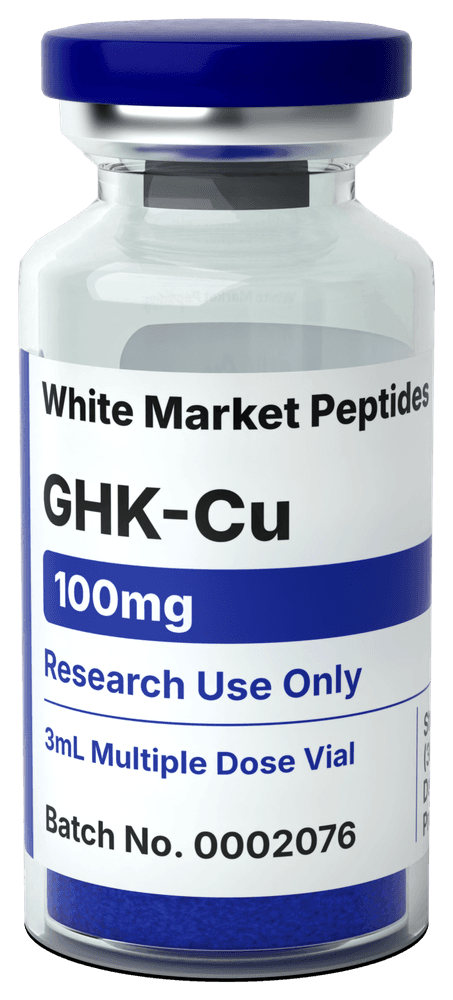
At a Glance
GHK-Cu (copper tripeptide-1) is a naturally occurring copper complex of the tripeptide glycyl-L-histidyl-L-lysine that declines with age and acts as a broad genomic repair signal, stimulating collagen synthesis, balancing matrix metalloproteinases, and suppressing inflammatory gene expression[1][2]. Research-grade GHK-Cu is used as a subcutaneous injectable solution for systemic and local repair applications.
- Reconstitute: Add 3.0 mL bacteriostatic water → 16.7 mg/mL concentration.
- Typical daily dose: 1–2 mg once daily (subcutaneous), 5 days on / 2 days off.
- Easy measuring: At 16.7 mg/mL, 1 unit = 0.01 mL ≈ 167 mcg on a U-100 insulin syringe.
- Storage: Lyophilized: freeze at −20 °C (−4 °F); after reconstitution, refrigerate at 2–8 °C (35.6–46.4 °F); use within 4 weeks.
Overview
- Goal: Support skin repair, wound healing, and matrix remodeling through collagen synthesis stimulation, MMP/TIMP balance, and broad genomic anti-inflammatory signaling[1][2].
- Schedule: Daily subcutaneous injections, 5 days on / 2 days off, for 12 weeks, followed by a 2–4 week rest period.
- Dose range: 1–2 mg once daily; begin low and titrate up as tolerated.
- Reconstitution: 3.0 mL per 50 mg vial (16.7 mg/mL).
- Storage: Lyophilized frozen at −20 °C; reconstituted refrigerated at 2–8 °C; use within 4 weeks.
What You’ll Need
Plan based on a 12-week cycle at 2 mg daily, 5 days/week (60 injections, 120 mg total).
- GHK-Cu Vials (50 mg each):
- 120 mg needed → 3 vials (with some leftover from the third).
- Insulin Syringes (U-100, 0.3 mL / 30-unit preferred):
- 60 injections → 60 syringes.
- Bacteriostatic Water (10 mL bottles):
- Per vial: 3.0 mL → 1 × 10 mL bottle covers all 3 vials (9 mL total).
- Alcohol Swabs: 2 per injection → 120 swabs per 12-week cycle.
How to Reconstitute
- Allow frozen vial to warm to room temperature (10–15 minutes).
- Draw 3.0 mL bacteriostatic water with a sterile syringe.
- Inject slowly down the vial wall to minimize foaming. Do not inject directly onto the lyophilized cake.
- Gently swirl or roll until fully dissolved—do not shake vigorously. Note: GHK-Cu solution will appear blue due to the copper chelation; this is normal.
- Label with reconstitution date and peptide name. Refrigerate at 2–8 °C, protected from light.
- Use within 4 weeks of reconstitution for optimal potency.
Dosing Schedule
| Week | Daily Dose | Units (U-100) | Volume | Schedule |
|---|---|---|---|---|
| 1–4 | 1.0 mg (1,000 mcg) | 6 units | 0.06 mL | Once daily, 5 days on / 2 days off |
| 5–8 | 1.5 mg (1,500 mcg) | 9 units | 0.09 mL | Once daily, 5 days on / 2 days off |
| 9–12+ | 2.0 mg (2,000 mcg) | 12 units | 0.12 mL | Once daily, 5 days on / 2 days off |
Frequency: Inject once daily subcutaneously, 5 days on / 2 days off. Begin at 1 mg for the first 4 weeks to assess tolerability, increase to 1.5 mg for weeks 5–8, then advance to 2 mg daily from week 9 onward if no adverse reactions are observed[3]. At 16.7 mg/mL (3.0 mL water per 50 mg vial), 1 unit on a U-100 syringe equals approximately 167 mcg.
Protocol Details
- Starting dose: 1,000 mcg (6 units / 0.06 mL) once daily for Weeks 1–4[3].
- Mid-range dose: 1,500 mcg (9 units / 0.09 mL) once daily for Weeks 5–8.
- Standard dose: 2,000 mcg (12 units / 0.12 mL) once daily for Weeks 9–12+.
- Frequency: Once daily, subcutaneous, 5 days on / 2 days off.
- Cycle length: 12-week active cycle; 2–4 weeks off before reassessment.
- Volume: 0.06–0.12 mL per injection, well within subcutaneous comfort range[6].
Storage
- Lyophilized: Store at −20 °C (−4 °F) or below for long-term stability[5]. Protect from moisture and light.
- Reconstituted: Refrigerate at 2–8 °C (35.6–46.4 °F). Do not freeze. Use within 4 weeks.
- Color check: GHK-Cu solutions appear blue—this is normal and indicates intact copper chelation.
- Inspect solution before each use; discard if discolored beyond the expected blue, cloudy, or particulate.
How GHK-Cu Works
GHK-Cu is a copper(II) complex of the tripeptide glycyl-L-histidyl-L-lysine that naturally occurs in human plasma, saliva, and urine. First isolated by Loren Pickart in 1973, plasma concentrations peak at approximately 200 ng/mL in young adults and fall to ~80 ng/mL by age 60[1].
Systemically administered GHK-Cu acts on multiple repair pathways. It stimulates fibroblasts to produce collagen I, III, and IV as well as glycosaminoglycans including dermatan and chondroitin sulfate[2]. It modulates the balance of matrix metalloproteinases (MMPs) and their tissue inhibitors (TIMPs), enabling healthy matrix remodeling without excessive scar formation. It upregulates decorin, a small proteoglycan that organizes collagen fibrils for improved mechanical strength[2]. At the gene expression level, GHK-Cu can shift over 4,000 human genes toward repair and away from inflammatory destruction, including 31 genes associated with COPD-like tissue damage[1]. It also delivers bioavailable copper to cuproenzymes including lysyl oxidase (critical for collagen and elastin cross-linking) and SOD1 (antioxidant defense).
Good to Know
- Use new sterile insulin syringes for each injection; dispose in a sharps container immediately.
- Rotate injection sites (abdomen, thighs, upper arms) at least 1–2 inches apart to prevent local irritation.
- GHK-Cu solution is normally blue; inspect clarity but do not expect the colorless appearance of other peptides.
- Document daily dose, injection site, and any skin or local reactions to track response.
- Skin rejuvenation: Human cosmetic trials show improved texture, fine-line reduction, and collagen density with topical GHK-Cu; injectable research extends these benefits systemically[3].
- Wound healing: Multicenter RCT demonstrated accelerated closure of diabetic foot ulcers with GHK-Cu gel adjunctive therapy[3].
- Post-procedure support: Randomized split-face trial showed improved CO₂-laser resurfacing recovery with topical copper tripeptide complex[4].
- Tolerability: Generally well tolerated in cosmetic and clinical studies; systemic copper toxicity is unlikely at typical research doses given the high-affinity chelation that prevents free copper reactivity.
- Blue color: The characteristic blue appearance of GHK-Cu solutions can concern new users but is normal and expected.
- For background on GHK-Cu's mechanism, evidence, and safety profile, see What Is GHK-Cu?.
Tips for Best Results
- Maintain adequate dietary protein (1.2–1.6 g/kg body weight) to provide amino acids for collagen synthesis.
- Ensure adequate vitamin C intake (collagen cross-linking cofactor) and dietary zinc (wound healing cofactor).
- Protect skin from UV exposure during GHK-Cu protocols—new matrix is photosensitive.
- Adequate hydration supports dermal hydration and glycosaminoglycan production.
Injection Tips
- Clean the vial stopper and injection site with separate alcohol swabs; allow both to air-dry fully before proceeding.
- Using a 29–31 gauge insulin syringe (5/16″ to 1/2″ needle), draw the calculated dose precisely.
- Pinch a fold of skin and insert the needle at 45° into subcutaneous fat (90° is acceptable with a short needle into a well-pinched fold).
- Inject slowly over 2–3 seconds; do not aspirate. Withdraw the needle, apply gentle pressure, and do not rub the site.
- Rotate injection sites (abdomen, thighs, upper arms) and dispose of each syringe in a sharps container immediately after use.
Related on pep-dose
- Article
What is GHK‑Cu?
What is GHK-Cu? Copper peptide for skin, hair, and tissue regeneration. Mechanism, evidence-based benefits, dosage guide, and risks.
- Protocol
GHK-Cu (100 mg)
GHK-Cu 100mg vial dosage protocol. Reconstitution, recommended doses, syringe units, and injection frequency guide.
- Blend
GLOW (70 mg)
GLOW 70mg peptide blend dosage protocol. GHK-Cu + TB-500 + BPC-157 reconstitution, injection schedule, and syringe guide.
- Article
What Is the GLOW Peptide Blend?
What is the GLOW peptide blend? GHK-Cu + TB-500 + BPC-157 regeneration stack. Components, synergy, dosing, and benefits.
- Blend
KLOW (80 mg)
KLOW 80mg peptide blend dosage protocol. GHK-Cu + TB-500 + BPC-157 + KPV reconstitution, escalating 8–12 week dosing schedule, and syringe guide.
- Article
What Is the KLOW Peptide Blend?
What is the KLOW peptide blend? GHK-Cu + TB-500 + BPC-157 + KPV stack. Components, anti-inflammatory benefits, and dosing.