Single-peptide protocol
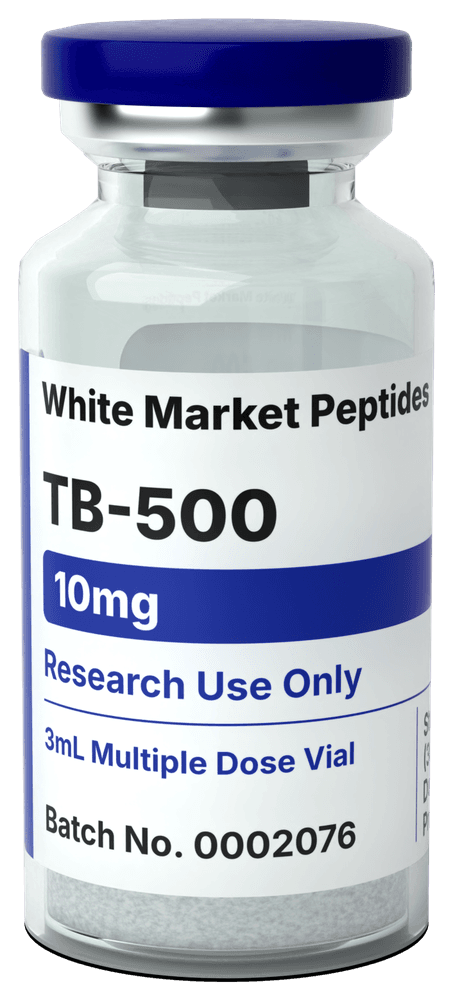
TB-500 (10 mg)
TB-500 10mg vial dosage protocol. Reconstitution, injection schedule, syringe units, and tissue repair dosing guide.
- Peptide
- tb-500
- Vial
- 10 mg
- Water
- 3 mL
- Concentration
- 3.33 mg/mL
Sponsored
At a Glance
TB-500 is a synthetic 7-amino acid peptide (Ac-LKKTETQ) corresponding to the active region of thymosin beta-4, a naturally occurring regenerative protein. It promotes tissue repair by binding G-actin monomers to enhance cellular motility, stimulating angiogenesis, and reducing inflammation.[1] The 10 mg vial provides approximately 10 days of peptide at the standard dose.
- Reconstitute: Add 3.0 mL bacteriostatic water → 3.33 mg/mL concentration.
- Standard dose: 500–1,000 mcg once daily subcutaneous injection.
- Easy measuring: At 3.33 mg/mL on a U-100 syringe, 1 unit = 0.01 mL = 33.3 mcg. A 500 mcg dose = 15 units / 0.15 mL.
- Storage: Lyophilised: freeze at −20 °C; reconstituted: refrigerate at 2–8 °C; use within 4 weeks.
Overview
- Goal: Promote tissue regeneration via enhanced cellular motility (G-actin binding), angiogenesis, and anti-inflammatory signalling.[1]
- Schedule: Once daily subcutaneous injection.
- Dose range: 500–1,000 mcg per injection (15–30 units / 0.15–0.30 mL).
- Reconstitution: 3.0 mL BAC water per 10 mg vial → 3.33 mg/mL.
- Injection route: Subcutaneous (preferred) or intramuscular.
What You’ll Need
Plan based on a 30-day course at 1,000 mcg once daily (30 injections, 30 mg total).
- TB-500 Vials (10 mg each): 30 mg needed ÷ 10 mg per vial → 3 vials.
- Insulin Syringes (U-100, 1 mL): 30 injections → 30 syringes.
- Bacteriostatic Water (10 mL bottles): 3.0 mL per vial → 1 × 10 mL bottle.
- Alcohol Swabs: 2 per injection → 60 swabs for the 30-day course.
How to Reconstitute
- Allow frozen lyophilised vial to reach room temperature (10–15 minutes).
- Draw 3.0 mL bacteriostatic water with a sterile syringe.
- Inject slowly down the inner vial wall at a 45° angle to avoid foaming.
- Gently swirl or roll until fully dissolved — never shake. Solution should be clear.
- Label with reconstitution date; refrigerate at 2–8 °C, protected from light. Use within 4 weeks.
Dosing Schedule
| Week | Daily Dose | Units (U-100) | Volume | Frequency |
|---|---|---|---|---|
| 1–2 | 500 mcg | 15 units | 0.15 mL | Once daily subQ |
| 3–4 | 750 mcg | 22.5 units | 0.225 mL | Once daily subQ |
| 5–8 | 1,000 mcg | 30 units | 0.30 mL | Once daily subQ |
Reconstitute with 3.0 mL bacteriostatic water for a concentration of 3.33 mg/mL, where 1 unit = 33.3 mcg on a U-100 syringe. Start low and titrate up every two weeks as you assess tolerance. TB-500 distributes systemically regardless of injection site, so you don’t need to inject near the injury — though some practitioners prefer proximal injection for acute issues. The 10 mg vial lasts roughly 10 days at the full dose (1,000 mcg/day) or 20 days at the starting dose (500 mcg/day).[1]
Protocol Details
- Starting: 500 mcg (15 units / 0.15 mL) subcutaneous, once daily.[1]
- Standard: 1,000 mcg (30 units / 0.30 mL) subcutaneous, once daily.
- Injection site: Abdomen, thigh, or upper arm; TB-500 distributes systemically from any site.
- Duration: Assess healing progress at week 4; adjust dose based on response.
Storage
- Lyophilised: Store at −20 °C; stable for up to 3 years frozen, 2 years refrigerated.
- Reconstituted: Refrigerate at 2–8 °C. Do not freeze. Use within 4 weeks.
- Appearance: Clear solution. Discard if cloudy, coloured, or particulate.
How TB-500 Works
TB-500 is a synthetic heptapeptide corresponding to amino acids 17–23 of thymosin beta-4, a 43-amino acid regenerative protein found in virtually all human cells. Its core mechanism involves binding to G-actin monomers, preventing their polymerisation into F-actin filaments. This keeps cells in a more motile state, enabling faster migration into damaged tissue.[1]
TB-500 also promotes angiogenesis (new blood vessel formation), activates satellite cell differentiation in skeletal muscle, and downregulates pro-inflammatory cytokines. Unlike BPC-157 which acts primarily at the local injection site, TB-500 distributes systemically via albumin binding, providing whole-body regenerative support. This complementary mechanism is why the two peptides are frequently combined in the Wolverine Stack.[2]
Good to Know
- TB-500 distributes systemically regardless of injection site — it does not need to be injected near the injury, unlike BPC-157.
- WADA-prohibited substance — competitive athletes subject to anti-doping rules must not use TB-500.
- TB-500 is often combined with BPC-157 for complementary systemic + local repair. See the Wolverine Stack Protocol.
- Initial effects (reduced inflammation) are typically noticed within 1–2 weeks; full regenerative benefits develop over 4–8 weeks.
- Temporary water retention and mild fatigue are common during the loading phase and typically resolve.
- Tissue regeneration: Promotes healing of tendons, ligaments, muscles, and chronic wounds through enhanced cellular motility and angiogenesis.[1]
- Anti-inflammatory: Reduces pro-inflammatory cytokines; may improve recovery from overtraining.
- Neuroprotective: Preclinical evidence of spinal cord and nerve tissue support.[2]
- Side effects: Fatigue, dizziness, headache, injection site irritation, temporary water retention — generally mild.
- Theoretical concern: Enhanced angiogenesis could be problematic in malignant conditions — avoid if history of cancer.
- For background on TB-500's mechanism, evidence, and safety profile, see What Is TB-500?.
Tips for Best Results
- Maintain adequate dietary protein (1.2–2.0 g/kg) to support tissue synthesis driven by TB-500.
- Progressively increase activity as healing permits — controlled loading stimulates aligned collagen deposition.
- Adequate sleep (7–9 hours) supports the anabolic repair environment.
- Stay well hydrated to help manage temporary water retention during loading phase.
Injection Tips
- Clean the vial stopper and injection site with separate alcohol swabs; allow both to air-dry fully before proceeding.
- Using a 29–31 gauge insulin syringe (5/16″ to 1/2″ needle), draw the calculated dose precisely.
- Pinch a fold of skin and insert the needle at 45° into subcutaneous fat (90° is acceptable with a short needle into a well-pinched fold).
- Inject slowly over 2–3 seconds; do not aspirate. Withdraw the needle, apply gentle pressure, and do not rub the site.
- Rotate injection sites (abdomen, thighs, upper arms) and dispose of each syringe in a sharps container immediately after use.
Related on pep-dose
- Article
What Is TB-500?
What is TB-500 (Thymosin Beta-4 Fragment)? Mechanism of action, tissue repair benefits, recommended dosing, and safety considerations.
- Protocol
TB-500 (5 mg)
TB-500 5mg vial dosage protocol. Reconstitution instructions, loading and maintenance dosing, and syringe measurements.
- Blend
GLOW (70 mg)
GLOW 70mg peptide blend dosage protocol. GHK-Cu + TB-500 + BPC-157 reconstitution, injection schedule, and syringe guide.
- Article
What Is the GLOW Peptide Blend?
What is the GLOW peptide blend? GHK-Cu + TB-500 + BPC-157 regeneration stack. Components, synergy, dosing, and benefits.
- Blend
KLOW (80 mg)
KLOW 80mg peptide blend dosage protocol. GHK-Cu + TB-500 + BPC-157 + KPV reconstitution, escalating 8–12 week dosing schedule, and syringe guide.
- Article
What Is the KLOW Peptide Blend?
What is the KLOW peptide blend? GHK-Cu + TB-500 + BPC-157 + KPV stack. Components, anti-inflammatory benefits, and dosing.
- Blend
Wolverine Stack (20 mg)
Wolverine Stack 20mg dosage protocol. BPC-157 + TB-500 reconstitution, injection schedule, and syringe measurements.
- Article
What Is the Wolverine Stack?
What is the Wolverine Stack? BPC-157 + TB-500 healing peptide combination. Synergy, tissue repair benefits, and dosing guide.