Single-peptide protocol
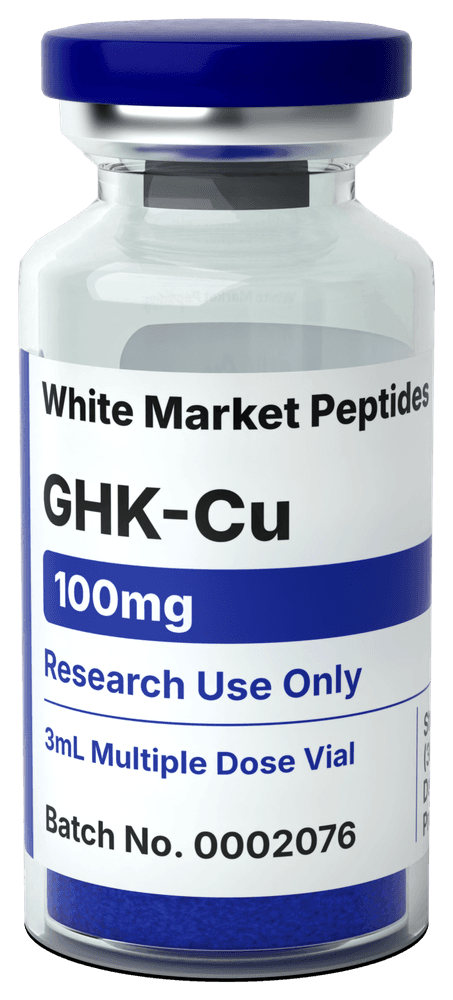
GHK-Cu (100 mg)
GHK-Cu 100mg vial dosage protocol. Reconstitution, recommended doses, syringe units, and injection frequency guide.
- Peptide
- ghk-cu
- Vial
- 100 mg
- Water
- 3 mL
- Concentration
- 33.33 mg/mL
Sponsored
At a Glance
GHK-Cu (Glycyl-L-Histidyl-L-Lysine copper complex) is a naturally occurring copper tripeptide that activates fibroblasts, stimulates collagen and elastin synthesis, promotes angiogenesis, and modulates over 4,000 human genes — 59% upregulated, 41% downregulated.[1] Plasma GHK-Cu levels decline from ~200 ng/mL at age 20 to ~80 ng/mL by age 60, making supplementation of interest for regenerative and anti-ageing research.
- Reconstitute: Add 3.0 mL bacteriostatic water → 33.3 mg/mL concentration.
- Standard dose: 1–2 mg once daily, subcutaneous (5 days on / 2 days off).
- Easy measuring: At 33.3 mg/mL on a U-100 syringe, 1 unit = 0.01 mL = 333 mcg. A 2 mg dose = 6 units / 0.06 mL.
- Storage: Lyophilised: freeze at −20 °C; reconstituted: refrigerate at 2–8 °C; use within 30 days.
Overview
- Goal: Stimulate collagen/elastin synthesis, promote tissue regeneration, and activate longevity-associated gene pathways (SIRT1, DNA repair).[1]
- Schedule: Daily subcutaneous injection, 5 days on / 2 days off, for 8–12 weeks.
- Dose range: 1–2 mg daily.
- Reconstitution: 3.0 mL BAC water per 100 mg vial → 33.3 mg/mL.
- Injection site: Abdomen, outer thighs, or upper arms (rotate daily).
What You’ll Need
Plan based on a 12-week cycle at 2 mg daily, 5 days/week (60 injections, 120 mg total).
- GHK-Cu Vials (100 mg each): 120 mg needed → 2 vials (with some leftover from the second).
- Insulin Syringes (U-100, 0.3 mL / 30-unit): 60 injections → 60 syringes.
- Bacteriostatic Water (10 mL bottles): 3.0 mL per vial → 1 × 10 mL bottle covers both vials (6 mL total).
- Alcohol Swabs: 2 per injection → 120 swabs per 12-week cycle.
How to Reconstitute
- Allow frozen lyophilised vial to reach room temperature (15–20 minutes).
- Draw 3.0 mL bacteriostatic water with a sterile syringe.
- Inject slowly down the inner vial wall to avoid foaming.
- Gently swirl until fully dissolved — a light blue colour is normal and expected.
- Label with reconstitution date; refrigerate at 2–8 °C, protected from light. Use within 30 days.
Dosing Schedule
Water: 3.0 mL → Concentration: 33.3 mg/mL → 1 unit = 333 mcg
| Week | Daily Dose | Units (U-100) | Volume | Schedule |
|---|---|---|---|---|
| 1–4 | 1.0 mg | 3 units | 0.03 mL | Once daily, 5 days on / 2 days off |
| 5–8 | 1.5 mg | 4.5 units | 0.045 mL | Once daily, 5 days on / 2 days off |
| 9–12+ | 2.0 mg | 6 units | 0.06 mL | Once daily, 5 days on / 2 days off |
Begin at 1 mg daily (5 days on / 2 days off) for the first 4 weeks, then advance to 1.5 mg and finally 2 mg daily. The 100 mg vial provides 50 injections at the 2 mg target dose, covering approximately 10 weeks of 5-on/2-off cycling. Reconstituted GHK-Cu may have a characteristic light blue colour from the copper complex — this is normal.[1]
Protocol Details
- Weeks 1–2: 1 mg (3 units / 0.03 mL) daily, 5 on / 2 off.
- Weeks 3–12: 2 mg (6 units / 0.06 mL) daily, 5 on / 2 off.
- Cycle: 8–12 weeks on; 2–4 week break before repeating.
Storage
- Lyophilised: Store at −20 °C or below; protect from moisture and light.
- Reconstituted: Refrigerate at 2–8 °C. Do not freeze. Use within 30 days. Protect from light.
- Appearance: Light blue solution is normal. Discard if darkened, cloudy, or particulate.
How GHK-Cu Works
GHK-Cu is a naturally occurring tripeptide (molecular weight 404.96 Da) found in human plasma, saliva, and urine. It binds copper(II) ions with high affinity, forming a stable complex that acts as a signalling molecule across multiple regenerative pathways.[1]
At the cellular level, GHK-Cu activates fibroblasts to increase type I and III collagen production by approximately 70%, stimulates elastin synthesis, and promotes glycosaminoglycan formation. It activates the SIRT1 longevity pathway and DNA repair genes. Gene expression studies show GHK-Cu affects 31.2% of human genes, upregulating those involved in tissue remodelling, antioxidant defence, and stem cell activity, while downregulating pro-inflammatory and tissue-destructive genes.[2]
Good to Know
- Reconstituted GHK-Cu has a characteristic light blue colour from the copper complex — this is expected and does not indicate contamination.
- The 100 mg vial is the most economical format for multi-week injectable protocols.
- Despite a very short plasma half-life (~4 minutes), GHK-Cu triggers sustained cellular cascades (collagen synthesis, wound healing, anti-inflammatory effects) lasting for days.
- Avoid use if you have Wilson’s disease, Menkes disease, or copper allergy.
- Do not exceed recommended doses — excess copper can cause toxicity.
- Collagen and skin: Increases type I and III collagen by ~70%; clinically shown to reduce wrinkle volume by 31.6% vs. active comparators.[1]
- Hair growth: May stimulate hair follicle enlargement and hair growth at injection sites.
- Wound healing: Promotes angiogenesis, nerve regeneration, and accelerates wound closure in preclinical models.
- Anti-ageing: Activates SIRT1 and DNA repair pathways; counters age-related decline in endogenous GHK-Cu levels.[2]
- Side effects: Injection site redness, swelling, bruising; occasional dizziness or headache — generally mild.
- Contraindications: Wilson’s disease, Menkes disease, copper allergy, active cancer, pregnancy/lactation.
- For background on GHK-Cu's mechanism, evidence, and safety profile, see What Is GHK-Cu?.
Tips for Best Results
- Ensure adequate vitamin C intake (supports collagen cross-linking and copper absorption).
- Maintain dietary protein intake (1.0–1.4 g/kg) to provide amino acids for collagen and elastin synthesis.
- Avoid excessive zinc supplementation (>40 mg/day) which can interfere with copper absorption.
- Protect skin from UV damage — collagen synthesis benefits are undermined by chronic sun exposure.
- Adequate sleep supports the anabolic repair processes that GHK-Cu enhances.
Injection Tips
- Clean the vial stopper and injection site with separate alcohol swabs; allow both to air-dry fully before proceeding.
- Using a 29–31 gauge insulin syringe (5/16″ to 1/2″ needle), draw the calculated dose precisely.
- Pinch a fold of skin and insert the needle at 45° into subcutaneous fat (90° is acceptable with a short needle into a well-pinched fold).
- Inject slowly over 2–3 seconds; do not aspirate. Withdraw the needle, apply gentle pressure, and do not rub the site.
- Rotate injection sites (abdomen, thighs, upper arms) and dispose of each syringe in a sharps container immediately after use.
Related on pep-dose
- Article
What is GHK‑Cu?
What is GHK-Cu? Copper peptide for skin, hair, and tissue regeneration. Mechanism, evidence-based benefits, dosage guide, and risks.
- Protocol
GHK-Cu (50 mg)
GHK-Cu 50mg vial dosage protocol. Reconstitution guide, injection schedule, syringe measurements, and copper peptide dosing.
- Blend
GLOW (70 mg)
GLOW 70mg peptide blend dosage protocol. GHK-Cu + TB-500 + BPC-157 reconstitution, injection schedule, and syringe guide.
- Article
What Is the GLOW Peptide Blend?
What is the GLOW peptide blend? GHK-Cu + TB-500 + BPC-157 regeneration stack. Components, synergy, dosing, and benefits.
- Blend
KLOW (80 mg)
KLOW 80mg peptide blend dosage protocol. GHK-Cu + TB-500 + BPC-157 + KPV reconstitution, escalating 8–12 week dosing schedule, and syringe guide.
- Article
What Is the KLOW Peptide Blend?
What is the KLOW peptide blend? GHK-Cu + TB-500 + BPC-157 + KPV stack. Components, anti-inflammatory benefits, and dosing.