Tissue Repair & Recovery
What Is the Wolverine Stack?
Sponsored
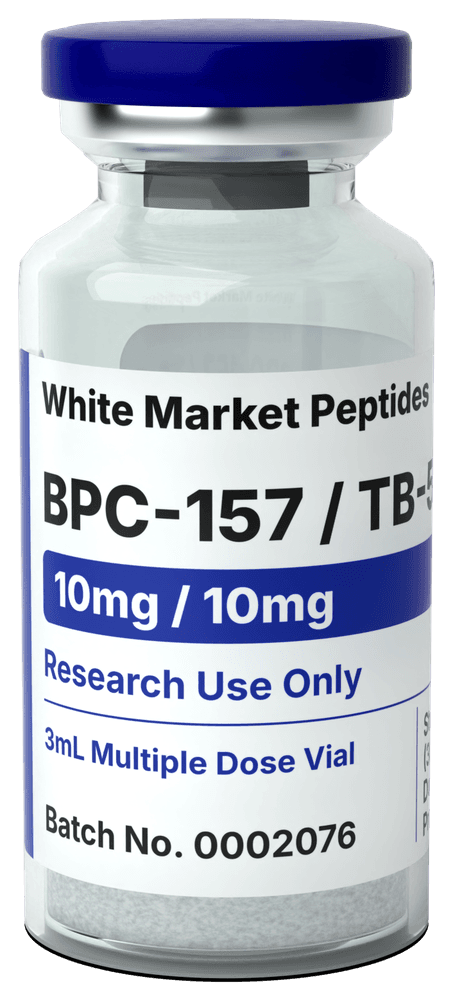
The Wolverine Stack is the most widely discussed peptide combination in the biohacking and sports recovery community, pairing BPC-157 (Body Protection Compound-157) with TB-500 (the active actin-binding fragment of thymosin beta-4) in a single coordinated protocol. The name references the Marvel character’s near-instant healing ability—reflecting the stack’s reputation for accelerating recovery from musculoskeletal injuries, tendon tears, muscle strains, and chronic soft-tissue damage. This guide explains what the Wolverine Stack is, why these two peptides are paired, what the research shows, and practical considerations for its use.
Composition note: The Wolverine Stack is available as a pre-mixed 20 mg vial containing BPC-157 10 mg + TB-500 10 mg in equal proportions, or it can be self-assembled from individual vials. The pre-mix simplifies reconstitution and ensures consistent dosing of both components simultaneously.
The Short Answer
The Wolverine Stack combines BPC-157 (local healing, angiogenesis, gut protection, FAK-paxillin pathway) with TB-500 (systemic repair, G-actin binding, cell migration, anti-fibrotic) to create a comprehensive, multi-mechanism tissue recovery protocol. BPC-157 excels at localized repair; TB-500 operates systemically. Together they address both the injury site and the broader physiological environment needed for healing.[1][2]
Key Concepts
Why these two peptides together?
BPC-157 and TB-500 operate through distinct but complementary pathways, making their combination more comprehensive than either alone:
- BPC-157 is a 15-amino acid peptide derived from human gastric juice proteins. It primarily acts locally—boosting VEGF receptor expression, activating the FAK-paxillin pathway in tendon cells, reducing prostaglandin E2, and normalizing the NO pathway to restore vascular function at the injury site.[1]
- TB-500 is a 7-amino acid synthetic fragment of thymosin beta-4. It works systemically—binding G-actin to enable cell migration, driving angiogenesis, down-regulating inflammatory cytokines, and suppressing myofibroblast activity to reduce scar tissue formation.[2]
Synergistic healing model:
- Phase 1 (Inflammatory, Days 1–5): TB-500 suppresses excessive cytokines (IL-6, TNF-α); BPC-157 normalizes the NO pathway and reduces prostaglandin-driven swelling. Together they shorten the inflammatory phase.
- Phase 2 (Proliferative, Days 5–21): BPC-157 activates FAK-paxillin signaling to recruit fibroblasts and endothelial cells; TB-500 enables their migration via actin remodeling. Both peptides drive angiogenesis to restore blood supply.
- Phase 3 (Remodeling, Weeks 3+): TB-500 reduces myofibroblast persistence to limit fibrosis; BPC-157 supports collagen organization and tendon cell maturation.
BPC-157 vs. TB-500: when each shines:
- BPC-157 is preferred for localized acute injuries (tendon, muscle tears), gut and intestinal disorders, and NSAID- or corticosteroid-induced damage. Best injected near the injury site for optimal local effect.
- TB-500 is preferred for systemic recovery, multiple concurrent injuries, cardiac or neural repair (preclinical), and reducing overall systemic inflammation. Injection site flexibility due to systemic distribution.
Step-by-Step: How the Wolverine Stack Protocol Works
Educational note: BPC-157 and TB-500 are research peptides not approved for human therapeutic use. This information is educational only and does not constitute medical advice.
Step 1 — Choose pre-mix or individual vials
Pre-mixed 20 mg vial (10 mg BPC-157 + 10 mg TB-500): Simplest approach—one reconstitution, one syringe, consistent dosing of both. Ideal when equal doses of each are appropriate.
Individual vials: Allows independent dose titration (e.g., higher TB-500 in the loading phase while keeping BPC-157 constant). More complex but more flexible.
Step 2 — Pre-mix reconstitution
Add 3.0 mL bacteriostatic water to the 20 mg vial → 6.67 mg/mL total (3.33 mg/mL each component). At this concentration on a U-100 syringe: 1 unit = 0.01 mL ≈ 66.7 mcg total blend.
Step 3 — Follow the once-daily titration structure
The total blend dose steps up over the cycle, injected once daily throughout:
- Weeks 1–2: 500 mcg total blend (7.5 units / 0.075 mL) once daily, SC. Approximately 250 mcg BPC-157 + 250 mcg TB-500 per injection.
- Weeks 3–4: 666 mcg total blend (10 units / 0.10 mL) once daily, SC. Approximately 333 mcg BPC-157 + 333 mcg TB-500 per injection.
- Weeks 5–8: 1,000 mcg total blend (15 units / 0.15 mL) once daily, SC. Approximately 500 mcg BPC-157 + 500 mcg TB-500 per injection.
Run a 4–8 week course; if recovery goals warrant a second course, take a 6-week break before cycling again.
For the full reconstitution math and dosing tables, see the Wolverine Stack 20 mg Dosage Protocol.
Step 4 — Injection strategy
- For acute local injuries: Inject as close to the injury site as safely possible (subcutaneously near, not into, the injured tissue) to maximize BPC-157’s local effects.
- For systemic recovery: Abdomen or thigh subcutaneous injection provides adequate TB-500 distribution.
Step 5 — What to track
Pain scores (NRS scale), range of motion, swelling, and functional performance at weeks 2, 4, and 8. Document injection sites and any local reactions.
Comparison & Alternatives
| Protocol | Components | Focus | Best For |
|---|---|---|---|
| Wolverine Stack | BPC-157 + TB-500 | Injury recovery | Acute/chronic musculoskeletal repair |
| GLOW Blend | GHK-Cu + TB-500 + BPC-157 | Regeneration + skin health | Multi-tissue healing with matrix remodeling |
| KLOW Blend | GHK-Cu + TB-500 + BPC-157 + KPV | Comprehensive repair + anti-inflammatory | Complex injuries with gut/immune involvement |
| BPC-157 alone | BPC-157 | Local healing | Acute injury, gut disorders |
| TB-500 alone | TB-500 | Systemic repair | Multiple injuries, cardiac/neural (preclinical) |
FAQs
What is the Wolverine Stack?
The Wolverine Stack is a combination of BPC-157 and TB-500, two research peptides that promote tissue repair through complementary mechanisms. BPC-157 works locally at injury sites; TB-500 distributes systemically. Together they accelerate recovery from musculoskeletal injuries more comprehensively than either alone.[1][2]
Why is it called the “Wolverine Stack”?
The name is a pop-culture reference to Marvel’s Wolverine, known for near-instant healing. It reflects the community’s experience of accelerated recovery with this combination. The name is informal and not used in scientific literature.
Is the Wolverine Stack available pre-mixed?
Yes. The Wolverine Stack is commonly available as a pre-formulated 20 mg vial (10 mg BPC-157 + 10 mg TB-500). This simplifies reconstitution and ensures a consistent 1:1 ratio of both components.
Can BPC-157 and TB-500 be mixed in the same syringe?
In pre-mixed vials, the two peptides are already combined and reconstituted together. For individually sourced peptides, mixing in the same syringe is possible but only if both are reconstituted in compatible diluents (bacteriostatic water, similar pH). Research suggests no known incompatibility between BPC-157 and TB-500.
How long before the Wolverine Stack shows results?
Most users report reductions in pain and inflammation within 1–2 weeks. Structural tissue improvements (tendons, muscle) typically emerge at 4–6 weeks. Full recovery from significant injuries may require 8–12 weeks of consistent protocol use.
Is the Wolverine Stack prohibited in sport?
Yes. Both BPC-157 and TB-500 are classified as non-approved peptide hormones/growth factors on the WADA Prohibited List, prohibited in- and out-of-competition. Athletes subject to drug testing should not use this stack.
Evidence Highlights
- BPC-157 orthopaedic review (PMC, 2025): 35 preclinical studies + 1 human pilot showing benefit in tendon, muscle, bone, and cartilage repair. Takeaway: Extensive preclinical basis; human data emerging.[1]
- TB-500/Tβ4 multi-tissue review (Goldstein, 2015): Documented repair effects across muscle, tendon, cornea, cardiac, and neural tissue with anti-fibrotic and pro-angiogenic mechanisms. Takeaway: Systemic healing agent with multiple tissue targets.[2]
- BPC-157 FAK-paxillin mechanism: Sikiric et al. demonstrated BPC-157 activates FAK-paxillin signaling in tendon cells to drive cell outgrowth and repair—explaining its local repair potency.
- Tβ4 Phase II wound trial: Improved closure of chronic venous stasis ulcers in human subjects with topical Tβ4 gel. Takeaway: Human proof-of-concept for the Tβ4 lineage of peptides.
Next Steps
- Wolverine Stack 20 mg Dosage Protocol — full reconstitution guide, dosing tables, supplies
- What Is BPC-157? — deep dive on the healing peptide
- What Is TB-500? — detailed TB-500 mechanism and evidence
- What Is the GLOW Blend? — how GHK-Cu elevates the Wolverine combination
Takeaway: The Wolverine Stack is the gold-standard research peptide combination for musculoskeletal recovery, pairing BPC-157’s local repair effects with TB-500’s systemic reach for a comprehensive, multi-phase healing protocol.
Related on pep-dose
- Blend
Wolverine Stack (20 mg)
Wolverine Stack 20mg dosage protocol. BPC-157 + TB-500 reconstitution, injection schedule, and syringe measurements.
- Protocol
BPC-157 (10 mg)
BPC-157 10mg vial dosage protocol. Reconstitution with bacteriostatic water, injection dosing, syringe units, and schedule.
- Protocol
BPC-157 (5 mg)
BPC-157 5mg vial dosage protocol. Reconstitution, injection schedule, syringe measurements, and recommended dosing for healing.
- Article
What is BPC-157?
What is BPC-157? Learn about this healing peptide — mechanism of action, tissue repair benefits, dosing guidelines, and safety profile.
- Protocol
TB-500 (10 mg)
TB-500 10mg vial dosage protocol. Reconstitution, injection schedule, syringe units, and tissue repair dosing guide.
- Protocol
TB-500 (5 mg)
TB-500 5mg vial dosage protocol. Reconstitution instructions, loading and maintenance dosing, and syringe measurements.
- Article
What Is TB-500?
What is TB-500 (Thymosin Beta-4 Fragment)? Mechanism of action, tissue repair benefits, recommended dosing, and safety considerations.