Tissue Repair & Recovery
What Is SS-31 (Elamipretide)?
Sponsored
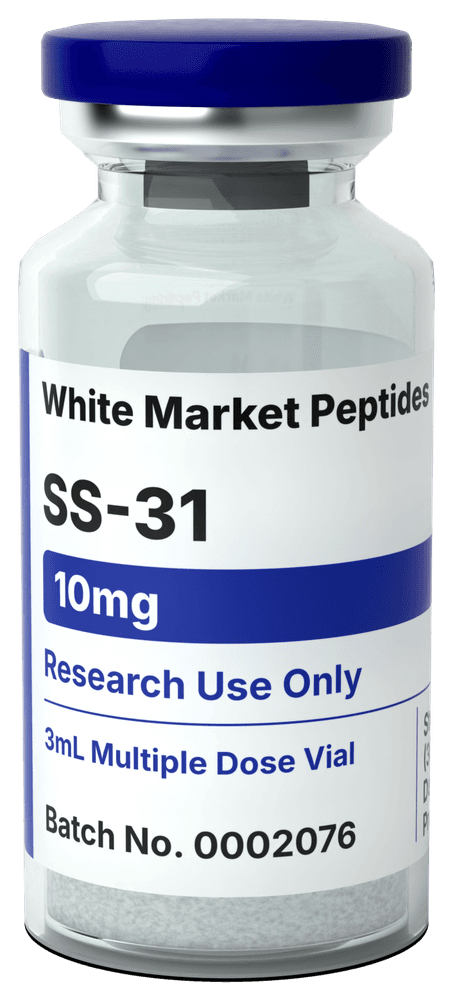
SS-31 (also known as Elamipretide, MTP-131, or Bendavia) is a synthetic aromatic-cationic tetrapeptide with the sequence D-Arg-2′,6′-Dmt-Lys-Phe-NH₂. It was designed to penetrate the inner mitochondrial membrane and bind selectively to cardiolipin — a phospholipid essential for electron transport chain (ETC) supercomplex assembly and optimal ATP production. By stabilizing cardiolipin, SS-31 restores mitochondrial bioenergetics in tissue under ischemic or oxidative stress. It has received FDA Fast Track designation for Barth syndrome (a pediatric mitochondrial cardiomyopathy) and has completed randomized phase 2 trials in heart failure.
Note on naming: "SS-31" refers to the Szeto-Schiller peptide nomenclature used in preclinical research. "Elamipretide" is the International Non-proprietary Name (INN); "MTP-131" and "Bendavia" are earlier developmental names used by Stealth Biotherapeutics. All refer to the same D-Arg-Dmt-Lys-Phe-NH₂ tetrapeptide.
The Short Answer
SS-31 is a cell-permeable, inner-mitochondrial-membrane–targeted tetrapeptide that binds cardiolipin to stabilize electron transport chain supercomplexes, reduce reactive oxygen species generation, and restore ATP production in energy-deprived or damaged tissue. In a randomized, placebo-controlled phase 2 trial (REPAIR-SHF), IV elamipretide significantly reduced left ventricular end-systolic and end-diastolic volume at end-infusion in patients with HFrEF, with a favorable safety profile.[2] A separate ex vivo study (Chatfield et al., 2019) in ventricular tissue from failing human hearts documented improved mitochondrial oxygen flux and ETC supercomplex-associated activity.[3]
Key Concepts
Molecular structure:
- Sequence: D-Arg-2′,6′-Dmt-Lys-Phe-NH₂ (alternating aromatic and cationic residues)
- Molecular weight: ~639 Da
- Design rationale: The alternating cationic (D-Arg, Lys) and aromatic (Dmt, Phe) residues enable spontaneous uptake across both the outer and inner mitochondrial membranes without relying on membrane potential — a key advantage over cationic compounds that accumulate via charge gradient and may lose efficacy when mitochondrial potential is compromised.[1]
Mechanism of action:
-
Cardiolipin binding: SS-31 preferentially associates with cardiolipin, the signature phospholipid of the inner mitochondrial membrane. Cardiolipin is required for the assembly and stability of respiratory supercomplexes (Complexes I, III, and IV). Loss of cardiolipin integrity — occurring under oxidative stress, ischemia, and aging — destabilizes supercomplexes and impairs electron flow.[1]
-
ETC supercomplex stabilization: By binding cardiolipin, SS-31 preserves supercomplex architecture, maintaining the substrate channeling efficiency that maximizes ATP yield per oxygen consumed.[1]
-
ROS reduction: Stabilized ETC supercomplexes produce fewer electrons that escape to form superoxide. SS-31 thereby reduces mitochondrial reactive oxygen species (ROS) without acting as a direct antioxidant scavenger.[1]
-
Cytochrome c retention: Cardiolipin anchors cytochrome c to the inner membrane for electron shuttling between Complexes III and IV. Loss of cardiolipin releases cytochrome c into the cytosol, triggering apoptosis. SS-31 protects this interaction.[1]
-
Membrane potential-independent uptake: Because SS-31 does not rely on ΔΨm for mitochondrial accumulation, it remains effective in severely depolarized mitochondria — precisely the conditions encountered in ischemic or failing tissue.[1]
Human Clinical Evidence
| Study | Design | Key Finding |
|---|---|---|
| Daubert et al. (2017) — REPAIR-SHF[2] | Randomized, placebo-controlled; 36 patients with HFrEF (EF ≤35%); IV elamipretide ascending dose (0.005, 0.05, 0.25 mg/kg/h) × 4-hour infusion | At 0.25 mg/kg/h, significant reduction in LV end-systolic and end-diastolic volume index at end-infusion vs. placebo; no serious AEs |
| Chatfield et al. (2019)[3] | Ex vivo; ventricular myocardial samples from 10 failing human hearts (UNOS donor tissue); 1 µM elamipretide | Significant improvement in CI-linked and CIV-linked mitochondrial oxygen flux and ETC supercomplex-associated CIV activity; mechanistic evidence in human failing cardiac tissue |
| Szeto (2014)[1] | Preclinical review | Established cardiolipin-binding mechanism; reviewed SS-31 efficacy in ischemia-reperfusion, heart failure, renal disease, and neurodegenerative animal models |
Current regulatory status: FDA Fast Track for Barth syndrome; phase 3 trials ongoing. Not FDA-approved for any indication as of the date of this publication. Research use only outside of approved clinical trials.
Dosage Reference
Educational reference only. The doses below derive from published clinical trials and preclinical data. SS-31 is not approved for unsupervised human use.
Reconstitution (10 mg vial): Add 1.0 mL bacteriostatic water → 10 mg/mL. On a U-100 insulin syringe, 1 unit = 0.01 mL = 0.1 mg.
| Dose | Volume (10 mg/mL) | U-100 Units |
|---|---|---|
| 2.5 mg | 0.25 mL | 25 units |
| 5 mg | 0.5 mL | 50 units |
| 10 mg | 1.0 mL | 100 units |
Typical SC schedule: A common community approach runs a fixed week-based ramp — 5 mg once daily for Weeks 1–2, then 10 mg once daily for Weeks 3–8 (subcutaneous), all from the single 10 mg/mL vial. A more conservative start of 2.5 mg (25 units / 0.25 mL) once daily for the first few days is sometimes used where injection-site sensitivity is a concern. Supervised protocols occasionally escalate to 15–20 mg/day, which requires splitting the dose across two separate SC injections drawn from two vials.
Clinical trial reference doses:
- REPAIR-SHF (IV): 0.05–0.25 mg/kg; at 70 kg, that is 3.5–17.5 mg.
- Barth syndrome (SC): 40 mg/day administered as a continuous 2-hour SC infusion via pump in clinical trials.
For full reconstitution steps and syringe tables, see the SS-31 10 mg Dosage Protocol.
Safety Profile
Clinical trial safety data:
- Injection-site reactions: Redness, pain, and induration at the SC injection site are frequently reported across elamipretide SC trials; they are manageable and have not required trial discontinuation in published studies.
- IV infusion (REPAIR-SHF): Well tolerated at both doses; no serious adverse events attributed to SS-31; transient mild flushing reported in some participants.[2]
- Systemic safety: No significant changes in renal function, hepatic enzymes, haematology, or ECG parameters in published trials.
Contraindications and cautions:
- No clinical data in pregnancy or lactation; avoid
- Long-term safety data beyond the published trial durations are limited
- Not approved for human use outside of clinical trials
Comparison: SS-31 vs. Related Mitochondrial-Targeted Agents
| SS-31 (Elamipretide) | MitoQ | Idebenone | |
|---|---|---|---|
| Class | Aromatic-cationic tetrapeptide | Ubiquinone + TPP cation | Synthetic short-chain CoQ analogue |
| Mitochondrial targeting | Membrane potential-independent; cardiolipin binding | Membrane potential-dependent accumulation | Passive diffusion |
| Primary mechanism | Cardiolipin stabilization → ETC supercomplex integrity | Electron carrier; antioxidant | CoQ10 analogue; electron carrier |
| Human RCT data | Yes (REPAIR-SHF, Barth syndrome trials) | Limited (small trials, ALS, Friedreich's ataxia) | Yes (LHON); approved in some jurisdictions |
| Route (research) | IV or SC injection | Oral | Oral |
| Regulatory status | Fast Track (Barth); investigational | Not FDA-approved | Approved for LHON in some countries |
FAQ
What does SS-31 treat?
In published human trials, SS-31 has been studied for ischemic heart failure (REPAIR-SHF) and Barth syndrome (a mitochondrial cardiomyopathy). It is not approved for any indication in the US. Preclinical studies report beneficial effects in models of acute kidney injury, Parkinson's disease, optic neuropathy, and skeletal muscle wasting.
How does SS-31 differ from antioxidant supplements like CoQ10?
CoQ10 and related antioxidants primarily act as electron carriers or scavengers. SS-31 does not function as a direct antioxidant scavenger; instead, it binds cardiolipin to preserve ETC supercomplex structure, which reduces ROS generation at the source. This mechanistic distinction means SS-31 remains effective in mitochondria that are too depolarized for potential-driven accumulation of cationic antioxidants.
Is SS-31 the same as MTP-131 or Bendavia?
Yes — all three names refer to the same tetrapeptide (D-Arg-2′,6′-Dmt-Lys-Phe-NH₂). MTP-131 and Bendavia were development-phase names used by Stealth Biotherapeutics; elamipretide is the INN; SS-31 is the original research designation from the Szeto-Schiller peptide series.
What are the most common side effects?
In the REPAIR-SHF IV trial, SS-31 was well tolerated with no serious adverse events attributed to the peptide.[2] Injection-site reactions (redness, pain, induration) are the primary adverse effect reported across elamipretide SC dosing in published clinical programs.
What is the evidence that SS-31 works in humans?
The REPAIR-SHF randomized trial (n=36, HFrEF EF ≤35%) showed significant reductions in LV end-systolic and end-diastolic volume at end-infusion in the 0.25 mg/kg/h cohort vs. placebo.[2] A separate ex vivo study (Chatfield et al., 2019) demonstrated improved mitochondrial oxygen flux in failing human ventricular tissue.[3] Phase 3 programs (Barth syndrome and cardiovascular outcomes) are ongoing; FDA approval is pending.
Related on pep-dose
Sources
- Szeto HH — British Journal of Pharmacology (2014) — First-in-class cardiolipin-protective compound as a therapeutic agent to restore mitochondrial bioenergetics
- Daubert MA et al. — Circulation: Heart Failure (2017) — Novel Mitochondria-Targeting Peptide in Heart Failure Treatment: A Randomized, Placebo-Controlled Trial of Elamipretide (REPAIR-SHF)
- Chatfield KC et al. — JACC Basic and Translational Science (2019) — Elamipretide Improves Mitochondrial Function in the Failing Human Heart