Single-peptide protocol
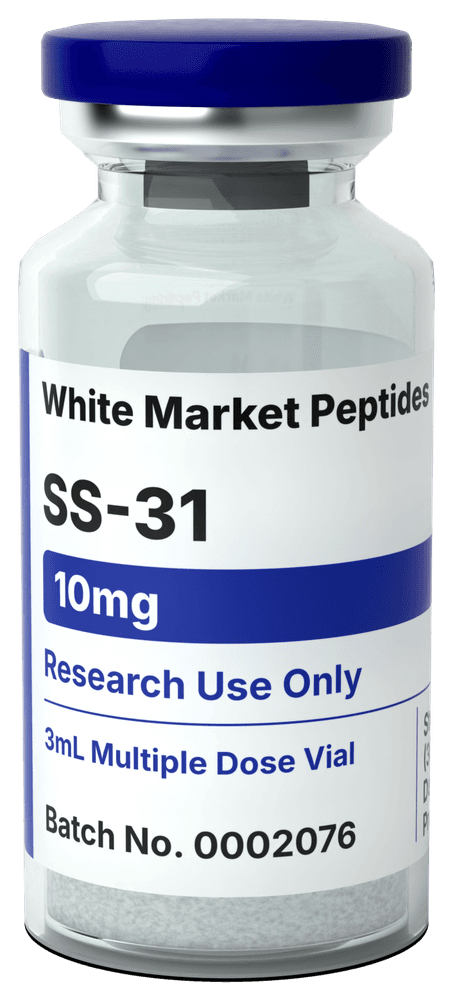
SS-31 (10 mg)
SS-31 (Elamipretide) 10 mg vial dosage protocol. Reconstitution, subcutaneous dosing table, storage, and injection guidance.
- Peptide
- ss-31
- Vial
- 10 mg
- Water
- 1 mL
- Concentration
- 10.00 mg/mL
Sponsored
At a Glance
SS-31 (Elamipretide) is an aromatic-cationic tetrapeptide that binds cardiolipin on the inner mitochondrial membrane to stabilize electron transport chain supercomplexes, reduce ROS generation, and restore ATP production in ischemic or failing tissue.[1] It has completed randomized phase 2 trials in heart failure (IV route, REPAIR-SHF) and is under study in Barth syndrome (a mitochondrial cardiomyopathy) via SC administration.
- Reconstitute: Add 1.0 mL bacteriostatic water → 10 mg/mL concentration.
- Standard dose: 5 mg once daily for Weeks 1–2, then 10 mg once daily for Weeks 3–8 (subcutaneous).
- Easy measuring: At 10 mg/mL on a U-100 syringe, 1 unit = 0.01 mL = 0.1 mg. A 5 mg dose = 50 units / 0.5 mL; a 10 mg dose = 100 units / 1.0 mL.
- Storage: Lyophilised: freeze at −20 °C; reconstituted: refrigerate at 2–8 °C; use within 4 weeks.
Overview
- Goal: Restore mitochondrial bioenergetics by stabilizing cardiolipin-dependent ETC supercomplexes and reducing mitochondrial ROS.[1]
- Schedule: Once-daily subcutaneous injection, ramping from 5 mg (Weeks 1–2) to 10 mg (Weeks 3–8).
- Dose range: 5–10 mg SC once daily (advanced supervised tier 15–20 mg/day via split injections); clinical trials used 40 mg/day SC in Barth syndrome and 0.05–0.25 mg/kg IV in REPAIR-SHF.
- Reconstitution: 1.0 mL BAC water per 10 mg vial → 10 mg/mL.
- Injection site: Abdomen, thigh, or upper arm; rotate daily.
What You'll Need
Plan based on the standard 8-week ramp: 5 mg once daily for Weeks 1–2 (70 mg) and 10 mg once daily for Weeks 3–8 (420 mg) — 56 injections, 490 mg total.
- SS-31 Vials (10 mg each): 490 mg needed ÷ 10 mg per vial → 49 vials.
- Insulin Syringes (U-100, 1 mL / 100-unit): 56 injections → 56 syringes.
- Bacteriostatic Water (10 mL bottles): 1.0 mL per vial × 49 vials → 5 × 10 mL bottles.
- Alcohol Swabs: 2 per injection → 112 swabs per 8-week cycle.
How to Reconstitute
- Allow frozen lyophilised vial to reach room temperature (10–15 minutes).
- Draw 1.0 mL bacteriostatic water with a sterile syringe.
- Inject slowly down the inner vial wall.
- Gently swirl until fully dissolved — do not shake. Solution should be clear and colourless.
- Label with reconstitution date; refrigerate at 2–8 °C, protected from light. Use within 4 weeks.
Dosing Schedule
| Week | Dose | U-100 Units | Volume (10 mg/mL) | Frequency |
|---|---|---|---|---|
| Weeks 1–2 | 5 mg | 50 units | 0.50 mL | Once daily |
| Weeks 3–8 | 10 mg | 100 units | 1.0 mL | Once daily |
Run a fixed week-based ramp: 5 mg once daily for Weeks 1–2 to assess individual tolerance, then advance to 10 mg once daily for Weeks 3–8. If you have injection-site sensitivity, you may begin at an even more conservative 2.5 mg (25 units / 0.25 mL) once daily for the first 3–5 days before stepping up to the 5 mg block. Injection-site reactions (redness, induration) are the most commonly reported adverse effect across elamipretide SC dosing in published clinical programs.
Advanced tier (medical supervision): Some supervised protocols escalate to 15–20 mg/day from Weeks 5+. Because a 10 mg vial reconstituted with 1.0 mL yields only 100 units / 1.0 mL, doses above 10 mg require two separate subcutaneous injections drawn from two vials — 15 mg = 1.5 mL given as 2 × 75 units (0.75 mL each), and 20 mg = 2.0 mL given as 2 × 100 units (1.0 mL each). This higher ceiling should only be used under clinical supervision.
Protocol Details
- Weeks 1–2 (starting): 5 mg (50 units / 0.50 mL) once daily SC.
- Weeks 3–8 (standard): 10 mg (100 units / 1.0 mL) once daily SC.
- Advanced tier (Weeks 5+, medical supervision): 15–20 mg/day given as two split SC injections — 15 mg = 2 × 75 units (0.75 mL each), 20 mg = 2 × 100 units (1.0 mL each), drawn from two vials.
- Optional conservative start: 2.5 mg (25 units / 0.25 mL) once daily for Days 1–5 if injection-site sensitivity is a concern, then resume the 5 mg → 10 mg ramp.
- Cycle: 8–12 weeks typical (clinical trials 4–12 weeks; limited data beyond 12 weeks); published Barth syndrome clinical programs have run up to 36 weeks.
- Injection site: Rotate systematically; avoid areas with existing induration or erythema.
Storage
- Lyophilised: Store at −20 °C (−4 °F); protect from moisture and light.
- Reconstituted: Refrigerate at 2–8 °C. Do not freeze. Use within 4 weeks.
- Appearance: Clear, colourless solution. Discard if cloudy, discoloured, or particulate.
How SS-31 Works
SS-31 (D-Arg-2′,6′-Dmt-Lys-Phe-NH₂) is a 4-amino acid aromatic-cationic peptide designed to penetrate both mitochondrial membranes without relying on membrane potential (ΔΨm). Its alternating cationic (D-Arg, Lys) and aromatic (Dmt, Phe) residues enable spontaneous inner-membrane uptake, making it effective in severely depolarized mitochondria where potential-driven compounds lose targeting ability.[1]
At the inner membrane, SS-31 binds selectively to cardiolipin — the phospholipid that scaffolds the respiratory supercomplexes (Complexes I, III, and IV). Cardiolipin integrity is required for optimal electron channeling through these supercomplexes. Under ischemia, oxidative stress, or aging, cardiolipin peroxidation destabilizes supercomplex architecture, impairs electron transfer, and increases ROS generation at Complexes I and III. By stabilizing cardiolipin, SS-31 preserves supercomplex integrity, restores efficient ATP synthesis, and reduces electron leak to superoxide.[1]
Additionally, cardiolipin anchors cytochrome c to the inner membrane for electron shuttling between Complexes III and IV. Cardiolipin loss releases cytochrome c into the cytosol, triggering apoptosis. SS-31's cardiolipin binding maintains this interaction.[1]
For mechanism, evidence, and trial data, see What Is SS-31 (Elamipretide)?
Good to Know
- Injection-site reactions are expected: Redness, pain, and induration at the SC injection site are expected with elamipretide SC dosing, consistent with published clinical programs; reactions have not required treatment discontinuation.
- Not FDA-approved: SS-31 is investigational; it has FDA Fast Track designation for Barth syndrome but remains in clinical development.
- Membrane potential-independent uptake distinguishes SS-31 from older mitochondria-targeted cationic compounds such as MitoQ, which require intact ΔΨm.[1]
- WADA status: Not individually named on the WADA Prohibited List; athletes should seek written confirmation from their Anti-Doping Organization.
- Doses above 10 mg need two injections: The 10 mg vial reconstituted with 1.0 mL yields a single 10 mg (100 units / 1.0 mL) injection; 15–20 mg advanced doses must be split across two SC injections from two vials. Partially used vials should be stored refrigerated and used within the stability window.
Tips for Best Results
- Administer at a consistent time each day to maintain steady exposure.
- Rotate injection sites systematically (e.g., left abdomen → right abdomen → left thigh → right thigh) and document each site to track induration patterns.
- If injection-site reactions are persistent at one site, extend rest periods before reusing that location.
- Apply a cold pack briefly to the injection site before and after injection to reduce local discomfort and blunt the inflammatory response.
Injection Tips
- Clean the vial stopper and injection site with separate alcohol swabs; allow both to air-dry fully before proceeding.[4]
- Use a 29–31 gauge insulin syringe (5/16″ to 1/2″ needle); draw the calculated dose precisely.
- Pinch a fold of skin and insert the needle at 45° into subcutaneous fat (90° is acceptable with a short needle into a well-pinched fold).
- Inject slowly over 2–3 seconds. Do not aspirate. Withdraw the needle, apply gentle pressure, and do not rub.
- Dispose of each syringe in a sharps container immediately after use.
Related on pep-dose
Sources
- Szeto HH — British Journal of Pharmacology (2014) — First-in-class cardiolipin-protective compound as a therapeutic agent to restore mitochondrial bioenergetics
- Daubert MA et al. — Circulation: Heart Failure (2017) — Novel Mitochondria-Targeting Peptide in Heart Failure Treatment: A Randomized, Placebo-Controlled Trial of Elamipretide
- Chatfield KC et al. — JACC Basic and Translational Science (2019) — Elamipretide Improves Mitochondrial Function in the Failing Human Heart
- CDC — General Best Practice Guidelines for Immunization — Vaccine Administration