Cognitive & Neurological
What Is Semax?
Sponsored
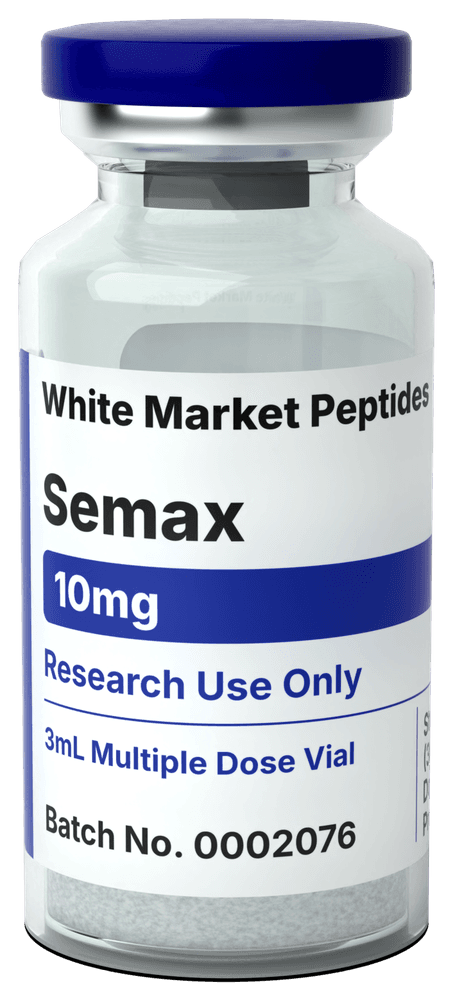
Semax is a synthetic ACTH(4-7)-PGP heptapeptide studied for BDNF induction, monoamine modulation, and neuroprotection. It holds a Russian pharmaceutical registration for ischemic stroke and optic nerve disease — the only regulatory approval in any jurisdiction for a research peptide in this class. This article covers mechanism, handling, comparisons with Selank and other nootropic compounds, and FAQs.
The Short Answer
Semax is a seven-amino-acid ACTH analog (MEHFPGP) that induces BDNF expression, inhibits enkephalin-degrading enzymes, and modulates striatal monoamines, with preclinical and limited Russian clinical evidence for cognitive and neuroprotective effects. Binding studies show specific basal forebrain binding at KD ~2.4 nM with downstream TrkB/MAPK activation. The PGP C-terminal tail degrades to an independently active metabolite that amplifies neurotrophic gene expression after proteolytic cleavage. (PubMed)
Naming note: Semax is also referenced as ACTH(4-7)-PGP and (Pro⁸,Gly⁹,Pro¹⁰)ACTH-(4-10) in the structural chemistry literature. CAS 80714-61-0. Do not use CAS 4037-01-8, which is native ACTH(4-10), a different peptide.
| Property | Details |
|---|---|
| Aliases / Synonyms | ACTH(4-7)-PGP; (Pro⁸,Gly⁹,Pro¹⁰)ACTH-(4-10); PubChem CID 9811102 |
| Family / Pathway | ACTH analog; BDNF/TrkB signaling; neurotrophic gene cascade; monoamine modulation |
| Sequence (AA) | Met–Glu–His–Phe–Pro–Gly–Pro (MEHFPGP) |
| Molecular Weight (Da) | ~813.93 g/mol |
| CAS | 80714-61-0 |
| Molecular Formula | C₃₇H₅₁N₉O₁₀S |
| Typical Diluent(s) | Bacteriostatic water (0.9% benzyl alcohol) or 0.9% saline |
| Example Concentration (educational) | 10 mg vial + 3.0 mL diluent → 3.33 mg/mL (3,333 mcg/mL). 0.09 mL = 300 mcg. |
| Storage | Lyophilized at −20 °C; reconstituted at 2–8 °C; minimize freeze-thaw; use within 30 days |
Key Concepts
What is Semax biologically?
Semax is built on ACTH residues 4-7 (Met-Glu-His-Phe), with native ACTH residues 8-10 (Arg-Trp-Gly) replaced by a synthetic Pro-Gly-Pro tail. Native ACTH(4-10) degrades in plasma within minutes; the PGP substitution substantially extends metabolic stability. The PGP tail is not inert: Dmitrieva et al. (2010) showed it degrades to the tripeptide Pro-Gly-Pro, which independently activates neurotrophic gene expression in cortical tissue. The overall biological profile of Semax reflects contributions from both the intact heptapeptide and this metabolite. (PubMed)
BDNF/TrkB binding and signaling
Dolotov et al. (2006) showed Semax binds basal forebrain membranes with high affinity (KD ~2.4 nM) and induces BDNF mRNA and protein expression, with downstream TrkB and MAPK/PI3K activation. This binding is specific and reversible but does not match the profile of classical melanocortin receptors (MC1R-MC5R). The molecular identity of the Semax binding site has not been characterized. BDNF induction is the primary proposed mechanism for Semax's nootropic effects. (PubMed)
Neurotrophic gene cascade
After intranasal Semax delivery in rats, Dmitrieva et al. (2010) and Shadrina et al. (2010) mapped upregulation of BDNF, TrkC, TrkA, NGF, and NT-3 in cortical and hippocampal tissue. Shadrina showed peak BDNF and NGF protein increases at 30–60 minutes post-administration with BDNF elevated for up to 24 hours. Both the intact Semax molecule and its PGP metabolite contributed to these effects, making the total neurotrophin signal a composite of both. (PubMed) (PubMed)
Enkephalinase inhibition
Kost et al. (2001) compared enkephalinase inhibition across several peptides. Semax IC₅₀ ~10 µM, somewhat more potent than Selank (~20 µM) in the same assay. This activity prolongs the availability of endogenous enkephalins subject to the same enzymatic degradation. The PGP metabolite retains some inhibitory activity. This mechanism is shared with Selank, with Semax showing the stronger signal. (PubMed)
Monoaminergic profile
Eremin et al. (2005) showed Semax increased serotonin turnover and potentiated amphetamine-induced dopamine release in rat striatum — presynaptic modulation, not direct receptor agonism. The dopaminergic component is notably stronger in Semax than in Selank (which is predominantly serotonergic). This complementary profile is the proposed basis for combined research, though no published co-administration study has tested it. (PubMed)
Mechanism of Action
Semax induces BDNF and a broad neurotrophic gene cascade through a high-affinity basal forebrain binding site independent of classical melanocortin receptors. Dolotov et al. (2006) established the binding (KD ~2.4 nM), BDNF induction, and TrkB/MAPK activation in basal forebrain tissue. (PubMed)
The non-melanocortin binding. Although Semax derives from ACTH and shares structural features with melanocortin-active fragments, its pharmacological profile in basal forebrain does not match MC1R-MC5R signaling. The binding site is real and measurable but unidentified at the molecular level. Semax is not simply an MC-receptor agonist with BDNF as a secondary effect.
Composite signal from metabolites. Because PGP is itself neurotrophically active (Dmitrieva et al. 2010), any study measuring Semax effects captures a composite of the intact peptide and its degradation product. Researchers should account for this in dose-response interpretations, since the PGP contribution is not dose-proportional once Semax is fully cleaved. (PubMed)
Information-gain insight: Think of Semax as a two-stage signal: the intact heptapeptide drives acute BDNF induction via the uncharacterized high-affinity site, then proteolysis releases PGP, which extends the neurotrophin cascade through its own mechanism. Two agents from one molecule. (PubMed)
Evidence by System
Neuroprotection and Ischemia
Key finding: Russian pharmaceutical registration for ischemic stroke rests on controlled clinical trials from Russian groups, including Romanova et al. (2006), which reported neurological score improvements in patients receiving intranasal Semax within 24 hours of stroke onset relative to standard care. Sample sizes were small within the Russian regulatory framework. No Western replication has been published. (PubMed)
Mechanistic support: Sudarkina et al. (2021) used proteomics in a rat cortical ischemia model and found Semax normalized pCREB, pJNK, MMP-9, and c-Fos in the peri-infarct zone — markers of ischemic signaling cascades. The proteomics data provide mechanistic grounding for the clinical signal but remain preclinical. (PMC)
Cognitive and Nootropic Effects
Key finding: BDNF induction (Dolotov 2006) and the neurotrophin cascade (Dmitrieva 2010, Shadrina 2010) underpin preclinical cognitive interest. Monoamine modulation (Eremin 2005) provides a second proposed mechanism. Human data are limited to the Russian clinical literature; no Western RCTs exist. (PubMed)
Why it matters for outcomes: BDNF/TrkB drives synaptic plasticity and long-term potentiation; sustained BDNF elevations for up to 24 hours after a single intranasal dose (Shadrina 2010) map onto learning and memory consolidation windows. This is the mechanistic link researchers track when using Semax as a BDNF-modulating tool. (PubMed)
Optic Nerve Disease
Key finding: Kurysheva et al. (2001) described Semax in optic nerve disease in a Russian clinical context. The same Russian pharmaceutical registration covers this indication. Evidence is from the Russian regulatory literature. (PubMed)
Delivery and Handling Considerations
Intranasal — primary research route. Most published efficacy studies use intranasal delivery. The large olfactory surface area and proximity to CNS parenchyma make IN delivery a rational choice for short-half-life peptides targeting brain tissue.
Subcutaneous. SC injection is used in research protocols requiring bioavailability control. The PGP metabolite is still produced after SC administration as serum exopeptidases cleave the C-terminal tail.
General lab handling (educational, not medical): Reconstitute with bacteriostatic water or sterile saline. Direct the diluent down the vial wall; swirl gently to dissolve. Store reconstituted solution at 2–8 °C; avoid freeze-thaw cycles; use within 30 days.
How to Use
Educational only — no medical advice. The steps below outline laboratory-style handling common in peptide research.
1) Set your target concentration
A standard working solution: 10 mg vial + 3.0 mL BAC water → 3.33 mg/mL (3,333 mcg/mL). On a U-100 insulin syringe: 1 unit = 0.01 mL ≈ 33 mcg. At a 300 mcg starting dose, draw 9 units (0.09 mL); at an 800 mcg peak dose, draw 24 units (0.24 mL).
2) Reconstitute with sterile technique
Clean the vial stopper with an alcohol swab; direct the diluent along the inner vial wall; swirl gently to dissolve. Solution should be clear and colorless. (PubMed)
3) Select route (research contexts)
- Intranasal (IN): primary route in most published mechanistic and clinical studies. Hippocampal BDNF induction documented after IN dosing. (PubMed)
- Subcutaneous (SC): used where bioavailability control is needed.
4) Educational dosing ranges (by literature context)
Preclinical literature does not establish human doses. Russian clinical protocols use hundreds of mcg per day intranasally. Researchers working SC typically use a once-daily titration in the hundreds-of-mcg range — for example, the Semax 10 mg Vial Dosage Protocol steps from 300 mcg once daily up to 800 mcg once daily over 8 weeks. Adjust by tissue target, readout, and tolerability.
5) Track outcomes
In cognitive or neuroprotection research, standardized measures (BDNF ELISA, neurological scoring, cognition battery) allow systematic tracking across time points consistent with the 30–60 minute peak and 24-hour BDNF window reported by Shadrina et al. (PubMed)
6) Store to maintain integrity
Keep lyophilized material at −20 °C, protected from moisture. Keep reconstituted solution at 2–8 °C; do not freeze; minimize freeze-thaw cycles; discard if cloudy or discolored.
Comparison / Alternatives
Semax vs. Selank vs. racetams: The core distinction within the Semax/Selank pair is that Semax drives BDNF induction and dopaminergic modulation while Selank drives anxiolysis and GABAergic gene modulation. Both share the PGP tail, both inhibit enkephalinases, and both were developed at the Institute of Molecular Genetics in Moscow. No published co-administration study exists.
| Dimension | Semax | Selank | Racetams (e.g., piracetam) |
|---|---|---|---|
| What it is | ACTH(4-7)-PGP heptapeptide (MEHFPGP). (PubMed) | Tuftsin-analog heptapeptide (TKPRPGP). | Small-molecule cyclic GABA derivatives. |
| Primary signal | BDNF induction, TrkB/MAPK; dopaminergic potentiation. (PubMed) | GABAergic gene modulation; serotonergic; enkephalinase inhibition. | AMPA receptor modulation; ACh turnover increase; mechanism debated. |
| Dominant monoamine | Dopaminergic + serotonergic (Eremin 2005). (PubMed) | Predominantly serotonergic. | Cholinergic primarily. |
| Primary outcome | Neuroprotection; cognitive support; BDNF-centric. | Anxiolysis without sedation; calm focus. | Cognitive enhancement; memory consolidation. |
| Regulatory status | Approved Rx in Russia (ischemic stroke, optic nerve disease). (PubMed) | Approved in Russia/Ukraine for GAD/neurasthenia. | OTC in most jurisdictions (Rx in some EU countries). |
| Evidence maturity | Russian clinical (stroke/optic); preclinical BDNF data; no Western RCTs. | Russian clinical (GAD); preclinical anxiolytic data; no Western RCTs. | Decades of study; mixed RCT results; limited effect sizes. |
| Notable extra | PGP metabolite independently activates neurotrophin genes. (PubMed) | Antiviral/immune signals in models; cytokine gene normalization. | Some evidence for acetylcholine precursor synergy. |
Bottom line for "best" choice: When BDNF-centric neuroprotection and dopaminergic cognition are the research endpoint, Semax is the targeted tool. When anxiety reduction with preserved focus is the goal, Selank fits better. For broad memory-consolidation work with a longer evidence base, racetams remain a reasonable benchmark.
Quick Reference
Copy-ready Researcher Checklist (Semax)
- Define the endpoint: neuroprotection (ischemia model), cognitive enhancement, or BDNF signaling study.
- Confirm identity and purity: Semax CAS 80714-61-0 (not CAS 4037-01-8, which is native ACTH(4-10)).
- Select route: Intranasal for CNS proximity and published precedent; SC for bioavailability control.
- Anchor concentration: 10 mg vial + 3.0 mL BAC water → 3.33 mg/mL; 0.09 mL = 300 mcg (1 unit ≈ 33 mcg).
- Track BDNF: hippocampal/cortical BDNF ELISA or qPCR as primary mechanistic readout. (PubMed)
- Account for the PGP metabolite: include parallel PGP arms when mechanistic attribution matters. (PubMed)
- Include melanocortin controls: MC receptor antagonists clarify pathway specificity.
- Store properly: lyophilized at −20 °C; reconstituted at 2–8 °C; use within 30 days.
- Report route and timing: BDNF kinetics differ by route; 30–60 min peak matters for sampling windows. (PubMed)
FAQ
What is Semax?
Semax is a synthetic ACTH(4-7)-PGP heptapeptide (MEHFPGP, CAS 80714-61-0) studied for BDNF induction, cognitive support, and neuroprotection. Key mechanisms include high-affinity basal forebrain binding with TrkB activation, enkephalinase inhibition, striatal monoamine modulation, and a neurotrophic gene cascade (BDNF, NGF, TrkC, TrkA, NT-3). (PubMed)
How does Semax work?
Semax binds specific basal forebrain sites (KD ~2.4 nM) and induces BDNF with downstream TrkB/MAPK signaling, independent of classical melanocortin receptors. The PGP C-terminal tail degrades to an independently active metabolite that amplifies neurotrophic gene expression. Enkephalinase inhibition extends endogenous neuropeptide availability. Monoamine modulation (dopamine, serotonin) contributes a separate signal. (PubMed)
Is Semax approved anywhere?
Semax is registered as a pharmaceutical in Russia for ischemic stroke and optic nerve disease, based on controlled clinical trials from Russian groups. No Western regulatory approval exists; no Western RCTs have been published. Outside Russia, it is a research compound. (PubMed)
How does Semax's monoamine profile differ from Selank?
Semax shows a stronger dopaminergic signal; Selank is predominantly serotonergic. Eremin et al. (2005) reported striatal serotonin turnover increases and potentiated amphetamine-induced dopamine release for Semax. This complementary profile is the basis for theoretical interest in combined research, though no published co-administration study exists. (PubMed)
How does Semax compare to Selank?
Both are synthetic heptapeptides with a PGP tail from the same Russian institute; both inhibit enkephalinases. The difference is in primary endpoint: Semax for BDNF/cognition/neuroprotection, Selank for anxiolysis without sedation. For a full comparison, see What Is Selank?.
Where can researchers source Semax and find dosing math?
Researchers can purchase Semax (10 mg) from White Market Peptides as research-grade lyophilized powder with COA. For step-by-step reconstitution and dosing math, see the Semax 10 mg Vial Dosage Protocol. (Educational; not medical advice.)
Next Steps
For step-by-step reconstitution math and dosing tables, see the Semax 10 mg Vial Dosage Protocol.
When you're ready to source research-grade material, you can purchase Semax (10 mg) from White Market Peptides. (For research use only; not for human consumption.)
For the companion anxiolytic peptide with GABAergic and immune-modulating signals, see What Is Selank?.
Key takeaway: Semax is a two-stage neurotrophic signal — the intact heptapeptide induces BDNF via a novel high-affinity site, and its PGP metabolite extends the neurotrophin cascade independently — making it a precise tool for BDNF-centric cognition and neuroprotection research. (PubMed)
Related on pep-dose
Sources
- Dolotov OV et al. — Semax, an analogue of ACTH(4-10) with cognitive effects, regulates BDNF and trkB expression in the rat hippocampus — J Neurochem (2006) — PMID 16996037
- Kost NV et al. — Semax and Selank inhibit the enkephalin-degrading enzymes from human serum — Biomed Khim (2001) — PMID 11443939
- Eremin KO et al. — Semax, an ACTH4-10 analogue with nootropic properties, activates dopaminergic and serotoninergic brain systems in rodents — Neurochem Res (2005) — PMID 16362768
- Dmitrieva VG et al. — Semax and Pro-Gly-Pro activate the transcription of neurotrophins and their receptor genes after focal brain ischemia in rats — Cell Mol Neurobiol (2010) — PMID 19633950
- Shadrina MI et al. — Neurotrophin-encoding genes as targets for Semax — Mol Biol (2010) — PMID 19662538
- Sudarkina OY et al. — Brain proteome changes associated with the neuroprotective effect of Semax in a rat model of focal ischemia — Molecules (2021) — PMC8226508
- Romanova GA et al. — Effects on learning and memory after photothrombosis of the prefrontal cortex in rats — Bull Exp Biol Med (2006) — PMID 17603664
- Kurysheva NI et al. — Treatment of optic nerve diseases — Vestn Oftalmol (2001) — PMID 11569188