Single-peptide protocol
Semax (10 mg)
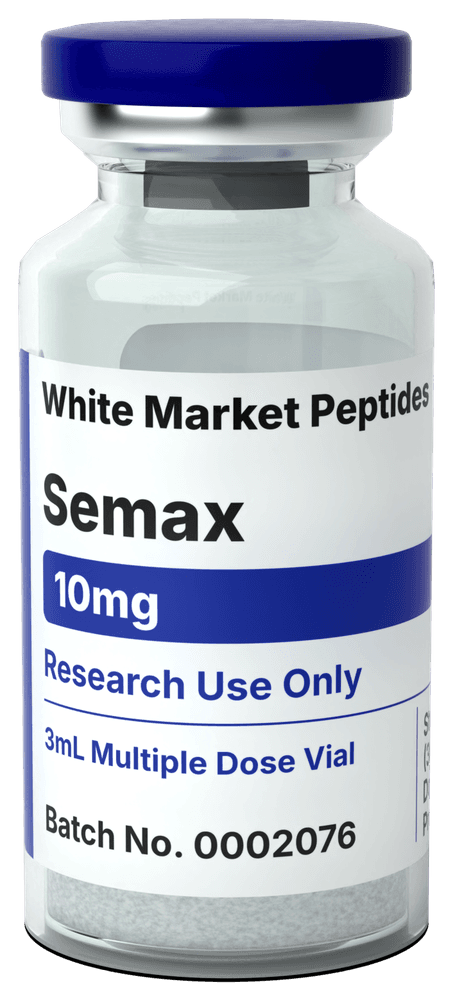
Semax 10 mg vial dosage protocol. Reconstitute with 3.0 mL BAC water for 3.33 mg/mL. Titrate 300→800 mcg/day SC over 8 weeks.
- Peptide
- semax
- Vial
- 10 mg
- Water
- 3 mL
- Concentration
- 3.33 mg/mL
Sponsored
At a Glance
Semax (MEHFPGP) is a synthetic ACTH(4-7)-PGP heptapeptide studied for BDNF induction, neuroprotection, and cognitive effects. The PGP C-terminal tail degrades to an independently active metabolite that extends the neurotrophic signal after proteolysis.[1]
- Reconstitute: Add 3.0 mL bacteriostatic water → 3.33 mg/mL (3,333 mcg/mL) concentration.
- Starting dose: 300 mcg once daily (9 units / 0.09 mL) subcutaneous for the first two weeks.
- Easy measuring: At 3.33 mg/mL on a U-100 syringe, 1 unit = 0.01 mL ≈ 33 mcg.
- Doses per vial: varies with the escalating dose — about 33 doses at 300 mcg, down to ~12 doses at 800 mcg; use within 30 days of reconstitution.
- Storage: Lyophilised: freeze at −20 °C; reconstituted: refrigerate at 2–8 °C; use within 30 days.
Overview
- Goal: Induce BDNF expression and activate TrkB/MAPK cascades; modulate striatal monoamines; inhibit enkephalin-degrading enzymes; support neuroprotective signaling.[1]
- Schedule: Once-daily subcutaneous injection; intranasal administration is the primary route in most published efficacy studies.[1]
- Dose range: 300 mcg (initiation) → 800 mcg (peak), titrated over 8 weeks.
- Reconstitution: 3.0 mL BAC water per 10 mg vial → 3.33 mg/mL.
- Storage: Lyophilised at −20 °C; reconstituted at 2–8 °C; use within 30 days.
What You'll Need
Plan based on an 8-week course titrated from 300 mcg to 800 mcg once daily (cumulative ≈ 30,800 mcg / 30.8 mg).
- Semax Vials (10 mg each): 30.8 mg cumulative → 4 vials (with buffer).
- Insulin Syringes (U-100, 1 mL): 1 per injection → 56 syringes for the 8-week course.
- Bacteriostatic Water (10 mL bottles): 3.0 mL per vial × 4 vials = 12 mL → 2 × 10 mL bottles.
- Alcohol Swabs: 2 per injection → 112 swabs for the course.
How to Reconstitute
- Allow frozen lyophilised vial to reach room temperature (10–15 minutes).
- Draw 3.0 mL bacteriostatic water with a sterile syringe.
- Inject slowly down the inner vial wall; do not inject directly onto the powder cake.
- Gently swirl or roll until fully dissolved — do not shake. Solution should be clear and colourless.
- Label with reconstitution date; refrigerate at 2–8 °C. Use within 30 days.
Dosing Schedule
| Week(s) | Dose | Units (U-100) | Volume |
|---|---|---|---|
| Weeks 1–2 | 300 mcg | 9 units | 0.09 mL |
| Weeks 3–4 | 500 mcg | 15 units | 0.15 mL |
| Weeks 5–6 | 600 mcg | 18 units | 0.18 mL |
| Weeks 7–8 | 800 mcg | 24 units | 0.24 mL |
Frequency: Inject once daily subcutaneously. Start at 300 mcg for the first two weeks to establish tolerability, then step up every two weeks to a peak of 800 mcg. At 3.33 mg/mL, a 10 mg vial (3.0 mL total) holds 10,000 mcg, so doses-per-vial fall as the dose climbs — roughly 33 doses at 300 mcg down to ~12 doses at 800 mcg. Doses are calculated at ≈33 mcg per unit for convenient measurement on a standard U-100 insulin syringe.[1]
Protocol Details
- Weeks 1–2: 300 mcg (9 units / 0.09 mL) once daily — initiation and tolerability.
- Weeks 3–4: 500 mcg (15 units / 0.15 mL) once daily.
- Weeks 5–6: 600 mcg (18 units / 0.18 mL) once daily.
- Weeks 7–8: 800 mcg (24 units / 0.24 mL) once daily — peak.[1]
- Cycling (optional): May extend to 12–16 weeks using an on/off cycle (e.g., 6 weeks on, 2 weeks off); most human data cover 4–8 weeks of continuous use, so longer protocols should incorporate rest periods.
- Injection site: Abdomen, thigh, or upper arm. Rotate sites between injections.
Storage
- Lyophilised: Store at −20 °C (−4 °F) or below; protect from moisture and light.
- Reconstituted: Refrigerate at 2–8 °C. Do not freeze. Use within 30 days.
- Appearance: Clear and colourless. Discard if cloudy, coloured, or particulate.
How Semax Works
Semax is a synthetic heptapeptide (Met-Glu-His-Phe-Pro-Gly-Pro, MEHFPGP) built on ACTH residues 4-7 with a synthetic Pro-Gly-Pro C-terminal extension that replaces native ACTH residues 8-10. The PGP tail substantially extends metabolic stability and is itself biologically active: it degrades to the tripeptide Pro-Gly-Pro, which independently activates neurotrophic gene expression in cortical tissue.[1] Dolotov et al. (2006) showed Semax binds basal forebrain membranes with KD ~2.4 nM and induces BDNF mRNA and protein, activating TrkB and downstream MAPK/PI3K cascades — through a binding site distinct from classical melanocortin receptors (MC1R-MC5R), which remain an uncharacterized target.[1] Semax also inhibits enkephalin-degrading enzymes (IC₅₀ ~10 µM) and modulates striatal monoamines (serotonin turnover, dopamine potentiation).[2] For the full mechanism, evidence base, and safety profile, see What Is Semax?.
Good to Know
- Semax CAS: 80714-61-0; Molecular Weight: ~813.93 g/mol; Formula: C₃₇H₅₁N₉O₁₀S. Do not use CAS 4037-01-8, which is native ACTH(4-10), a different peptide.
- Most published efficacy studies use intranasal delivery. SC is used for research protocols requiring bioavailability control; the PGP metabolite is still produced after SC administration.[1]
- Russian pharmaceutical registration covers ischemic stroke and optic nerve disease. Human data originate entirely from Russian clinical literature; no Western RCTs have been published.
- The PGP degradation product independently activates neurotrophic genes, so total effect reflects both the intact Semax molecule and its metabolite.[1]
- Semax inhibits enkephalinases at IC₅₀ ~10 µM, somewhat more potent than Selank (~20 µM) in the same assay.[2]
- Semax shows a stronger dopaminergic signal than Selank, which is predominantly serotonergic — the basis for theoretical complementarity in combined research protocols. No published co-administration study exists.
- Mild injection site reactions are the predominant reported side effect.
- For mechanism and clinical evidence detail, see What Is Semax?.
Tips for Best Results
- Collect baseline cognitive or neurological measures before the first dose; BDNF peak (30–60 minutes post-dose) and 24-hour sustained elevation are the relevant pharmacokinetic windows for sampling.
- Time injections consistently; day-to-day variability in dosing window complicates tracking across the titration phase.
- Store reconstituted vials promptly and adhere to the 30-day use window.
- If tracking neuroprotection endpoints in an animal model, align tissue collection times to the BDNF and NGF peak windows mapped by Shadrina et al. (2010): ~30–60 min for peak, up to 24 h for BDNF.
- Include both Semax-treated and PGP-treated arms in mechanistic studies to separate metabolite contributions from intact-peptide effects.
Injection Tips
- Clean the vial stopper and injection site with separate alcohol swabs; allow both to air-dry fully before proceeding.
- Using a 29–31 gauge insulin syringe (5/16″ to 1/2″ needle), draw the calculated dose precisely.
- Pinch a fold of skin and insert the needle at 45° into subcutaneous fat (90° is acceptable with a short needle into a well-pinched fold).
- Inject slowly over 2–3 seconds; do not aspirate. Withdraw the needle, apply gentle pressure, and do not rub the site.
- Rotate injection sites (abdomen, thighs, upper arms) and dispose of each syringe in a sharps container immediately after use.[4]
Related on pep-dose
Sources
- Dolotov OV et al. — Semax, an analogue of ACTH(4-10) with cognitive effects, regulates BDNF and trkB expression in the rat hippocampus — J Neurochem (2006) — PMID 16996037
- Kost NV et al. — Semax and Selank inhibit the enkephalin-degrading enzymes from human serum — Biomed Khim (2001) — PMID 11443939
- Bachem Peptide Technical Guide
- CDC — General Best Practice Guidelines for Immunization