Growth Hormone & Anti-Aging
What Is NAD+?
Sponsored
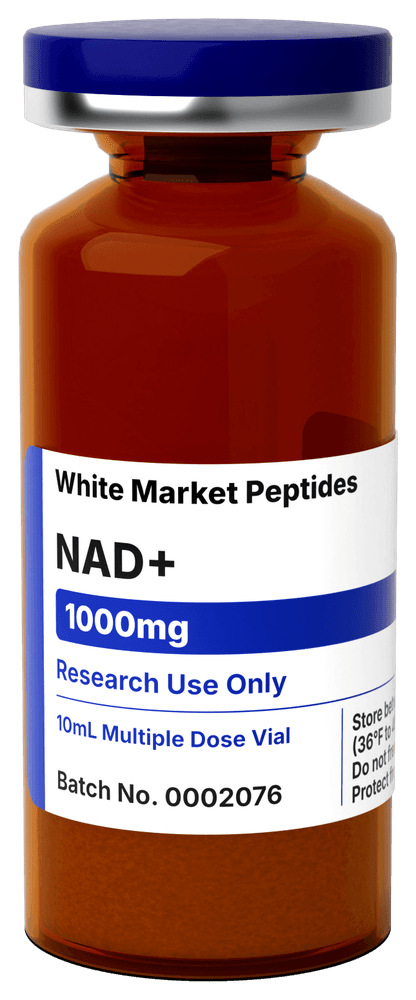
NAD+ (Nicotinamide Adenine Dinucleotide) is a coenzyme present in every living cell that serves two distinct roles: a redox carrier shuttling electrons through glycolysis and the citric acid cycle to drive ATP synthesis, and a consumed substrate for sirtuins and PARPs — enzymes governing DNA repair, gene expression, and metabolic adaptation. Intracellular NAD+ concentrations decline by approximately 50% between early adulthood and midlife across liver, muscle, and brain tissue, a decline mechanistically linked to age-related functional loss.[3][4] Injectable NAD+ (intravenous or subcutaneous) bypasses the poor oral bioavailability of the molecule itself to achieve rapid systemic repletion.
Note on nomenclature: NAD+ is the oxidized form. NADH is the reduced form. Precursors such as NMN (nicotinamide mononucleotide) and NR (nicotinamide riboside) raise the intracellular NAD+ pool by different biosynthetic routes. The WMP product is NAD+ itself — not a precursor.
The Short Answer
NAD+ is a central metabolic coenzyme that declines with age; restoring it activates sirtuins (SIRT1–7) and PARPs that drive DNA repair, mitochondrial biogenesis, and metabolic homeostasis. Animal studies consistently show NAD+ repletion extends lifespan and healthspan.[1] The first large randomized human trial of an NAD+ precursor (NMN, Science 2021) reported improved skeletal muscle insulin signaling in prediabetic women.[2] Human evidence for injectable NAD+ specifically remains limited to pilot and observational reports; no placebo-controlled RCT has been published.
Key Concepts
Molecular function — two separate roles:
NAD+ acts as a redox carrier that accepts electrons from NADH-generating reactions (glycolysis, β-oxidation, the TCA cycle) and transfers them to Complex I of the mitochondrial electron transport chain, driving ATP synthesis. This cycling does not consume NAD+ — NADH is re-oxidized back to NAD+.
NAD+ is consumed (not cycled) by three enzyme classes:[1]
- Sirtuins (SIRT1–7): NAD+-dependent deacylases. SIRT1 deacetylates PGC-1α to drive mitochondrial biogenesis; SIRT3 activates antioxidant enzymes in mitochondria. Both require NAD+ as a co-substrate and are silenced when NAD+ falls.
- PARPs (poly(ADP-ribose) polymerases): Consume large quantities of NAD+ during DNA strand-break repair. Accumulated DNA damage in aging chronically activates PARPs, accelerating NAD+ depletion.
- CD38/CD157: Ectoenzymes that hydrolyze NAD+; their expression increases with age and inflammatory signaling ("inflammaging"), further depleting the available pool.
Age-related decline:
NAD+ drops ~50% in rodent liver, kidney, and brain between young and aged animals, with oxidative stress markers rising inversely.[3] Human blood NAD+ follows a similar downward trajectory.[4] The combined drain of PARP activation and rising CD38 outpaces the salvage pathway's replenishment capacity.
Why injectable over oral?
Oral NAD+ is substantially degraded by gut-wall enzymes and has low systemic bioavailability. Oral precursors (NMN, NR) are better absorbed and converted intracellularly. Injectable NAD+ bypasses gut metabolism entirely, producing rapid blood-level elevation. This makes it useful when speed of repletion is the research objective, or when gut function is compromised.
Human Evidence
| Study | Design | Key Finding |
|---|---|---|
| Rajman et al. (2018)[1] | Review of in vivo NAD+ evidence | NAD+ repletion via precursors extends lifespan and healthspan in multiple animal species; mechanistic framework well established via SIRT1, SIRT3, and PARP biology |
| Yoshino et al. (2021)[2] | RCT, 25 postmenopausal prediabetic women, NMN 250 mg/day × 10 weeks | NMN elevated skeletal muscle NAD+ metabolome and improved insulin signaling pathways; primary endpoint (insulin-stimulated glucose disposal) did not reach significance |
| Braidy et al. (2011)[3] | Animal (Wistar rats, age cohorts) | NAD+ declines ~50% from young to old across liver, kidney, brain; inversely correlated with oxidative stress markers and SIRT1 activity |
| Verdin (2015)[4] | Review | Synthesizes NAD+ roles in aging, neurodegeneration, and metabolic disease; positions NAD+ repletion as a candidate therapeutic strategy |
No placebo-controlled RCT of injectable NAD+ has been published. Observational reports describe IV NAD+ infusion in substance withdrawal and neurodegenerative contexts; these lack the design to establish efficacy.
Dosage Reference
Educational reference only. Injectable NAD+ dosing is not established by clinical trials. The following reflects common research approaches extrapolated from preclinical data and observational practice.
NAD+ is sold in more than one vial size. The dose is the same regardless; only the concentration — and therefore the syringe volume — changes with how much compound is in the vial and how much water you add.
500 mg vial — add 3.0 mL bacteriostatic water → 166.7 mg/mL. On a U-100 insulin syringe, 1 unit = 0.01 mL ≈ 1.67 mg.
| Dose | Volume (166.7 mg/mL) | U-100 Units |
|---|---|---|
| 50 mg | 0.30 mL | 30 units |
| 75 mg | 0.45 mL | 45 units |
| 100 mg | 0.60 mL | 60 units |
1000 mg vial — add 3.0 mL bacteriostatic water → 333.3 mg/mL. On a U-100 insulin syringe, 1 unit = 0.01 mL ≈ 3.33 mg.
| Dose | Volume (333.3 mg/mL) | U-100 Units |
|---|---|---|
| 50 mg | 0.15 mL | 15 units |
| 75 mg | 0.225 mL | 22.5 units |
| 100 mg | 0.30 mL | 30 units |
Subcutaneous: 50–100 mg once daily, started low and titrated up (Week 1 = 50 mg, Week 2 = 75 mg, Week 3+ = 100 mg) to limit the insomnia, anxiety, and fatigue that can follow starting too high. Rotate sites. At 333.3 mg/mL every daily volume is at or under 0.30 mL; at 166.7 mg/mL the 100 mg maintenance dose is 0.60 mL, which can be split across two sites if a single injection feels too large.
Intravenous: 500–1000 mg diluted in 250–500 mL normal saline; infuse over 1–4 hours under clinical supervision. Slowing the drip rate resolves the flush/nausea/chest-tightness that are rate-dependent infusion reactions.
For full reconstitution tables, supply planning, and syringe math, see the NAD+ 500 mg and NAD+ 1000 mg dosage protocols.
Safety Profile
IV infusion reactions (rate-dependent): Flushing, chest tightness, nausea, and palpitations — common but transient; managed by slowing the infusion rate. No serious adverse events attributable to NAD+ are described in the available literature at research doses.
Subcutaneous: Site burning and local irritation are frequently reported; NAD+ solution is acidic (pH ~3–4), which contributes to injection-site discomfort.
Contraindications and cautions:
- No formal human pharmacokinetic or toxicology studies for injectable NAD+
- Sirtuin activation and PARP modulation have potential relevance in oncology contexts — discuss with an oncologist before use if cancer history exists
- Pregnancy and lactation: no data; avoid
- Regulatory status: not FDA-approved as a drug in injectable form; classified as a research compound in the United States
Comparison: Injectable NAD+ vs. Oral Precursors
| NAD+ (injectable) | NMN (oral) | NR (oral) | |
|---|---|---|---|
| Route to cell | Direct plasma delivery | Enzymatic conversion: NMN → NAD+ | NR → NMN → NAD+ |
| Speed of repletion | Rapid (minutes–hours) | Hours–days | Hours–days |
| Human RCT data | None for injectable form | Yes (Yoshino 2021) | Yes (multiple small trials) |
| Oral bioavailability | Poor; hence injectable | Moderate | Good |
| Injection required | Yes | No | No |
| WMP product | NAD+ 1000 mg | — | — |
FAQ
What does NAD+ do in the cell?
NAD+ has two distinct functions. As a redox carrier it accepts electrons during glycolysis and the TCA cycle (becoming NADH), then donates them to Complex I of the mitochondrial electron transport chain to generate ATP. As a consumed substrate, it is cleaved by sirtuins and PARPs during DNA repair and gene regulation — processes that require adequate NAD+ to remain active. The interplay between these two functions determines how much NAD+ is available for each pathway.
Why does NAD+ decline with age?
Two converging factors accelerate consumption beyond what the salvage pathway replenishes: (1) accumulated DNA damage chronically activates PARP enzymes, which are high-throughput NAD+ consumers; (2) the ectoenzyme CD38, upregulated by the chronic low-grade inflammation of aging, hydrolyzes NAD+ in the extracellular space. The result is a net depletion that impairs sirtuin function and mitochondrial quality control.
Is injectable NAD+ better than taking NMN or NR?
For speed of plasma elevation, injectable NAD+ has a practical advantage. For human clinical evidence, oral NMN and NR are better studied (published RCTs exist). The choice depends on the research question: oral precursors are adequate for studying metabolic outcomes over weeks; injectable NAD+ is used when rapid repletion is the objective or when gut absorption cannot be assumed.
What side effects should researchers anticipate?
IV infusion: rate-dependent flushing, chest tightness, nausea, and palpitations — manageable by slowing the drip. Subcutaneous: burning and local irritation at injection sites due to the acidic pH of the solution. No formal safety trials exist for injectable NAD+.
Is NAD+ the same as a peptide?
No. NAD+ is a dinucleotide coenzyme (adenosine + nicotinamide connected by a phosphate bridge), not a peptide. It is included in the WMP catalog as a research compound alongside peptides because of its research and clinical overlap with the longevity and metabolic health space.
Related on pep-dose
- Protocol
NAD+ (500 mg)
NAD+ 500 mg vial dosage protocol. Reconstitution with bacteriostatic water to 166.7 mg/mL, low-dose subcutaneous titration, syringe units, supply planning, and storage.
- Protocol
NAD+ (1000 mg)
NAD+ 1000 mg vial dosage protocol. Reconstitution with bacteriostatic water, low-dose subcutaneous titration, IV infusion reference, syringe units, and storage.
Sources
- Rajman L, Chwalek K, Sinclair DA — Cell Metabolism (2018) — Therapeutic Potential of NAD-Boosting Molecules: The In Vivo Evidence
- Yoshino M et al. — Science (2021) — Nicotinamide mononucleotide increases muscle insulin sensitivity in prediabetic women
- Braidy N et al. — PLoS One (2011) — Age related changes in NAD+ metabolism, oxidative stress and Sirt1 activity in Wistar rats
- Verdin E — Science (2015) — NAD+ in aging, metabolism, and neurodegeneration