Single-peptide protocol
NAD+ (500 mg)
NAD+ 500 mg vial dosage protocol. Reconstitution with bacteriostatic water to 166.7 mg/mL, low-dose subcutaneous titration, syringe units, supply planning, and storage.
- Peptide
- nad-plus
- Vial
- 500 mg
- Water
- 3 mL
- Concentration
- 166.67 mg/mL
Sponsored
At a Glance
NAD+ (Nicotinamide Adenine Dinucleotide) is a cellular coenzyme required for ATP production, DNA repair via PARP enzymes, and sirtuin-mediated metabolic regulation. Intracellular NAD+ declines with age, and injectable NAD+ is used in research settings to achieve rapid systemic repletion that bypasses the limited oral bioavailability of the molecule itself.[1]
- Reconstitute: Add 3.0 mL bacteriostatic water → 166.7 mg/mL concentration.
- Subcutaneous dose range: 50–100 mg once daily, titrated up over the first weeks.
- Easy measuring: At 166.7 mg/mL on a U-100 syringe, 1 unit = 0.01 mL ≈ 1.67 mg. A 50 mg dose = 30 units / 0.30 mL.
- Storage: Lyophilised: freeze at −20 °C; reconstituted: refrigerate at 2–8 °C; use within 4 weeks.
Overview
- Goal: Restore intracellular NAD+ pool to support sirtuin and PARP activity, mitochondrial biogenesis, and oxidative metabolism.[1][2]
- Schedule: Once-daily subcutaneous injection, started low and titrated up.
- Dose range: 50–100 mg SC once daily (titrated, max 100 mg).
- Reconstitution: 3.0 mL BAC water per 500 mg vial → 166.7 mg/mL.
- Injection site (SC): Abdomen, thigh, or upper arm; rotate sites daily.
- Cycle: 8–16 weeks total; titration occupies the first 2 weeks, then 100 mg maintenance from Week 3 onward.
What You'll Need
Plan based on an 8-week titrated cycle (Week 1 = 50 mg, Week 2 = 75 mg, Weeks 3–8 = 100 mg once daily; 56 injections, ~5,075 mg total).
- NAD+ Vials (500 mg each): ~5,075 mg needed ÷ 500 mg per vial → 11 vials.
- Insulin Syringes (U-100, 1 mL / 100-unit): 56 injections → 56 syringes.
- Bacteriostatic Water (10 mL bottles): 3.0 mL per vial → 4 × 10 mL bottles (covers all 11 vials with margin).
- Alcohol Swabs: 2 per injection → 112 swabs per 8-week cycle.
Extending maintenance toward the full 16-week arc scales these up proportionally (a 16-week course runs ~112 injections and ~22 vials).
How to Reconstitute
- Allow frozen lyophilised vial to reach room temperature (10–15 minutes).
- Draw 3.0 mL bacteriostatic water with a sterile syringe.
- Inject slowly down the inner vial wall to avoid foaming.
- Gently swirl until fully dissolved — do not shake. Solution should be clear and colourless.
- Label with reconstitution date; refrigerate at 2–8 °C, protected from light. Use within 4 weeks.
Dosing Schedule
| Week | Dose | U-100 Units | Volume (166.7 mg/mL) | Frequency |
|---|---|---|---|---|
| Week 1 | 50 mg | 30 units | 0.30 mL | Once daily |
| Week 2 | 75 mg | 45 units | 0.45 mL | Once daily |
| Weeks 3+ (maintenance) | 100 mg | 60 units | 0.60 mL | Once daily |
Start at 50 mg once daily in Week 1, increase to 75 mg in Week 2, then hold at the 100 mg maintenance dose from Week 3 onward. This gradual titration avoids the insomnia, anxiety, and fatigue that can follow starting too high. At 166.7 mg/mL the maintenance dose is 0.60 mL, which is toward the upper end for a single subcutaneous site; split it across two sites if needed, or reconstitute with 1.5 mL instead (→ 333.3 mg/mL) to halve every volume.
Protocol Details
- Starting dose: 50 mg (30 units / 0.30 mL) once daily SC for Week 1.[1]
- Week 2: 75 mg (45 units / 0.45 mL) once daily SC.
- Maintenance dose: 100 mg (60 units / 0.60 mL) once daily SC from Week 3 onward — this is the daily ceiling for the SC protocol.
- Cycle: 8–16 weeks total; titration occupies only the first 2 weeks, then 100 mg maintenance. The evidence base does not define a single optimal cycle length.
Storage
- Lyophilised: Store at −20 °C (−4 °F); protect from moisture and light.
- Reconstituted: Refrigerate at 2–8 °C. Do not freeze. Use within 4 weeks.
- Appearance: Clear, colourless solution. Discard if cloudy, discoloured, or particulate.
How NAD+ Works
NAD+ is a dinucleotide coenzyme (adenosine + nicotinamide) that participates in cellular metabolism in two distinct capacities. As a redox carrier, it accepts electrons during glycolysis and the tricarboxylic acid cycle (becoming NADH), then donates them to Complex I of the mitochondrial electron transport chain to drive ATP synthesis — the fundamental mechanism of aerobic energy production.
As a consumed substrate, NAD+ is cleaved by sirtuins (SIRT1–7) and poly(ADP-ribose) polymerases (PARPs) during DNA repair and gene expression control. SIRT1 deacetylates PGC-1α to drive mitochondrial biogenesis; SIRT3 activates antioxidant enzymes within mitochondria. Both require adequate NAD+ as a co-substrate. PARPs consume NAD+ at high rates during DNA strand-break repair; chronically activated PARPs under accumulated genotoxic stress accelerate depletion.[1]
Intracellular NAD+ declines approximately 50% between young adulthood and middle age across multiple tissues, driven by increased PARP activity and rising expression of CD38 (an NAD+-hydrolyzing ectoenzyme upregulated by age-related inflammatory signaling).[2] Injectable NAD+ bypasses gut-wall degradation that limits oral bioavailability, achieving rapid blood-level elevation.
For mechanism and evidence detail, see What Is NAD+?
Good to Know
- The 500 mg vial reconstituted with 3.0 mL gives 166.7 mg/mL — half the concentration of the 1000 mg vial at the same water volume, so unit counts and volumes are double those of the NAD+ 1000 mg protocol for the same dose.
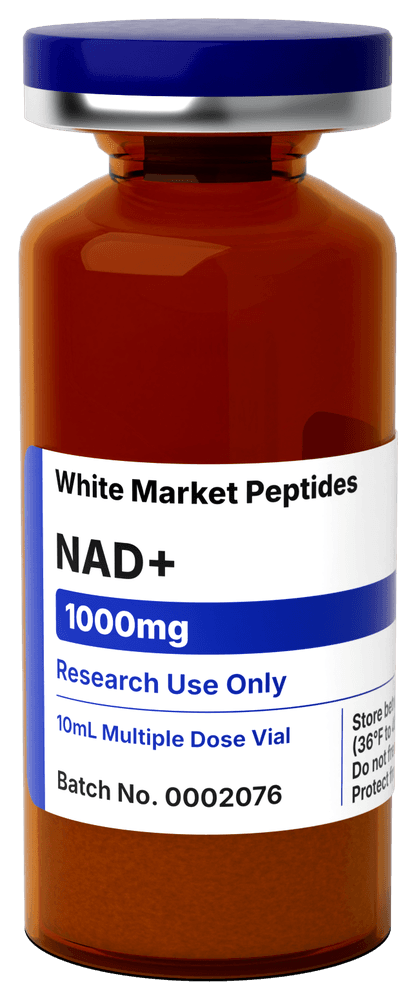
- White Market Peptides stocks NAD+ as a 1000 mg vial. A single 1000 mg vial equals two 500 mg protocols' worth of compound; reconstitute it with 6.0 mL to land on the same 166.7 mg/mL used here, or with 3.0 mL for 333.3 mg/mL (half the volumes).
- NAD+ solution is acidic (pH ~3–4) and commonly causes a burning sensation on SC injection; injecting slowly and starting at the low 50 mg dose reduces local discomfort while you assess tolerance.
- Titrating gradually (50 → 75 → 100 mg over the first weeks) limits the insomnia, anxiety, and fatigue that can occur when starting too high.
- NAD+ is not FDA-approved as a drug in injectable form; it is a research compound.
- Oral precursors (NMN, NR) have published human RCT data that injectable NAD+ lacks; they are alternatives for research contexts where injection is not required.
- Sirtuins activated by NAD+ include SIRT1 (nuclear, regulates PGC-1α and FOXO) and SIRT3 (mitochondrial, activates SOD2 and IDH2); both are silenced when NAD+ is depleted.[1]
Tips for Best Results
- Administer in the morning; NAD+ drives mitochondrial biogenesis via SIRT1/PGC-1α activation, which may synergise with morning exercise.
- Allow reconstituted vial to reach room temperature before drawing; cold solution increases injection discomfort.
- Rotate injection sites daily and document site, dose, and time to track local reactions.
- Adequate dietary protein and B-vitamins (particularly niacin/B3) support the salvage pathway that recycles NAD+ intracellularly.
Injection Tips
- Clean the vial stopper and injection site with separate alcohol swabs; allow both to air-dry fully before proceeding.[4]
- Use a 29–31 gauge insulin syringe (5/16″ to 1/2″ needle); draw the calculated dose precisely.
- Pinch a fold of skin and insert the needle at 45° into subcutaneous fat; 90° is acceptable with a short needle into a well-pinched fold.
- Inject slowly over 3–5 seconds (the acidic solution benefits from a slower injection pace). Do not aspirate. Withdraw the needle, apply gentle pressure.
- Rotate injection sites (abdomen, thighs, upper arms) and dispose of each syringe in a sharps container immediately after use.
Related on pep-dose
- Article
What Is NAD+?
What is NAD+? The cellular coenzyme behind energy production, DNA repair, and sirtuin activation. Age-related decline, IV/SC administration, and research evidence.
- Protocol
NAD+ (1000 mg)
NAD+ 1000 mg vial dosage protocol. Reconstitution with bacteriostatic water, low-dose subcutaneous titration, IV infusion reference, syringe units, and storage.
Sources
- Rajman L, Chwalek K, Sinclair DA — Cell Metabolism (2018) — Therapeutic Potential of NAD-Boosting Molecules: The In Vivo Evidence
- Verdin E — Science (2015) — NAD+ in aging, metabolism, and neurodegeneration
- Bachem Peptide Technical Guide — Handling and Storage Guidelines for Peptides
- CDC — General Best Practice Guidelines for Immunization — Vaccine Administration