Weight Loss & Metabolic
What is 5-Amino-1MQ?
Sponsored
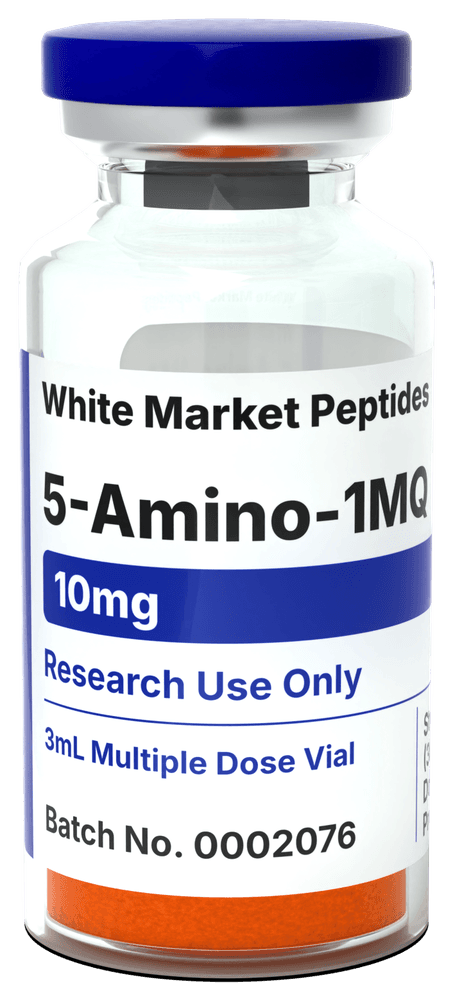
5-Amino-1MQ is a small-molecule enzyme inhibitor that raises cellular metabolism and may promote fat loss. It blocks NNMT, the fat-regulating enzyme, which pushes up NAD⁺ levels and energy use inside cells[1]. Early mouse studies show it can cut body fat without suppressing appetite[2]. It's still an experimental research compound, though, with no human trials yet[3].
| Aliases/Synonyms | Family/Pathway | Sequence (AA) | Molecular Weight (Da) | CAS Number | Typical Diluent(s) | Example Concentration | Storage (lyophilized / reconstituted) |
|---|---|---|---|---|---|---|---|
| 5-Amino-1-methylquinolinium (5-Amino-1MQ) iodide[4] | Small-molecule NNMT inhibitor (NAD⁺ metabolism modulator) | N/A (not a peptide; quinolinium analog) | 286.11 (iodide salt)[4] | 42464-96-0[5] | Bacteriostatic water or sterile saline (powder is moderately water-soluble) | e.g. 10 mg reconstituted in 2 mL yields 5 mg/mL solution | Dry: refrigerate or room temp; Reconstituted: refrigerate (~2–8 °C), use within ~30 days |
Key Concepts
5-Amino-1MQ selectively inhibits the enzyme nicotinamide N-methyltransferase (NNMT). NNMT is a cytosolic enzyme that consumes nicotinamide (vitamin B₃) to make 1-methylnicotinamide (MNA), using SAM (S-adenosylmethionine) as a methyl donor[6][7]. That reaction matters to the NAD⁺ salvage pathway, since nicotinamide is a key precursor to NAD⁺ (nicotinamide adenine dinucleotide), the coenzyme cells run their energy metabolism on[8].
Think of NNMT as a metabolic brake. By methylating and burning through nicotinamide, it leaves fewer building blocks to recycle NAD⁺. So high NNMT activity drags NAD⁺ levels down and slows cellular energy production[9]. NNMT is elevated in obesity, and that may feed fat storage and a sluggish metabolism[10][11]. Mice engineered to lack or suppress NNMT carry much less fat and run higher metabolic rates than normal mice[12][13]. That's why NNMT looks like a good target for obesity and metabolic disease[14].
5-Amino-1MQ (5-amino-1-methylquinolinium) is a small cationic molecule, not a peptide, despite being sold in peptide research circles. It's built to shut NNMT off. The compound binds NNMT's active site and stops it from methylating nicotinamide[15]. Now nicotinamide doesn't get wasted as MNA; it can be recycled back into NAD⁺, which restores cellular NAD⁺ levels[16]. With more NAD⁺ on hand, cells (fat cells and liver cells especially) speed up their metabolism: more fuel oxidation, more fat burned, less energy parked in adipose tissue[16][11]. In fat cells studied in vitro, the compound raised NAD⁺ and suppressed lipogenesis (fat creation) inside the cells[17]. The shift tells the body to burn fuel instead of storing it.
The compound is also highly selective. It does not meaningfully inhibit other related methyltransferase enzymes or knock out the rest of the NAD⁺ salvage machinery[17]. That selectivity matters, because it means the compound hits NNMT without dragging in off-target effects on other enzymes that handle methylation or NAD⁺ metabolism. Acting just on NNMT, 5-Amino-1MQ tunes a metabolic pathway tied to obesity, type 2 diabetes, and cellular aging[18][19].
So the core mechanism is metabolic. The compound inhibits an enzyme (NNMT) that otherwise caps how much energy a cell can produce. Block it, and more NAD⁺ is freed for cellular reactions, which can raise energy expenditure and curb fat buildup. It works inside cells to change how fuel gets used, not on the brain to dull hunger.
Research-Backed Benefits and Effects of 5-Amino-1MQ
Animal studies point to real fat loss and metabolic gains from 5-Amino-1MQ. In diet-induced obese mice, the compound dropped body weight and white fat mass and shrank fat cell size[20]. The mice did this without eating less[2]. They kept eating normally and still lost weight, which says the compound raised their energy burn instead of starving them through appetite suppression. Block NNMT and the body burns more calories at rest. Most weight-loss drugs don't work that way.
The metabolic markers improved too. Treated mice got leaner and showed better insulin sensitivity and normalized blood sugar, walking back the diabetes features that diet had induced[18]. One study found an NNMT inhibitor improved glucose tolerance and cut insulin resistance in obese mice[19]. Plasma cholesterol came down in the treated mice as well[21]. So you get less fat, steadier blood sugar, and a better lipid profile, roughly what you'd want from a weight-loss and metabolic drug combined.
NNMT inhibition also burns energy through thermogenesis. Raising NAD⁺ and reworking fat cell metabolism pushed up oxygen consumption in white adipose tissue, so more calories went out as heat[13]. It didn't lean on the usual brown fat or UCP1 route, so it may be a fresh way to make white fat cells burn[13]. The compound can flip fat tissue from a storage depot into something that burns calories.
The effects reach other tissues in research settings. In aged mice, an NNMT inhibitor woke up senescent muscle stem cells and improved the regenerative capacity of aged skeletal muscle[22]. Restoring NAD⁺ in those stem cells helped old muscle heal and grow more like young muscle. That hints 5-Amino-1MQ (or similar NNMT blockers) might have rejuvenation effects on muscle, maybe aiding recovery or pushing back on age-related muscle loss. Early cancer work shows inhibiting NNMT can shift the tumor environment too, for instance cutting ovarian cancer metastasis in mice when added to other treatment[23]. Many cancers hijack metabolism and over-express NNMT in tumors[24], so blocking it might slow certain cancer cells or the cells that support them[15]. Muscle aging and cancer sit outside the weight-loss focus, but they show the compound is being chased down several therapeutic angles.
What the compound has shown so far:
- Fat loss and body composition: Big drops in fat mass and body weight in obese mice[20], and without cutting appetite, which points to actual metabolic fat-burning.
- Better metabolic health: Improved insulin sensitivity, normalized blood glucose, and lower cholesterol in animal models[18][21]. If that holds in people, it could help with type 2 diabetes or metabolic syndrome.
- More energy and calorie burn: Raising NAD⁺ pushes up cellular energy use. Mice on the compound burn more calories (higher oxygen consumption) and may run more thermogenesis in fat tissue[13], which could mean a higher basal metabolic rate.
- Muscle and tissue health (research stage): Dormant muscle stem cells switched back on in aged mice[22], which suggests better muscle repair. Niche, but it's caught the eye of longevity researchers.
- No major side effects in animal studies: Mice tolerated the compound well, with no observable adverse effects even at high doses[2]. Doses up to 60 mg/kg per day, several times the effective dose, showed no signs of toxicity in preclinical testing[23]. That's a wide safety margin in animals, but human safety is untested.
Every one of these benefits comes from preclinical work, mostly in mice. The results look good, but human outcomes might differ, and it'll take real clinical trials to prove the compound is safe and effective in people. 5-Amino-1MQ is not an approved treatment today; it lives in lab and experimental use only[3].
Dosage and Administration
In research settings, 5-Amino-1MQ is given by subcutaneous injection. It ships as a lyophilized (freeze-dried) powder, usually in small vials (5 mg, 10 mg, or 50 mg). Before use, you reconstitute the powder with a sterile diluent, normally bacteriostatic water (0.9% benzyl alcohol) or sterile saline, which keeps the solution sterile across several days of use. Mix a 10 mg vial with 1–2 mL of bacteriostatic water and you get 5–10 mg per mL, which you draw into insulin syringes for precise sub-Q dosing. (Use proper aseptic technique when reconstituting and handling to keep it sterile.)
Preclinical dosing was usually weight-based. Mice saw effects around 20 mg per kg of body weight per day by injection[23]. Mice run a much faster metabolism than we do, so you can't scale that straight across. No official human dose guidelines exist, since the compound isn't approved for human use. Some researchers and trial proposals have extrapolated ranges anyway, mostly in the tens of milligrams per day. A few wellness clinics working off-label suggest trial doses around 50–100 mg per day by subcutaneous injection, split into one or two shots. Those bigger absolute doses (50+ mg) track the much larger body mass of a human versus a mouse, plus the fact that oral absorption is probably poor, so injection is the route.
Unofficial cycle lengths run about 4 to 12 weeks of daily use, then a break. A common one is an 8-week cycle of daily injections followed by a few weeks off to reassess. Experimental users start low and titrate up: begin near the low end (~50 mg daily) for a week or two to check tolerance, then move to ~75 mg if needed. That's all anecdotal, but it tracks how you'd sensibly approach any new compound.
None of these dosing practices are backed by clinical trial data. They come from interpolating animal data and from the bodybuilding and peptide community. If the compound ever reaches formal human trials, the effective dose could land somewhere else. Until then any dose is a guess. The reconstitution math and example schedules below are for research and lab reference only.
Administration: Once reconstituted, the compound goes in subcutaneously (into the fat layer under the skin) with a fine insulin needle. Common sites are the abdomen, thigh, or shoulder, anywhere with some subcutaneous fat. Animal studies used both intraperitoneal (into the abdominal cavity) and subcutaneous routes[23]. Sub-Q is the one used in practice, for ease and steady absorption. There's no known oral form for humans; the compound is a charged quinolinium salt, so swallowing it would probably mean poor absorption. Injection is the reliable way to get it into circulation.
Storage matters after reconstitution. Keep the solution refrigerated, usually 2–8 °C. People use bacteriostatic water so it stays usable for 2–4 weeks in the fridge; the benzyl alcohol in "bac water" holds back bacterial growth. Still, use it within a month and keep things clean. For longer storage, unopened lyophilized vials hold at freezer temperatures (–20 °C) or at least refrigerated, and the dry powder stays stable for months if kept cold and dry[25]. Let refrigerated vials warm to room temperature before opening so moisture doesn't condense inside.
Any human use of 5-Amino-1MQ is experimental. Don't self-experiment without medical supervision. If you do, go slow and talk to a knowledgeable medical professional first. Accurate scales, sterile technique, and a clear read on the legal status (research use only) all matter.
5-Amino-1MQ vs Other Weight Management Compounds
How does 5-Amino-1MQ compare to other weight-loss or metabolic therapies? Its mechanism is its own, so the comparisons come with caveats. Here it sits next to two well-known agents: GLP-1 receptor agonists (e.g. Semaglutide) and AOD-9604 (an experimental "fat-burning" peptide fragment). The three get to weight loss by different routes: metabolic activation, appetite suppression, and hormone mimicry.
| Compound | Mechanism of Action | Effect on Appetite | Status/Usage |
|---|---|---|---|
| 5-Amino-1MQ | NNMT inhibitor; raises NAD⁺ and cellular energy expenditure in fat cells[21][20]. Increases fat oxidation and thermogenesis (a metabolic accelerator). | No appetite suppression. Weight loss happens without eating less[2]. Mice ate normally and still lost fat by burning more calories. | Research-phase only. Not approved for humans; used in lab studies for obesity/diabetes. Early results show fat loss and improved metabolism in animals[18]. |
| GLP-1 Analog (Semaglutide, e.g. Wegovy) | GLP-1 receptor agonist; mimics an incretin hormone. Increases insulin, slows gastric emptying, greatly reduces hunger by acting on brain satiety centers. | Strong appetite suppression. Patients feel full sooner and eat much less, so calorie intake drops and weight comes off. | FDA-approved medication for obesity and diabetes. Proven ~10–15% body weight reduction in 6–12 months on average. Taken as weekly injections; known side effects include nausea due to the appetite mechanism. |
| AOD-9604 (HGH fragment 176–191) | Fragment of human Growth Hormone designed to stimulate lipolysis (fat breakdown) without affecting blood sugar. Activates β3-adrenergic receptors in fat cells to increase fat burning[26][27]. | No direct appetite effect. It works peripherally on fat metabolism, and food intake stayed unchanged in trials. | Experimental peptide (not FDA-approved). Showed modest weight loss in trials: e.g. ~2.8 kg lost in 12 weeks at optimal dose vs ~0.8 kg on placebo[28]. Safe and well-tolerated, but efficacy was mild, so development was halted. Now used in some wellness clinics as an off-label peptide for fat loss. |
5-Amino-1MQ takes a metabolic route: make the body burn more energy. GLP-1 drugs come at weight loss from the other side, by getting people (or animals) to eat less. So 5-Amino-1MQ didn't cause nausea or appetite loss in animal studies, while GLP-1 agonists often bring gastrointestinal side effects along with their appetite suppression. The two could in theory complement each other: one drug to eat less (GLP-1), another to burn more (5-A1MQ), hitting obesity from two sides.
Against AOD-9604, the other "fat-burning" agent, 5-Amino-1MQ looks stronger. Mice saw fat mass swing back toward normal[29], while AOD-9604's human results were modest. AOD-9604 tried to trigger fat release through one hormone pathway (a growth hormone fragment) and never worked well in people. 5-Amino-1MQ stops fat storage at the enzyme level and revs up internal energy use. That's a fresh angle, and it may be why the preclinical data look so good. But AOD-9604 at least went through clinical trials; 5-Amino-1MQ hasn't been tested in humans at all, so hold the excitement until it clears that bar.
You can also line 5-Amino-1MQ up against NAD⁺-boosting supplements like NR or NMN, since they all aim to raise NAD⁺. 5-Amino-1MQ stops the loss of NAD⁺ by inhibiting its consumption through NNMT; NR and NMN supply more building blocks to make NAD⁺. Both push NAD⁺ up, which can help metabolic health. NR and NMN sell as anti-aging and energy supplements, but their weight-loss effect is weak; they're more general health. The compound's targeted enzyme inhibition may hit fat metabolism harder, based on the animal data. You could imagine combining the two (stop NAD⁺ loss plus add NAD⁺ supply), but that's speculation for now.
5-Amino-1MQ Research & Usage Checklist
If you're handling 5-Amino-1MQ for research, run through this:
- Verify legality and purity: Buy from a reputable research-chemical source. Confirm high purity (≥98%) and remember it's not FDA-approved for human use. Only proceed where possessing it for research is legal.
- Use sterile technique: When reconstituting, wear gloves and wipe the vial top with alcohol. Dilute with bacteriostatic water or the recommended solvent under sterile conditions. This keeps it from getting contaminated, which matters if you store and use it over several days.
- Calculate doses carefully: Double-check your math. Mix 10 mg in 2 mL and that's 5 mg per mL (0.05 mg per 0.01 mL tick on an insulin syringe). A bad calculation can put a self-experiment way off the mark.
- Start low and monitor: In any experiment (animal model or self-trial), start at a conservative dose and watch for reactions. Mice showed no adverse effects, but individuals respond differently. Step the dose up only if it's well-tolerated.
- Track changes: Log appetite, energy, body weight, and other markers. The compound isn't supposed to touch appetite, so note any subtle shift. With lab animals, record food intake and weight on a schedule. The data tells you about effect and safety.
- Pair with a healthy lifestyle: The compound isn't a shortcut. Keep up a proper diet and exercise where it applies. Mice paired with a healthy diet lost even more fat[29]. Real-world results will lean on the lifestyle around it.
- Watch for side effects: Stay alert for anything unusual (in lab animals or yourself). None showed up in mouse studies[2], but no human data means surprises are possible. If something worrying shows up (injection-site inflammation, dizziness), stop and assess.
- Consult a professional: If you're new to this, talk to a medical professional or experienced researcher before and during use. Given how experimental the compound is, that guidance helps with dosing and reading the effects. Medical oversight is important if you have any health conditions.
Follow these and you'll keep things safer and get cleaner results. Err toward caution; the compound shows promise, but it's still early-stage science.
FAQ
What is 5-Amino-1MQ used for?
Researchers mostly study it as a fat-loss and metabolic agent. It's a small molecule that inhibits NNMT, an enzyme tied to obesity, which is meant to raise energy expenditure and cut fat storage. In animals it produced clear weight loss, better insulin sensitivity, and lower cholesterol[20][21]. It's not an approved drug. Use stays in labs and experimental wellness settings, where it's being looked at for obesity, diabetes, and maybe anti-aging.
How does 5-Amino-1MQ work for weight loss?
It speeds up metabolism at the cellular level. It blocks NNMT, the enzyme that slows metabolism by consuming NAD⁺. With NNMT off, cells hold more NAD⁺ and run their metabolism harder[16]. Fat cells then burn more energy and make less fat. That's how obese mice got leaner without eating less. The compound burns extra calories and fat by working inside cells, not by killing appetite or blocking absorption.
Is 5-Amino-1MQ a peptide or a drug?
It's not a peptide, even though peptide sites sell it. Chemically it's a small organic molecule, a modified quinoline compound. Peptides are short proteins built from amino acids; 5-Amino-1MQ has a different structure (C₁₀H₁₁N₂⁺ iodide salt)[30]. It's not a recognized pharmaceutical drug either; it's a research chemical, developed in the lab for its metabolic effects. Call it an experimental drug candidate, not a licensed medication.
Has 5-Amino-1MQ been tested in humans?
No. There are no published human clinical trials of 5-Amino-1MQ as of 2025[3]. The evidence comes from cell studies and animal models, mostly mice. The results look good (weight loss, metabolic benefits), but nobody knows how much carries over to people. A compound can behave differently in humans, and safety here is unproven. Any human use right now is experimental; some longevity or fitness people self-experiment, but that's not formal study. It'll take controlled clinical trials to pin down doses, safety, and real efficacy in humans.
What are the side effects of 5-Amino-1MQ?
In animal studies, basically none. Mice dosed for weeks showed no adverse effects on behavior or organ health, even at higher doses[2]. It didn't cause the appetite loss or nausea that many weight-loss drugs do. But it's never been tested in humans, so the human side-effect profile is unknown. Plausible ones include injection-site reactions or metabolic effects from bad dosing. Anyone using it is basically a test subject, so caution matters. For now the side effects in humans are largely unknown: animal data says well-tolerated, human reactions are uncharted.
How do you take 5-Amino-1MQ (dosage & administration)?
In research settings, by subcutaneous injection. You mix the dry powder with sterile bacteriostatic water first. A common prep dissolves 10 mg in 1–2 mL of water, then you use an insulin syringe to inject part of it under the skin, often around the belly. Experimental doses vary: some protocols run around 50–75 mg once daily, others up to 100 mg split into two shots, all unofficial. There's no agreed "right" human dose. Swallowing it doesn't work (the compound gets destroyed or barely absorbed), so injection is the route that gets it into the blood. Only do this under professional guidance, since no approved dosing standard exists.
Where can I buy 5-Amino-1MQ?
From specialized research-chemical suppliers. Pharmacies don't carry it, since it's not a medicine. Reputable peptide and research-compound sites sell it for "laboratory use," listing high-purity powder in a range of vial sizes[15]. White Market Peptides lists 5-Amino-1MQ (10 mg) for research use. Buy from a vendor that provides third-party testing or a certificate of analysis. Check your local laws too; some regions limit these compounds to licensed researchers. Counterfeit and low-purity product is out there, and using it can be dangerous, so quality and legality come first.
Is 5-Amino-1MQ legal and FDA approved?
5-Amino-1MQ is not FDA approved and isn't regulated as a drug or supplement. It sits in a gray area: legally sold for "research purposes" but not for human consumption. In the U.S. you can buy and possess it as a chemical reagent, but it can't be marketed as a supplement or medication. Other countries take similar lines, with details that vary. Since it's unapproved, no agency vouches for its safety or efficacy, so anyone using it on themselves does so at their own risk. Athletes should check WADA or other doping lists; NNMT inhibitors aren't mainstream enough to be listed yet, but that can change. Bottom line: legally it's lab research only, and human use is off-label and experimental.
The Bottom Line
5-Amino-1MQ goes after obesity and metabolic disease through the body's own energy balance. It works at the enzyme level to make the body burn more fat, a different route from the appetite drugs and hormone mimics. If human trials track the animal data, it could earn a spot in weight management alongside diet and exercise.
Keep expectations low for now. It's an experimental compound with unknown effects in humans. Long-term safety, the right dose, and the full set of effects are all still open. The mechanism is novel on paper, but without human data it's a research experiment, not a proven therapy. If you're considering self-experimentation, talk to a healthcare professional and go slow, or wait for more data.
We'll update these guides at pep-dose.com as new research lands.
This article is from pep-dose.com for educational purposes. It is not medical advice. Always consult a qualified professional before considering any research compound.
Related on pep-dose
Sources
- Roles of Nicotinamide N-Methyltransferase in Obesity and Type 2 Diabetes — PMC
- Selective and membrane-permeable small molecule inhibitors of nicotinamide N-methyltransferase reverse high fat diet-induced obesity in mice. — Sigma-Aldrich
- Roles of Nicotinamide N-Methyltransferase in Obesity and Type 2 Diabetes — PMC
- 5-Amino-1-methylquinolinium iodide ≥98% (HPLC) — Sigma-Aldrich
- 5-Amino-1-methylquinolinium iodide ≥98% (HPLC) — Sigma-Aldrich
- Roles of Nicotinamide N-Methyltransferase in Obesity and Type 2 Diabetes — PMC
- Nicotinamide N-Methyltransferase in Cardiovascular Diseases: Metabolic Regulator and Emerging Therapeutic Target — MDPI
- Nicotinamide N-Methyltransferase in Cardiovascular Diseases: Metabolic Regulator and Emerging Therapeutic Target — MDPI
- Nicotinamide N-Methyltransferase in Cardiovascular Diseases: Metabolic Regulator and Emerging Therapeutic Target — MDPI
- Roles of Nicotinamide N-Methyltransferase in Obesity and Type 2 Diabetes — PMC
- Nicotinamide N-Methyltransferase in Cardiovascular Diseases: Metabolic Regulator and Emerging Therapeutic Target — MDPI
- Roles of Nicotinamide N-Methyltransferase in Obesity and Type 2 Diabetes — PMC
- Nicotinamide N-Methyltransferase in Cardiovascular Diseases: Metabolic Regulator and Emerging Therapeutic Target — MDPI
- Reduced calorie diet combined with NNMT inhibition establishes a distinct microbiome in DIO mice — Nature
- 5-Amino-1-methylquinolinium iodide ≥98% (HPLC) — Sigma-Aldrich
- Roles of Nicotinamide N-Methyltransferase in Obesity and Type 2 Diabetes — PMC
- Roles of Nicotinamide N-Methyltransferase in Obesity and Type 2 Diabetes — PMC
- Roles of Nicotinamide N-Methyltransferase in Obesity and Type 2 Diabetes — PMC
- Nicotinamide N-Methyltransferase in Cardiovascular Diseases: Metabolic Regulator and Emerging Therapeutic Target — MDPI
- Roles of Nicotinamide N-Methyltransferase in Obesity and Type 2 Diabetes — PMC
- Selective and membrane-permeable small molecule inhibitors of nicotinamide N-methyltransferase reverse high fat diet-induced obesity in mice. — Sigma-Aldrich
- 5-Amino-1MQ — Creative Enzymes
- 5-Amino-1-methylquinolinium iodide ≥98% (HPLC) — Sigma-Aldrich
- 5-Amino-1-methylquinolinium iodide ≥98% (HPLC) — Sigma-Aldrich
- 5-Amino-1-methylquinolinium iodide ≥98% (HPLC) — Sigma-Aldrich
- AOD9604 — Wikipedia
- Obesity drug codenamed AOD9604 highly successful in trials — News-Medical
- Reduced calorie diet combined with NNMT inhibition establishes a distinct microbiome in DIO mice — Nature
- 5-Amino-1-methylquinolinium iodide ≥98% (HPLC) — Sigma-Aldrich