Single-peptide protocol
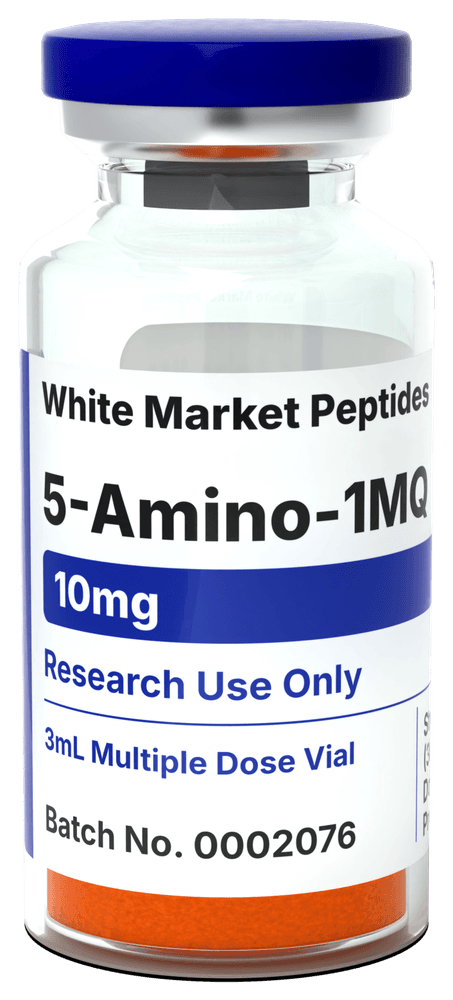
5-Amino-1MQ (10 mg)
5-Amino-1MQ 10mg vial dosage protocol. Subcutaneous reconstitution, dosing, and syringe units for this NNMT inhibitor. Research use only.
- Peptide
- 5-amino-1mq
- Vial
- 10 mg
- Water
- 2 mL
- Concentration
- 5.00 mg/mL
Sponsored
At a Glance
5-Amino-1MQ is a small-molecule NNMT inhibitor (not a peptide), supplied as a lyophilised iodide salt. Blocking nicotinamide N-methyltransferase spares nicotinamide for NAD⁺ synthesis, which raises cellular NAD⁺ and energy expenditure. CAS 42464-96-0. C₁₀H₁₁IN₂. MW 286.11.[1] Research use only. No human trials exist.[2]
- Reconstitute: Add 2.0 mL bacteriostatic water → 5 mg/mL concentration.
- Standard dose: 5 mg (100 units / 1.00 mL) subcutaneous once daily, after a 2-day titration at 2.5 mg.
- Easy measuring: At 5 mg/mL on a U-100 syringe, 1 unit = 0.01 mL = 50 mcg. A 2.5 mg dose = 50 units / 0.50 mL; 5 mg = 100 units / 1.00 mL.
- Storage: Lyophilised: freeze at −20 °C (stable up to ~24 months); reconstituted: refrigerate at 2–8 °C, use within 2–4 weeks, do not refreeze.
Overview
- Goal: Inhibit NNMT to raise NAD⁺ and shift fat cells toward burning fuel rather than storing it.[2]
- Schedule: Once-daily subcutaneous injection (some protocols split into twice daily) on a 4–12 week cycle.
- Dose range: 2.5–5 mg per day (titrate up from 2.5 mg).
- Reconstitution: 2.0 mL BAC water per 10 mg vial → 5 mg/mL.
- Injection site: Abdomen, thigh, or upper arm; rotate daily.
What You'll Need
Plan based on a 4-week cycle at 5 mg once daily (28 injections, 140 mg total).
- 5-Amino-1MQ Vials (10 mg each): 140 mg needed ÷ 10 mg per vial → 14 vials.
- Insulin Syringes (U-100, 1 mL): 28 injections → 28 syringes.
- Bacteriostatic Water (10 mL bottles): 2.0 mL per vial → 3 × 10 mL bottles.
- Alcohol Swabs: 2 per injection → 56 swabs per 4-week cycle.
How to Reconstitute
- Allow the frozen lyophilised vial to reach room temperature (10–15 minutes) to avoid condensation.
- Draw 2.0 mL bacteriostatic water with a sterile syringe.
- Inject slowly down the inner vial wall; do not spray directly onto the powder.
- Gently swirl or roll until dissolved. Do not shake. The iodide salt is orange, so the solution may look pale yellow to orange; that is expected. It should be clear, not cloudy.
- Label with reconstitution date; refrigerate at 2–8 °C. Do not refreeze. Use within 2–4 weeks.
Dosing Schedule
| Phase | Dose | Units (U-100) | Volume | Frequency |
|---|---|---|---|---|
| Days 1–2 (titration) | 2.5 mg | 50 units | 0.50 mL | Once daily (SC) |
| Day 3+ (standard) | 5 mg | 100 units | 1.00 mL | Once daily (SC) |
| Twice-daily option | 2.5 mg | 50 units | 0.50 mL | Twice daily (SC) |
Begin at 2.5 mg once daily for the first two days to gauge tolerance, then move to 5 mg once daily. The 5 mg dose fills a full 1 mL U-100 syringe (100 units). At 5 mg/day, one 10 mg vial lasts 2 days; the elimination half-life is roughly 3.8–6.9 hours, so split twice-daily dosing keeps levels steadier across the day.
Protocol Details
- Days 1–2 (titration): 2.5 mg (50 units / 0.50 mL) once daily.
- Day 3+ (standard): 5 mg (100 units / 1.00 mL) once daily.[2]
- Twice-daily option: 2.5 mg (50 units / 0.50 mL) morning and evening, keeping blood levels steadier given the 3.8–6.9 h half-life.
- Cycle length: 4–12 weeks daily, then a break. An 8-week cycle followed by 2–4 weeks off is common in research protocols.
- Injection site: Abdomen, thigh, or upper arm; rotate daily.
Storage
- Lyophilised: Store at −20 °C (−4 °F); the dry powder is stable for up to ~24 months. Protect from moisture and light.
- Reconstituted: Refrigerate at 2–8 °C. Do not refreeze. Use within 2–4 weeks.
- Appearance: Pale yellow to orange solution (the iodide salt is orange). Discard if cloudy or particulate.
How 5-Amino-1MQ Works
5-Amino-1MQ (5-amino-1-methylquinolinium) is a small cationic molecule that inhibits nicotinamide N-methyltransferase (NNMT). It is not a peptide, despite being sold alongside research peptides. CAS 42464-96-0. C₁₀H₁₁IN₂ (iodide salt). MW 286.11.[1]
NNMT normally consumes nicotinamide (vitamin B₃) to make 1-methylnicotinamide, using SAM as the methyl donor. That drains a precursor the cell would otherwise recycle into NAD⁺. By binding NNMT's active site, 5-Amino-1MQ spares nicotinamide, raises intracellular NAD⁺, and pushes fat and liver cells toward higher fuel oxidation and lower fat storage.[2] The inhibition is selective for NNMT, so it leaves the related methyltransferases and the broader NAD⁺ salvage pathway alone.[1]
In diet-induced obese mice, NNMT inhibition reduced body weight and white fat mass without cutting food intake, and combining it with a reduced-calorie diet deepened the effect.[3] All of this is preclinical. There are no human trials.[2]
Good to Know
- Research use only. 5-Amino-1MQ is not FDA-approved and has no published human clinical data. Any human use is experimental.[2]
- It is a small molecule, not a peptide: a quinolinium iodide salt, not a chain of amino acids.[1]
- The 5 mg dose fills a full 1 mL U-100 syringe (100 units). Double-check the volume before injecting.
- Mechanism is metabolic, not appetite-based: in animals it raised energy expenditure rather than suppressing hunger.[3]
- Use accurate measuring and clean technique; double-check the reconstitution math each time.
- For background on the mechanism, evidence, and research context, see What Is 5-Amino-1MQ?.
Tips for Best Results
- Bring refrigerated or frozen vials to room temperature before opening to avoid condensation in the powder.
- Start at 2.5 mg and hold for two days before moving to 5 mg. Gauge tolerance first.
- In preclinical work, pairing NNMT inhibition with a reduced-calorie diet produced larger fat loss than the compound alone, so diet and training matter.[3]
- Log dose, route, site, and any changes in energy or body composition across a cycle.
- Keep an accurate microgram/milligram scale and verify your reconstitution math each time.
Injection Tips
- Clean the vial stopper and injection site with separate alcohol swabs; allow both to air-dry fully before proceeding.
- Using a 29–31 gauge insulin syringe (5/16″ to 1/2″ needle), draw the calculated dose precisely.
- Pinch a fold of skin and insert the needle at 45–90° into subcutaneous fat.
- Inject slowly over 2–3 seconds; aspiration is not required for subcutaneous injections. Withdraw the needle, apply gentle pressure, and do not rub the site.
- Rotate injection sites (abdomen, thighs, upper arms) and dispose of each syringe in a sharps container immediately after use.[4]
Related on pep-dose
Sources
- 5-Amino-1-methylquinolinium iodide ≥98% (HPLC) — Sigma-Aldrich (SML2832)
- Roles of Nicotinamide N-Methyltransferase in Obesity and Type 2 Diabetes — PMC
- Reduced calorie diet combined with NNMT inhibition establishes a distinct microbiome in DIO mice — Nature Scientific Reports (2021)
- CDC — General Best Practice Guidelines for Immunization (injection technique)