Single-peptide protocol
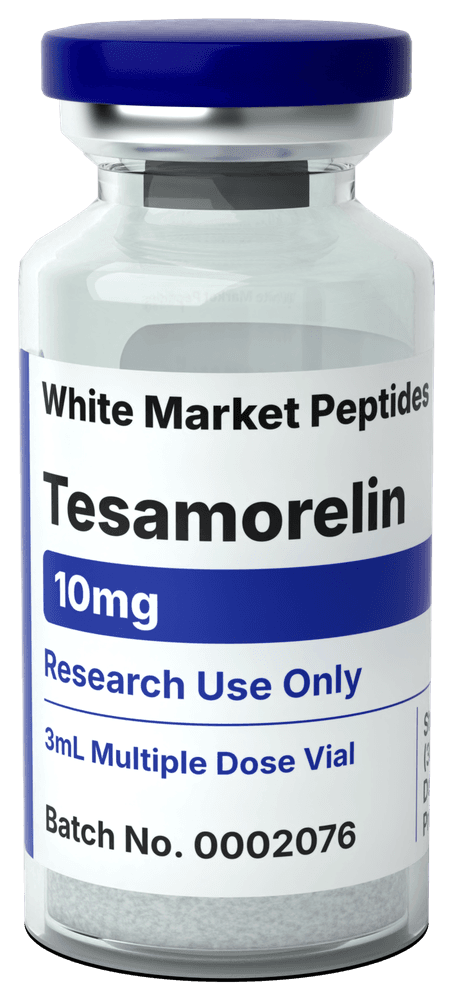
Tesamorelin (5 mg)
Tesamorelin 5mg vial dosage protocol. Reconstitution, daily injection schedule, syringe measurements, and storage guidance.
- Peptide
- tesamorelin
- Vial
- 5 mg
- Water
- 2.5 mL
- Concentration
- 2.00 mg/mL
Sponsored
At a Glance
Tesamorelin is a synthetic analogue of growth hormone-releasing hormone (GHRH) that stimulates pulsatile GH secretion from the pituitary, resulting in increased IGF-1, reduced visceral adipose tissue, and improved body composition.[1] It is FDA-approved as Egrifta SV for HIV-associated lipodystrophy at 2 mg/day.
- Reconstitute: Add 2.5 mL bacteriostatic water → 2.0 mg/mL concentration.
- Standard dose: 1–2 mg once daily subcutaneously in the evening.
- Easy measuring: At 2.0 mg/mL on a U-100 syringe, 1 unit = 0.01 mL = 20 mcg. A 1 mg dose = 50 units / 0.50 mL; a 2 mg dose = 100 units / 1.00 mL.
- Storage: Lyophilised: freeze at −20 °C; reconstituted: refrigerate at 2–8 °C; use within 3 weeks.
Overview
- Goal: Reduce visceral adipose tissue and improve body composition via stimulated pulsatile GH secretion and downstream IGF-1 elevation.[1]
- Schedule: Once-daily subcutaneous injection in the evening (to align with natural GH pulsatility).
- Dose range: 1–2 mg per day; 2 mg is the FDA-approved clinical dose.
- Reconstitution: 2.5 mL BAC water per 5 mg vial → 2.0 mg/mL.
- Cycle: Assess body composition and IGF-1 levels at 12 weeks.
What You’ll Need
Plan based on a 4-week cycle at 2 mg/day (28 injections, 56 mg total).
- Tesamorelin Vials (5 mg each): 56 mg needed ÷ 5 mg per vial → 12 vials.
- Insulin Syringes (U-100, 1 mL): 28 injections → 28 syringes.
- Bacteriostatic Water (10 mL bottles): 2.5 mL per vial → 1 × 10 mL bottle covers 4 vials.
- Alcohol Swabs: 2 per injection → 56 swabs per 4-week cycle.
How to Reconstitute
- Allow frozen lyophilised vial to reach room temperature (10–15 minutes).
- Draw 2.5 mL bacteriostatic water with a sterile syringe.
- Inject slowly down the inner vial wall; do not inject directly onto the lyophilised cake.
- Gently swirl until fully dissolved — do not shake. Solution should be clear and colourless.
- Label with reconstitution date; refrigerate at 2–8 °C, protected from light. Use within 3 weeks.
Dosing Schedule
| Phase | Dose | Units (U-100) | Volume | Frequency |
|---|---|---|---|---|
| Week 1 (titration) | 1 mg | 50 units | 0.50 mL | Once daily (evening) |
| Week 2+ (standard) | 2 mg | 100 units | 1.00 mL | Once daily (evening) |
At the standard 2 mg/day research dose, the 5 mg vial (reconstituted in 2.5 mL) provides 2.5 doses. Plan to purchase multiple vials for a sustained protocol. A 4-week cycle at 2 mg/day requires 56 mg total → approximately 12 vials. Evening dosing aligns with the body's natural overnight GH pulse to amplify the response.[2]
Protocol Details
- Research start: 1 mg (50 units / 0.50 mL) once daily in the evening for Weeks 1–2.
- Standard dose: 2 mg (100 units / 1.00 mL) once daily in the evening from Week 3+.[1]
- Injection site: Abdomen subcutaneous; rotate sites to avoid lipohypertrophy.
- Cycle length: Minimum 12 weeks to assess visceral fat reduction; continue if tolerated and response is positive.
Storage
- Lyophilised: Store at −20 °C (−4 °F); protect from moisture and light.
- Reconstituted: Refrigerate at 2–8 °C. Do not freeze. Use within 3 weeks (tesamorelin is slightly less stable than some peptides post-reconstitution).
- Appearance: Clear, colourless solution. Discard if cloudy or particulate.
How Tesamorelin Works
Tesamorelin is a synthetic conjugate of the full 44-amino acid GHRH (growth hormone-releasing hormone) sequence with a trans-3-hexenoic acid moiety that stabilises the peptide against plasma dipeptidyl peptidase IV (DPP-IV) degradation, extending its effective half-life.[3]
On binding pituitary GHRH receptors, tesamorelin stimulates pulsatile GH release in a physiologically appropriate pattern — unlike exogenous GH, which suppresses natural pulsatility. Increased GH drives hepatic and peripheral IGF-1 production, which promotes lipolysis in visceral adipocytes (reducing trunk fat), stimulates protein synthesis, and supports lean body mass. The net effect is a shift in body composition toward reduced visceral adipose tissue and preserved or increased lean mass.[1]
Good to Know
- Inject in the evening to align with the body's natural overnight GH secretion pulse and maximise pituitary stimulation.[2]
- Monitor fasting glucose — GH can reduce insulin sensitivity; periodic glucose checks are advisable for individuals with metabolic risk.
- WADA-prohibited (Category S2: Peptide Hormones, Growth Factors) — athletes under anti-doping rules must not use tesamorelin.
- Abdominal injection is preferred — tesamorelin was FDA-approved specifically for visceral fat reduction and abdominal injection maximises local effect.
- Visceral fat reduction: Falutz et al. (2010 NEJM): tesamorelin 2 mg/day for 26 weeks reduced trunk fat by 15.2% vs. 1.6% placebo in HIV-associated lipodystrophy.[2]
- IGF-1 elevation: Significant increases in serum IGF-1 in all major trials; typically normalises IGF-1 in GH-deficient adults.
- Lean body mass: Modest preservation or improvement in lean mass alongside fat loss.
- Side effects: Fluid retention, arthralgia, peripheral oedema, and myalgia occur in a minority of users — dose reduction mitigates these effects.
- Glucose: GH-mediated insulin resistance is possible; monitor fasting glucose particularly in pre-diabetic individuals.
- For background on Tesamorelin's mechanism, evidence, and safety profile, see What Is Tesamorelin?.
Tips for Best Results
- Pair with a calorie-controlled diet and resistance training to maximise and maintain body-composition improvements.
- Fasted evening injection (≥2 hours after last meal) avoids insulin-driven blunting of the GH pulse.
- Track waist circumference, fasting glucose, and IGF-1 (if available) at 6 and 12 weeks.
- Adequate sleep is essential — tesamorelin's mechanism synergises with sleep-related GH release.
Injection Tips
- Clean the vial stopper and injection site with separate alcohol swabs; allow both to air-dry fully before proceeding.
- Using a 29–31 gauge insulin syringe (5/16″ to 1/2″ needle), draw the calculated dose precisely.
- Pinch a fold of skin and insert the needle at 45° into subcutaneous fat (90° is acceptable with a short needle into a well-pinched fold).
- Inject slowly over 2–3 seconds; do not aspirate. Withdraw the needle, apply gentle pressure, and do not rub the site.
- Rotate injection sites (abdomen, thighs, upper arms) and dispose of each syringe in a sharps container immediately after use.