Single-peptide protocol
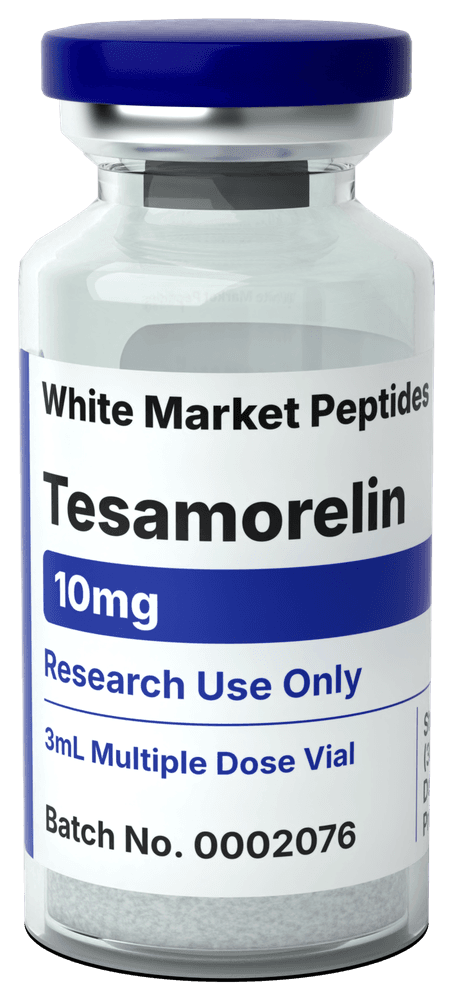
Tesamorelin (10 mg)
Tesamorelin 10mg vial dosage protocol. Reconstitution, daily dosing, syringe units, and growth hormone release guide.
- Peptide
- tesamorelin
- Vial
- 10 mg
- Water
- 3 mL
- Concentration
- 3.33 mg/mL
Sponsored
At a Glance
Tesamorelin is a synthetic growth hormone-releasing hormone (GHRH) analogue with a trans-3-hexenoic acid modification for DPP-4 resistance. FDA-approved as EGRIFTA for HIV-associated lipodystrophy, it stimulates endogenous pulsatile growth hormone release from the pituitary, increasing IGF-1 levels and preferentially mobilising visceral adipose tissue.[1]
- Reconstitute: Add 3.0 mL bacteriostatic water → 3.33 mg/mL concentration.
- Standard dose: 1–2 mg once daily, subcutaneous (abdomen), preferably in the evening.
- Easy measuring: At 3.33 mg/mL on a U-100 syringe, 1 unit = 0.01 mL ≈ 33.3 mcg. A 2 mg dose = 60 units / 0.60 mL.
- Storage: Lyophilised: refrigerate at 2–8 °C; reconstituted: refrigerate at 2–8 °C; use within 4 weeks.
Overview
- Goal: Stimulate endogenous pulsatile GH release to reduce visceral fat, improve body composition, and increase IGF-1 levels.[1]
- Schedule: Once-daily subcutaneous injection (abdomen) for 12–26 weeks.
- Dose range: 1–2 mg daily.
- Reconstitution: 3.0 mL BAC water per 10 mg vial → 3.33 mg/mL.
- Injection site: Abdomen only (per FDA label); rotate within the abdominal area.
What You’ll Need
Plan based on a 12-week cycle at 2 mg daily (84 injections, 168 mg total).
- Tesamorelin Vials (10 mg each): 168 mg needed ÷ 10 mg per vial → 17 vials.
- Insulin Syringes (U-100, 1 mL): 84 injections → 84 syringes.
- Bacteriostatic Water (10 mL bottles): 3.0 mL per vial → 6 × 10 mL bottles.
- Alcohol Swabs: 2 per injection → 168 swabs per 12-week cycle.
How to Reconstitute
- Allow refrigerated lyophilised vial to reach room temperature (10–15 minutes).
- Draw 3.0 mL bacteriostatic water with a sterile syringe.
- Inject slowly down the inner vial wall; do not spray directly onto the powder.
- Roll gently in hands for 30 seconds or swirl in a circle until dissolved — do not shake. Solution should be clear.
- Label with reconstitution date; refrigerate at 2–8 °C. Avoid freeze-thaw cycles. Use within 4 weeks.
Dosing Schedule
| Phase | Dose | Units (U-100) | Volume | Frequency |
|---|---|---|---|---|
| Week 1 (titration) | 1 mg | 30 units | 0.30 mL | Once daily (evening) |
| Weeks 2+ (standard) | 2 mg | 60 units | 0.60 mL | Once daily (evening) |
Begin at 1 mg daily for the first week to assess tolerance, then increase to 2 mg daily. Evening administration aligns with natural nocturnal GH pulsatility. The 10 mg vial provides 5 days at the 2 mg dose or 10 days at the 1 mg dose. Tesamorelin has a very short elimination half-life (8–11 minutes), but its downstream effects on GH release and IGF-1 elevation persist for hours.[1]
Protocol Details
- Week 1: 1 mg (30 units / 0.30 mL) once daily in the evening — tolerability assessment.
- Weeks 2+: 2 mg (60 units / 0.60 mL) once daily in the evening — standard dose.[1]
- FDA-approved dose: 1.4 mg daily (EGRIFTA SV).
- Cycle: 12–26 weeks; clinical trials support up to 52 weeks with monitoring.
Storage
- Lyophilised: Refrigerate at 2–8 °C (35–46 °F); protect from light.
- Reconstituted: Refrigerate at 2–8 °C. Avoid freeze-thaw cycles. Use within 4 weeks.
- Appearance: Clear solution. Discard if cloudy, coloured, or particulate.
How Tesamorelin Works
Tesamorelin is a 44-amino acid synthetic GHRH analogue with a trans-3-hexenoic acid modification at the N-terminus that confers resistance to DPP-4 enzymatic degradation, extending its effective signalling window.[1]
It binds GHRH receptors on pituitary somatotroph cells, stimulating the release of endogenous growth hormone in a pulsatile, physiological manner. The elevated GH increases hepatic IGF-1 production and enhances lipolysis, with preferential mobilisation of visceral fat through upregulation of lipolytic enzymes and beta-adrenergic receptor sensitivity in visceral adipocytes. Unlike exogenous GH injection, tesamorelin preserves the body’s natural feedback loops and pulsatile GH secretion pattern.[2]
Good to Know
- Administer in the evening to align with the natural nocturnal growth hormone pulsatility.
- Inject into the abdomen only (per FDA prescribing information); rotate to different areas of the abdomen.
- Monitor IGF-1 levels during therapy; persistent elevations may warrant dose adjustment.
- Tesamorelin stimulates endogenous GH release (unlike exogenous GH), preserving natural pulsatile secretion patterns.
- Monitor fasting glucose — tesamorelin may affect glucose tolerance in some individuals.
- Contraindications: Active malignancy, pregnancy, hypersensitivity to tesamorelin, disruption of hypothalamic-pituitary axis.
- Visceral fat reduction: FDA-approved for reducing excess abdominal fat in HIV-associated lipodystrophy; 26-week studies show significant visceral adipose tissue reduction.[1]
- Body composition: Increases skeletal muscle area and density alongside fat reduction.[2]
- Lipid profile: May improve triglycerides and cholesterol ratios.
- Side effects: Injection site reactions (erythema, pruritus, pain), arthralgia, myalgia, peripheral oedema, carpal tunnel syndrome symptoms.
- Metabolic monitoring: May cause glucose intolerance; monitor fasting glucose during prolonged use.
- One of few FDA-approved peptides — more clinical safety data available than most research peptides.
- For background on Tesamorelin's mechanism, evidence, and safety profile, see What Is Tesamorelin?.
Tips for Best Results
- Combine with regular resistance training to maximise the muscle-building effects of elevated GH/IGF-1.
- Maintain a moderate caloric deficit if fat loss is the primary goal — tesamorelin enhances lipolysis but does not replace dietary control.
- Adequate sleep (7–9 hours) is critical — the majority of GH secretion occurs during deep sleep.
- Monitor carbohydrate intake; tesamorelin may affect glucose metabolism.
- Avoid eating within 2 hours of injection — insulin blunts GH secretion.
Injection Tips
- Clean the vial stopper and injection site with separate alcohol swabs; allow both to air-dry fully before proceeding.
- Using a 29–31 gauge insulin syringe (5/16″ to 1/2″ needle), draw the calculated dose precisely.
- Pinch a fold of skin and insert the needle at 45° into subcutaneous fat (90° is acceptable with a short needle into a well-pinched fold).
- Inject slowly over 2–3 seconds; do not aspirate. Withdraw the needle, apply gentle pressure, and do not rub the site.
- Rotate injection sites (abdomen, thighs, upper arms) and dispose of each syringe in a sharps container immediately after use.
Related on pep-dose
- Article
What Is Tesamorelin?
What is Tesamorelin? Growth hormone-releasing hormone analog. Benefits for visceral fat, mechanism, dosing, and side effects.
- Protocol
Tesamorelin (5 mg)
Tesamorelin 5mg vial dosage protocol. Reconstitution, daily injection schedule, syringe measurements, and storage guidance.