Single-peptide protocol
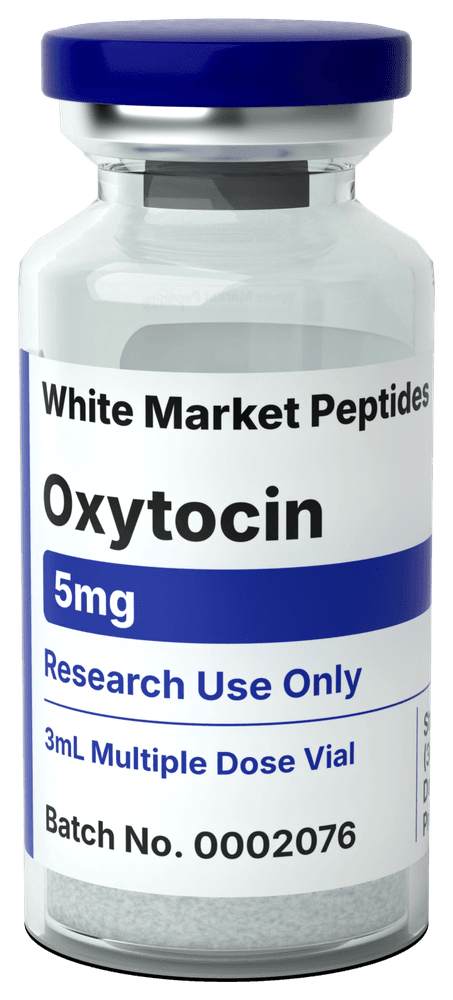
Oxytocin (5 mg)
Oxytocin 5mg vial dosage protocol. Reconstitute with 3.0 mL BAC water for 1.67 mg/mL. Research dosing 100–500 mcg SC, titrated over 12 weeks.
- Peptide
- oxytocin
- Vial
- 5 mg
- Water
- 3 mL
- Concentration
- 1.67 mg/mL
Sponsored
At a Glance
Oxytocin is a naturally occurring nonapeptide hormone studied for prosocial, anxiolytic, anti-inflammatory, and pain-modulating effects. Intranasal administration is the predominant route in human CNS research; subcutaneous injection is the standard route for research peptide protocols and peripheral-effect studies.[1]
- Reconstitute: Add 3.0 mL bacteriostatic water → 1.67 mg/mL (1,667 mcg/mL) concentration.
- Standard dose: 200–300 mcg subcutaneous, once daily.
- Easy measuring: At 1.67 mg/mL on a U-100 syringe, 1 unit = 0.01 mL = 16.7 mcg. A 200 mcg dose = 12 units / 0.12 mL.
- Doses per vial: 10 doses at 500 mcg; 25 doses at 200 mcg; use within 28–30 days of reconstitution.
- Storage: Lyophilised: 2–8°C or −20°C; reconstituted: refrigerate at 2–8°C, protect from light, use within 28–30 days.
Overview
- Goal: Research into prosocial, anxiolytic, anti-inflammatory, and pain-modulating effects of oxytocin via subcutaneous administration.[1]
- Schedule: Once daily subcutaneous injection; rotate injection sites between administrations.
- Dose range: 100–500 mcg per injection (6–30 units / 0.06–0.30 mL); titrate gradually.
- Reconstitution: 3.0 mL BAC water per 5 mg vial → 1.67 mg/mL (1 unit = 16.7 mcg).
- Storage: Lyophilised at 2–8°C or −20°C; reconstituted at 2–8°C; use within 28–30 days.
What You’ll Need
Plan based on a 30-day course at 200 mcg once daily (30 injections, 6,000 mcg total).
- Oxytocin Vials (5 mg each): 6,000 mcg ÷ 5,000 mcg per vial → 2 vials (25 doses per vial at 200 mcg).
- Insulin Syringes (U-100, 1 mL): 1 per injection → 30 syringes for the course.
- Bacteriostatic Water (10 mL bottles): 3.0 mL per vial → 1 × 10 mL bottle covers both vials.
- Alcohol Swabs: 2 per injection (vial stopper + injection site) → 60 swabs for the course.
How to Reconstitute
- Allow frozen or refrigerated vial to reach room temperature (10–15 minutes).
- Draw 3.0 mL bacteriostatic water with a sterile syringe.
- Inject slowly down the inner vial wall; do not inject directly onto the lyophilised cake.
- Gently swirl until fully dissolved — do not shake or vortex. Solution should be clear and colourless.
- Label with reconstitution date; refrigerate at 2–8°C, protected from light. Use within 28–30 days.
Dosing Schedule
| Phase | Dose | Units (U-100) | Volume | Frequency |
|---|---|---|---|---|
| Weeks 1–2 (start) | 100 mcg | 6 units | 0.06 mL | Once daily SC |
| Weeks 3–4 | 200 mcg | 12 units | 0.12 mL | Once daily SC |
| Weeks 5–6 | 300 mcg | 18 units | 0.18 mL | Once daily SC |
| Weeks 7–8 | 400 mcg | 24 units | 0.24 mL | Once daily SC |
| Weeks 9–12 (maintenance) | 500 mcg | 30 units | 0.30 mL | Once daily SC |
Reconstitute each 5 mg vial with 3.0 mL bacteriostatic water for a concentration of 1.67 mg/mL (1 unit on a U-100 syringe = 16.7 mcg). Administer subcutaneously once daily, rotating injection sites. Titrate gradually — oxytocin exhibits an inverted-U dose–response curve, meaning the optimal dose window is narrow and exceeding it may reduce or reverse the desired effect.[1]
Vial Usage Reference
| Dose per Injection | Doses per 5 mg Vial | Vials for 30-Day Course |
|---|---|---|
| 100 mcg | 50 doses | 1 vial |
| 200 mcg | 25 doses | 1 vial |
| 300 mcg | 16 doses | 2 vials |
| 500 mcg | 10 doses | 3 vials |
Protocol Details
- Starting (Weeks 1–2): 100 mcg (6 units / 0.06 mL) subcutaneous, once daily.[2]
- Weeks 3–4: 200 mcg (12 units / 0.12 mL) subcutaneous, once daily.
- Weeks 5–6: 300 mcg (18 units / 0.18 mL) subcutaneous, once daily.
- Weeks 7–8: 400 mcg (24 units / 0.24 mL) subcutaneous, once daily.
- Weeks 9–12: 500 mcg (30 units / 0.30 mL) subcutaneous, once daily.
- Frequency: Once daily; consistent timing relative to research assessments recommended.
- Injection site: Abdomen, thigh, or upper arm. Rotate sites between injections.
- Note: Intranasal administration (24 IU ≈ 40 mcg) is the predominant route in published human CNS behavioural research; SC is the standard research peptide route for peripheral and systemic effects.[1]
Storage
- Lyophilised: Store at 2–8°C (standard refrigeration) or −20°C (freezer) for long-term storage; protect from moisture and light.
- Reconstituted: Refrigerate at 2–8°C. Do not freeze. Use within 28–30 days.
- Appearance: Clear, colourless solution. Discard if cloudy, discoloured, or particulate matter is visible.
How Oxytocin Works
Oxytocin is a cyclic nonapeptide (Cys–Tyr–Ile–Gln–Asn–Cys–Pro–Leu–Gly–NH2; MW ≈1,007 Da) synthesised in the paraventricular and supraoptic nuclei of the hypothalamus and released from the posterior pituitary. The disulfide bridge between Cys1 and Cys6 is essential for receptor binding activity.[1]
Oxytocin acts on the Gq/11-coupled oxytocin receptor (OXTR), distributed throughout the brain — including the amygdala, nucleus accumbens, hypothalamus, and prefrontal cortex — and in peripheral tissues including the uterus, breast, kidneys, heart, and immune cells. Central OXTR activation modulates the amygdala's threat-processing circuits (reducing fear and anxiety responses), engages dopaminergic reward pathways in the nucleus accumbens (reinforcing social behaviour), and suppresses HPA axis stress responses via corticotropin-releasing factor inhibition. Peripheral OXTR on immune cells mediates anti-inflammatory effects through NF-κB suppression and reduced pro-inflammatory cytokine production.[3]
For a detailed breakdown of the mechanism, receptor pharmacology, and research evidence by application, see the What Is Oxytocin? education article.
Good to Know
- Intranasal vs. SC — different contexts: In published human CNS research, intranasal oxytocin at 24 IU (≈40 mcg) is the standard route for studying social, cognitive, and emotional effects. Subcutaneous injection is used for peripheral effects and in research peptide settings. The two routes have distinct pharmacokinetic profiles and are not directly interchangeable in research design.
- Inverted-U dose–response: Oxytocin does not follow a simple "more is better" dose–response. Multiple studies document that both underdosing and overdosing may produce diminished or paradoxically opposite effects. This is one of the most well-documented characteristics of oxytocin pharmacology. Start at the lower end and titrate conservatively.[1]
- Sex differences: Oxytocin effects are "highly sexually differentiated" in the published literature. Effects observed in male cohorts may not apply in female cohorts and vice versa. Researchers should account for biological sex in protocol design and result interpretation.[2]
- Potency conversion: WHO standard is 600 IU per mg. Therefore: 1 IU ≈ 1.67 mcg; 24 IU (the standard intranasal research dose) ≈ 40 mcg; 500 mcg SC ≈ 300 IU.
- ASD research context: The large NIH-funded RCT (Sikich 2021, N=290, 24 weeks) found no improvement in ASD social functioning with 24 IU intranasal oxytocin twice daily. SC protocols for ASD are not supported by published evidence.[2]
- Pregnancy contraindication: Exogenous oxytocin at any dose is contraindicated outside the medically supervised obstetric context due to its uterotonic action.
- Prosocial & trust (human, intranasal): Single-dose 24 IU intranasal oxytocin increased trust in Trust Game paradigms and reduced social anxiety measures across multiple trials.[2]
- Anxiety reduction (human, intranasal): Multiple trials document anxiolytic effects at 24 IU intranasal; effect is context-dependent and sexually differentiated.
- ASD (human RCT): Definitively negative primary outcome in the largest trial to date; 24 weeks, 290 subjects, no improvement in social functioning.[2]
- Anti-inflammatory / wound healing (animal data): Robust preclinical data; no human RCTs completed.[3]
- Pain modulation (animal data): Antinociceptive effects via spinal and supraspinal pathways; limited human data.[3]
- Injection site: Mild redness or discomfort possible at SC injection sites; rotate sites to minimise.
- Nausea: Possible at higher SC doses; typically transient.
- Behavioural variability: Due to the inverted-U dose–response and context-dependency, individual responses can vary significantly; more is not better.
Injection Tips
- Clean the vial stopper and injection site with separate alcohol swabs; allow both to air-dry fully before proceeding.
- Using a 29–31 gauge insulin syringe (5/16″ to 1/2″ needle), draw the calculated dose precisely.
- Pinch a fold of skin and insert the needle at 45° into subcutaneous fat (90° is acceptable with a short needle into a well-pinched fold).
- Inject slowly over 2–3 seconds; do not aspirate. Withdraw the needle, apply gentle pressure, and do not rub the site.
- Rotate injection sites (abdomen, thighs, upper arms) and dispose of each syringe in a sharps container immediately after use.