Single-peptide protocol
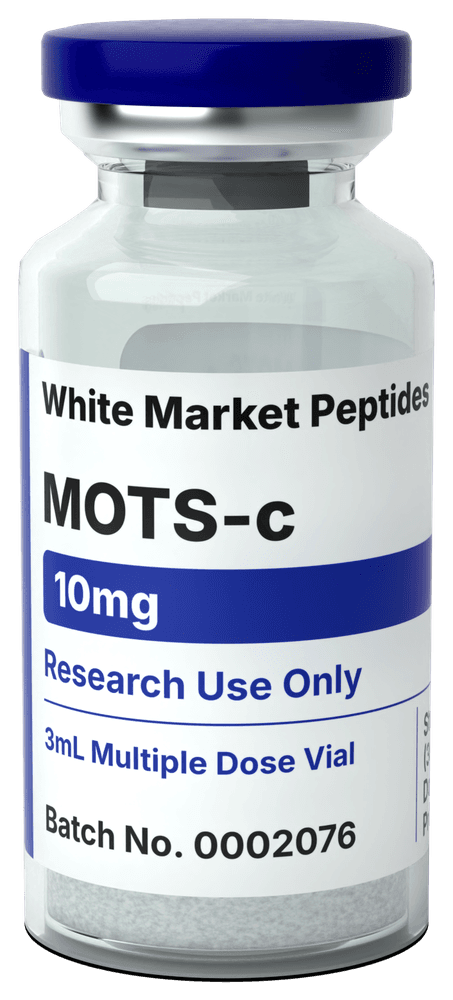
MOTS-c (10 mg)
MOTS-c 10mg vial dosage protocol. Reconstitution, injection schedule, syringe units, and mitochondrial peptide dosing.
- Peptide
- mots-c
- Vial
- 10 mg
- Water
- 3 mL
- Concentration
- 3.33 mg/mL
Sponsored
At a Glance
MOTS-c (Mitochondrial Open Reading Frame of the 12S rRNA Type-c) is a 16-amino acid mitochondrial-derived peptide that activates the AMPK pathway to improve glucose utilisation, lipid metabolism, and cellular energy homeostasis.[1] It functions as an exercise mimetic and metabolic regulator, with emerging research into longevity and insulin sensitisation.
- Reconstitute: Add 3.0 mL bacteriostatic water → 3.33 mg/mL concentration.
- Dose range: 200–1,000 mcg/day subcutaneously, gradually increasing over 10+ weeks.
- Easy measuring: At 3.33 mg/mL on a U-100 syringe, 1 unit = 0.01 mL = 33.3 mcg. A 500 mcg dose = 15 units / 0.15 mL.
- Storage: Lyophilised: freeze at −20 °C; reconstituted: refrigerate at 2–8 °C; use within 7 days for optimal potency.
Overview
- Goal: Activate AMPK-driven metabolic pathways to improve glucose utilisation, mitochondrial biogenesis, and exercise capacity.[1]
- Schedule: Daily subcutaneous injection for 10+ weeks with gradual dose escalation.
- Dose range: 200–1,000 mcg per injection.
- Reconstitution: 3.0 mL BAC water per 10 mg vial → 3.33 mg/mL.
- Injection site: Abdomen, outer thighs, or upper arms (rotate systematically).
What You’ll Need
Plan based on a 10-week gradual cycle (200 mcg/day for 4 weeks, then 500 mcg/day for 6 weeks — 70 injections, 24.6 mg total).
- MOTS-c Vials (10 mg each): 24.6 mg needed ÷ 10 mg per vial → 3 vials.
- Insulin Syringes (U-100, 1 mL): 70 injections → 70 syringes.
- Bacteriostatic Water (10 mL bottles): 3.0 mL per vial → 1 × 10 mL bottle.
- Alcohol Swabs: 2 per injection → 140 swabs per 10-week cycle.
How to Reconstitute
- Allow frozen lyophilised vial to reach room temperature (10–15 minutes).
- Draw 3.0 mL bacteriostatic water with a sterile syringe.
- Inject slowly down the inner vial wall to avoid foaming.
- Gently swirl until fully dissolved — do not shake vigorously. Solution should be clear.
- Label with reconstitution date; refrigerate at 2–8 °C. Use within 7 days for optimal potency.
Dosing Schedule
Water: 3.0 mL → Concentration: 3.33 mg/mL → 1 unit = 33.3 mcg
| Week | Daily Dose | Units (U-100) | Volume | Frequency |
|---|---|---|---|---|
| 1–2 | 200 mcg | 6 units | 0.06 mL | Once daily |
| 3–4 | 400 mcg | 12 units | 0.12 mL | Once daily |
| 5–6 | 600 mcg | 18 units | 0.18 mL | Once daily |
| 7–8 | 800 mcg | 24 units | 0.24 mL | Once daily |
| 9–10+ | 1,000 mcg | 30 units | 0.30 mL | Once daily |
Begin at 200 mcg daily and titrate up every 2 weeks as tolerated. MOTS-c has a short plasma half-life, but triggers sustained AMPK/NRF2 transcriptional cascades lasting well beyond clearance.[1]
Protocol Details
- Weeks 1–4: 200 mcg daily (6 units / 0.06 mL) — tolerability assessment.
- Weeks 5–8: 500 mcg daily (15 units / 0.15 mL) — moderate dose.
- Weeks 9+: 1,000 mcg daily (30 units / 0.30 mL) — full dose.
- Cycle: 10–12+ weeks on; 4-week break before repeating.
Storage
- Lyophilised: Store at −20 °C (−4 °F); protect from moisture and light.
- Reconstituted: Refrigerate at 2–8 °C. Use within 7 days (shorter than most peptides). Do not freeze.
- Appearance: Clear solution. Discard if cloudy, coloured, or particulate.
How MOTS-c Works
MOTS-c is a 16-amino acid peptide encoded in the mitochondrial genome (12S rRNA gene). Unlike nuclear-encoded peptides, MOTS-c is produced directly by mitochondria and acts as a retrograde signal from mitochondria to the nucleus, regulating metabolic gene expression.[1]
Its primary mechanism involves activation of AMP-activated protein kinase (AMPK), the master metabolic switch that enhances glucose uptake, fatty acid oxidation, and mitochondrial biogenesis. MOTS-c also activates the NRF2 antioxidant pathway, supporting cellular stress resistance and longevity-associated gene expression. Exercise naturally elevates MOTS-c levels, which is why it is often described as an “exercise mimetic” peptide.[2]
Good to Know
- MOTS-c has a very short reconstituted shelf life (7 days) compared to most peptides — plan your injection schedule accordingly to minimise waste.
- WADA-prohibited substance — competitive athletes subject to anti-doping rules must not use MOTS-c.
- Best administered in the morning or pre-exercise to align with natural metabolic rhythms.
- Despite the short plasma half-life (~30 minutes), MOTS-c triggers sustained AMPK and NRF2 signalling cascades that persist for hours.
- Ensure ≥99% purity; research-grade peptides with lower purity may contain toxic impurities.
- Metabolic improvement: Activates AMPK to improve glucose utilisation and insulin sensitivity in preclinical models.[1]
- Exercise mimetic: Replicates some molecular benefits of exercise, including enhanced mitochondrial biogenesis and improved endurance capacity.
- Longevity research: MOTS-c levels decline with age; supplementation may counteract age-related metabolic decline.[2]
- Side effects: Reported effects include increased heart rate, injection site irritation, occasional insomnia, headache, and mild GI symptoms — generally mild and transient.
- Regulatory status: Not FDA-approved; WADA-prohibited. No completed clinical trials establishing definitive safety or efficacy.
- For background on MOTS-c's mechanism, evidence, and safety profile, see What Is MOTS-c?.
Tips for Best Results
- Pair with regular exercise (both aerobic and resistance training) to complement AMPK activation.
- Maintain a balanced diet with adequate complex carbohydrates to support enhanced glucose metabolism.
- Prioritise sleep (7–9 hours) — mitochondrial biogenesis is enhanced during restorative sleep phases.
- Stay well hydrated, especially if combining MOTS-c with fasted training.
Injection Tips
- Clean the vial stopper and injection site with separate alcohol swabs; allow both to air-dry fully before proceeding.
- Using a 29–31 gauge insulin syringe (5/16″ to 1/2″ needle), draw the calculated dose precisely.
- Pinch a fold of skin and insert the needle at 45° into subcutaneous fat (90° is acceptable with a short needle into a well-pinched fold).
- Inject slowly over 2–3 seconds; do not aspirate. Withdraw the needle, apply gentle pressure, and do not rub the site.
- Rotate injection sites (abdomen, thighs, upper arms) and dispose of each syringe in a sharps container immediately after use.