Weight Loss & Metabolic
What Is MOTS-c?
Sponsored
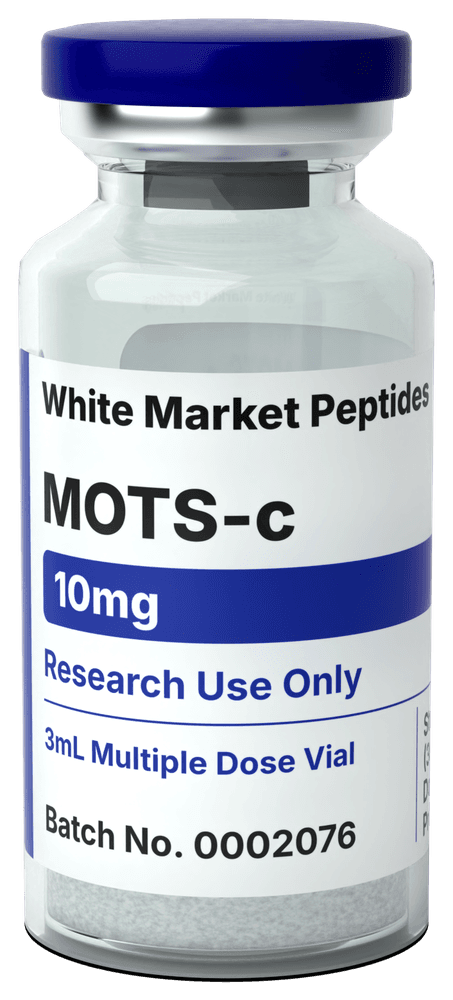
MOTS-c (Mitochondrial Open Reading Frame of the 12S rRNA type-c) is a 16-amino acid peptide encoded within the mitochondrial genome, making it a unique member of a recently discovered class of signaling molecules called mitochondrial-derived peptides (MDPs). Unlike most peptides synthesized by nuclear genes, MOTS-c is directly produced by the mitochondria and functions as a systemic metabolic regulator with striking parallels to the effects of exercise. It has attracted intense scientific interest for its roles in insulin sensitivity, fat metabolism, cellular stress response, and longevity.
Note on naming: MOTS-c stands for “Mitochondrial Open Reading Frame of the 12S rRNA type-c.” It is sometimes written MOTS‑c and should not be confused with other mitochondrial peptides such as humanin or SHLPs.
The Short Answer
MOTS-c is a mitochondria-encoded peptide that acts as a mitohormone, translocating to the nucleus under metabolic stress to regulate gene expression via the AMPK and folate-AICAR pathways. Animal and early human studies show it improves insulin sensitivity, enhances exercise capacity, reduces fat accumulation, and extends healthspan in multiple model organisms.[1] Plasma MOTS-c levels decline with age and have been implicated in age-related disease.[2]
Key Concepts
What is MOTS-c (definition)?
MOTS-c is encoded within a short open reading frame (sORF) of the 12S rRNA gene in the human mitochondrial genome and was identified by Changhan David Lee and colleagues at the University of Southern California in 2015.[1] Its sequence is: Ac-MRWQEMGYIFYPRKLR-NH2. Crucially, it is not merely a mitochondrial byproduct—it is a functional hormone released into circulation, acting on distant tissues.
The mitochondria-to-nucleus signaling axis:
Under metabolic stress (nutrient deprivation, exercise, oxidative stress), MOTS-c translocates from the cytoplasm into the cell nucleus, where it binds to stress-response transcription factors including NRF2 and ATF1/ATF7 to regulate metabolic gene programs.[4]
Mechanisms, in one line each:
- AMPK activation: MOTS-c activates AMP-activated protein kinase (AMPK), the master regulator of cellular energy homeostasis, mimicking the metabolic effects of exercise.[1]
- Folate-AICAR pathway: MOTS-c inhibits folate and purine metabolism, leading to AICAR accumulation, which in turn activates AMPK independently of AMP/ATP ratios.[1]
- Insulin sensitization: It improves glucose uptake in skeletal muscle and reduces systemic insulin resistance in diet-induced obesity models.[1]
- Exercise mimetic: MOTS-c recapitulates many transcriptional and metabolic effects of physical exercise, including increased fatty acid oxidation and mitochondrial biogenesis.[3]
- Stress response regulation: It modulates the integrated stress response (ISR), protecting cells during ischemia and metabolic overload.[3]
- Longevity association: Circulating MOTS-c declines with age and is implicated in age-related disease biology;[2] exogenous MOTS-c extends lifespan in male mice on a high-fat diet.[1]
Age-related decline: Plasma MOTS-c concentrations decrease significantly with age in humans, with the steepest declines observed after age 50, and lower levels have been associated with multiple age-related metabolic diseases.[2]
Step-by-Step: How to Work With MOTS-c
Quick orientation: MOTS-c is a research peptide not approved for human therapeutic use. The following information is educational only and does not constitute medical advice.
Step 1 — Understand the vial sizes and use case
Research-grade MOTS-c is typically available in 5 mg, 10 mg, and 20 mg lyophilized vials. The 10 mg vial offers the best balance of economy and flexibility for multi-week protocols. For reconstitution and dosing math, see the MOTS-c 10 mg Dosage Protocol.
Step 2 — Source with documentation
- Request a Certificate of Analysis (COA) with HPLC purity (≥99%) and mass spec confirmation of the 16-amino acid sequence.
- Ensure the product is lyophilized (freeze-dried) and stored at −20°C until use.
Step 3 — Reconstitution math
General rule: For a 10 mg vial, add 2.0 mL bacteriostatic water → 5.0 mg/mL stock solution. At 5.0 mg/mL on a U-100 insulin syringe, 1 unit ≈ 50 mcg.
Step 4 — Timing and injection site
- Many researchers favor morning administration, ideally 30–60 minutes before exercise, to amplify the exercise-mimetic effects.
- Subcutaneous injection into the abdomen, thigh, or upper arm; rotate sites systematically.
Step 5 — Cycle and rest
- Common protocols: 4–12 weeks on, 4 weeks off. Longer cycles have been explored in animal research without obvious toxicity.
- Track fasting glucose, energy levels, and body composition to assess response.
Comparison & Alternatives
MOTS-c is unique among research peptides as a mitochondria-encoded metabolic regulator; its nearest functional comparators are other AMPK activators (AICAR, metformin) and exercise itself.
| Modality | Mechanism | Primary Benefit | Evidence Level | Route |
|---|---|---|---|---|
| MOTS-c | AMPK activation, folate-AICAR, nuclear stress response | Insulin sensitivity, metabolic health, longevity | Preclinical + early human association data | SC injection (research) |
| AICAR | Direct AMPK activator (AMPK substrate analog) | Exercise mimetic, fat oxidation | Preclinical; no human RCTs | SC injection or oral |
| Metformin | Mitochondrial complex I inhibition → AMPK | T2DM glycemic control, longevity research | Robust (decades of RCTs) | Oral |
| 5-Amino-1MQ | NNMT inhibition → mitochondrial upregulation | Fat loss, metabolic health | Preclinical | Oral capsule (research) |
| Exercise | Multiple pathways (AMPK, PGC-1α, GLUT4) | Insulin sensitivity, cardiovascular, longevity | Strongest evidence base | N/A |
FAQs
What is MOTS-c?
MOTS-c is a 16-amino acid peptide encoded in the mitochondrial genome that acts as a systemic metabolic hormone. Discovered in 2015, it activates AMPK, improves insulin sensitivity, enhances fat oxidation, and is associated with longer healthspan in both animals and humans.[1]
Is MOTS-c the same as exercise in a vial?
Not exactly, but the analogy is apt. MOTS-c reproduces many transcriptional signatures of aerobic exercise in skeletal muscle, including AMPK activation, GLUT4 upregulation, and fatty acid oxidation. In aged male mice, it significantly improved grip strength and endurance independent of voluntary exercise.[3]
Does MOTS-c decline with age?
Yes. Circulating MOTS-c decreases significantly with age in both animal models and humans, and lower levels have been linked to age-related metabolic disease, positioning it as a candidate biomarker of aging biology.[2]
What is the MOTS-c dosing protocol?
In preclinical research, MOTS-c has been studied at 5–15 mg/kg in rodents. In human research and community use, doses of 5–10 mg three times weekly via subcutaneous injection are commonly reported. See the MOTS-c 10 mg Dosage Protocol for full details.
Is MOTS-c safe?
Long-term human safety data is lacking, as MOTS-c remains a research peptide without FDA approval. Animal studies have not reported significant toxicity. It does not affect thyroid or reproductive hormones in preclinical models. As with all research peptides, quality sourcing and aseptic technique are essential.
Can MOTS-c help with type 2 diabetes?
Preclinical evidence is compelling. MOTS-c dramatically improved insulin sensitivity and reduced fat mass in diet-induced obese mice. A small human study reported correlations between plasma MOTS-c and insulin sensitivity markers. Human RCTs have not yet been conducted.[1]
Evidence Highlights
- Discovery paper (Lee et al., Cell Metabolism, 2015): MOTS-c identified in human mitochondrial 12S rRNA; shown to regulate insulin sensitivity and prevent diet-induced obesity in mice. Takeaway: Established MOTS-c as a functional mitohormone.[1]
- Aging biology of MOTS-c (Mohtashami et al., Int J Mol Sci, 2022): Review synthesizing evidence that circulating MOTS-c declines with age and is associated with multiple age-related diseases. Takeaway: Frames MOTS-c as a candidate biomarker of aging biology.[2]
- Nuclear translocation (Kim et al., Cell Metab, 2018): MOTS-c translocates to the nucleus and engages stress-response transcription factors (NRF2, ATF1/ATF7) to regulate nuclear gene expression under metabolic stress. Takeaway: Defines the mechanism by which MOTS-c acts as a mitohormone.[4]
- Aging and physical function (Reynolds et al., Nat Commun, 2021): Exogenous MOTS-c reversed age-related decline in muscle function and metabolic health in aged mice; endogenous MOTS-c is induced by exercise. Takeaway: Geroscience potential beyond metabolic disease.[3]
Next Steps
If you are researching MOTS-c dosing:
- See the MOTS-c 10 mg Vial Dosage Protocol for reconstitution steps, dosing tables, and supply requirements.
MOTS-c is a biologically novel mitohormone with compelling preclinical evidence for metabolic improvement and longevity; it is not yet approved for human use and remains a research-stage peptide.
Related on pep-dose
Sources
- The mitochondrial-derived peptide MOTS-c promotes metabolic homeostasis and reduces obesity and insulin resistance — PubMed
- MOTS-c, the Most Recent Mitochondrial Derived Peptide in Human Aging and Age-Related Diseases — PubMed
- MOTS-c is an exercise-induced mitochondrial-encoded regulator of age-dependent physical decline and muscle homeostasis — PubMed
- The Mitochondrial-Encoded Peptide MOTS-c Translocates to the Nucleus to Regulate Nuclear Gene Expression in Response to Metabolic Stress — PubMed