Single-peptide protocol
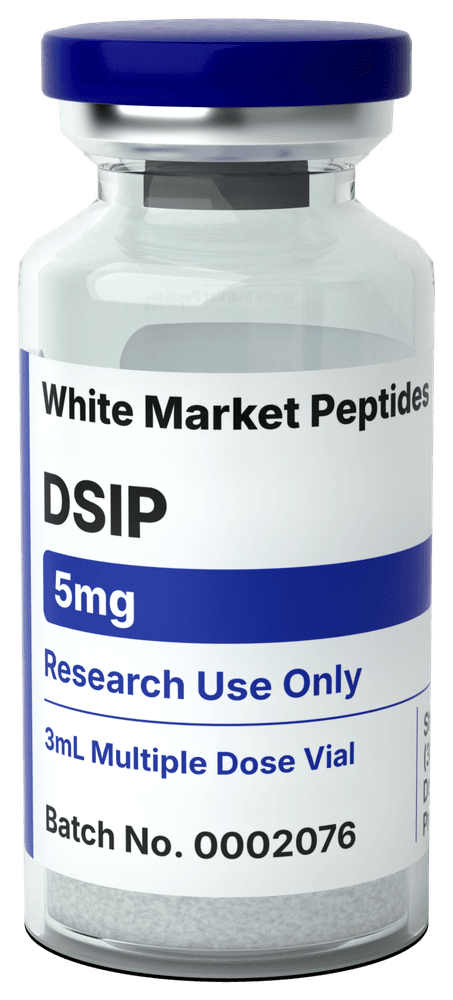
DSIP (5 mg)
DSIP 5mg vial dosage protocol. Reconstitute with 3.0 mL bacteriostatic water for 1.67 mg/mL. Titrate from 100 mcg to 250–300 mcg once daily, in the evening 30–60 min before sleep.
- Peptide
- dsip
- Vial
- 5 mg
- Water
- 3 mL
- Concentration
- 1.67 mg/mL
Sponsored
At a Glance
DSIP (Delta Sleep-Inducing Peptide) is a naturally occurring nine-amino-acid neuropeptide studied for its ability to promote deep delta-wave sleep and modulate the HPA axis. Published human research used intravenous administration; community researchers typically use subcutaneous injection at lower doses extrapolated from animal data.[1]
- Reconstitute: Add 3.0 mL bacteriostatic water → 1.67 mg/mL (1,667 mcg/mL) concentration.
- Standard dose: 250–300 mcg before sleep subcutaneous injection, 30–60 minutes prior to sleep, titrated up over the first weeks.
- Easy measuring: At 1.67 mg/mL on a U-100 syringe, 1 unit = 0.01 mL ≈ 16.7 mcg. A 250 mcg dose = 15 units / 0.15 mL.
- Doses per vial: ~20 doses at 250 mcg (≈17 at 300 mcg); use within 4 weeks of reconstitution.
- Storage: Lyophilised: freeze at −20 °C; reconstituted: refrigerate at 2–8 °C; use within 4 weeks.
Overview
- Goal: Promote deep delta-wave sleep via neuropeptide modulation of sleep architecture and HPA axis.[1]
- Schedule: Subcutaneous injection once daily in the evening, 30–60 minutes before sleep, over a 4–8 week cycle (optional extension to 12 weeks with periodic breaks).
- Dose: 100–300 mcg per injection (6–18 units / 0.06–0.18 mL), titrated; standard 250–300 mcg.
- Reconstitution: 3.0 mL BAC water per 5 mg vial → 1.67 mg/mL.
- Storage: Lyophilised at −20 °C; reconstituted at 2–8 °C; use within 4 weeks.
What You’ll Need
Plan based on an 8-week once-daily course titrated from 100 mcg up to 250–300 mcg (56 injections, approx. 12,800 mcg total).
- DSIP Vials (5 mg each): 12,800 mcg ÷ 5,000 mcg per vial → 3 vials (~20 doses per vial at 250 mcg).
- Insulin Syringes (U-100, 1 mL): 1 per injection → 56 syringes for the course.
- Bacteriostatic Water (10 mL bottles): 3.0 mL per vial × 3 vials → 1 × 10 mL bottle.
- Alcohol Swabs: 2 per injection → 112 swabs for the course.
How to Reconstitute
- Allow frozen vial to reach room temperature (10–15 minutes).
- Draw 3.0 mL bacteriostatic water with a sterile syringe.
- Inject slowly down the inner vial wall; do not inject directly onto the lyophilised cake.
- Gently swirl until fully dissolved — do not shake. Solution should be clear and colourless.
- Label with reconstitution date; refrigerate at 2–8 °C, protected from light. Use within 4 weeks.
Dosing Schedule
| Phase | Dose | Units (U-100) | Volume | Timing |
|---|---|---|---|---|
| Week 1 | 100 mcg | 6 units | 0.06 mL | 30–60 min before sleep |
| Week 2 | 150 mcg | 9 units | 0.09 mL | 30–60 min before sleep |
| Week 3 | 200 mcg | 12 units | 0.12 mL | 30–60 min before sleep |
| Weeks 4–8 | 250–300 mcg | 15–18 units | 0.15–0.18 mL | 30–60 min before sleep |
Reconstitute each 5 mg vial with 3.0 mL bacteriostatic water for a concentration of 1.67 mg/mL (1 unit on a U-100 syringe ≈ 16.7 mcg). Administer subcutaneously once daily in the evening, 30–60 minutes before intended sleep time. Start low and step the dose up weekly: DSIP shows a U-shaped dose-response, so titrate gradually and hold at the lowest dose that produces a consistent effect.[3] DSIP is not intended for daytime use.[1]
Protocol Details
- Week 1: 100 mcg (6 units / 0.06 mL) subcutaneous, once daily, 30–60 min before sleep.[2]
- Week 2: 150 mcg (9 units / 0.09 mL) subcutaneous, once daily, 30–60 min before sleep.
- Week 3: 200 mcg (12 units / 0.12 mL) subcutaneous, once daily, 30–60 min before sleep.
- Weeks 4–8 (standard): 250–300 mcg (15–18 units / 0.15–0.18 mL) subcutaneous, once daily, 30–60 min before sleep.
- Advanced (optional): Some researchers extend to 350–500 mcg (21–30 units / 0.21–0.30 mL) once daily from week 5+; note that formal human studies used ≤ ~300 mcg equivalents, so this tier exceeds the documented range.
- Frequency: Once daily, in the evening 30–60 minutes before sleep.
- Cycle: 4–8 weeks; optional extension to 12 weeks with periodic breaks.
- Injection site: Abdomen, thigh, or upper arm. Rotate sites between injections.
- Note: An initial mild arousal effect may occur in the first hour; sleep-promoting effects typically emerge in the second hour.[2]
Storage
- Lyophilised: Store at −20 °C (−4 °F); protect from moisture and light.
- Reconstituted: Refrigerate at 2–8 °C. Do not freeze. Use within 4 weeks.
- Appearance: Clear, colourless solution. Discard if cloudy, discoloured, or particulate.
How DSIP Works
DSIP is a nine-amino-acid neuropeptide (WAGGDASGE; MW 849 Da) first isolated from the cerebral venous blood of sleeping rabbits by Schoenenberger & Monnier at the University of Basel in 1977.[1] The most distinctive feature of DSIP — and its primary scientific puzzle — is that its receptor has never been identified despite nearly five decades of research.
What is established: DSIP crosses the blood-brain barrier via both passive diffusion and a saturable transport system. It modulates the hypothalamic-pituitary-adrenal (HPA) axis, correlating with cortisol levels. It interacts with the pineal gland through N-acetyltransferase modulation, influencing melatonin synthesis. Its antinociceptive effects in animals are blocked by the opioid antagonist naloxone, suggesting functional interaction with opioid receptors.[4] The net result of these interactions — in the correct dose and timing window — is an enhancement of delta-wave (slow-wave) EEG activity and deeper sleep architecture.
Good to Know
- Published human research used intravenous administration at 25 nmol/kg (≈1.5 mg IV for 70 kg). Community subcutaneous dosing at 100–300 mcg is extrapolated from animal research — no human pharmacokinetic data for SC DSIP exists.
- DSIP shows a U-shaped dose-response curve in animal models — both sub-optimal and supra-optimal doses may produce diminished or reversed effects. Start at 100 mcg and step up weekly, holding at the lowest dose that produces a consistent effect.[3]
- Cumulative benefit was observed across multiple administrations in human IV studies; results on a single night may be modest.
- Do not use concurrently with opioid medications — DSIP has demonstrated opioid receptor activity and additive CNS/respiratory depression is theoretically possible.
- Athletes subject to anti-doping rules should seek written confirmation from their Anti-Doping Organization before use; WADA Section S2 catch-all clauses may apply.
- Sleep (human IV data): Weak but statistically significant improvements in sleep efficiency and onset latency in the only double-blind study (Bes et al. 1992, N=16); no subjective improvement was found.[2] Earlier open studies were more positive but less controlled.
- Withdrawal (uncontrolled human data): 87–97% of 107 inpatients showed marked improvement in alcohol or opiate withdrawal symptoms (Dick et al. 1984); no placebo group was included.[5]
- Pain (animal data): Supraspinal opioid-mediated analgesia confirmed in mice; no human analgesic trials exist.[4]
- Neuroprotection (animal data): Intranasal DSIP accelerated motor recovery post-stroke in rats; Deltaran combination achieved 100% ischemia survival vs. 62% in controls.
- First-hour arousal: An initial mildly arousing effect in the first hour post-injection is documented in human studies; do not expect immediate sedation.
- No daytime sedation reported in any published human study.
- For background on DSIP's mechanism, evidence, and safety profile, see What Is DSIP?.
Tips for Best Results
- Administer 30–60 minutes before the intended sleep time to align with the delayed onset of sleep-promoting effects.
- Minimize blue-light exposure and screen use in the 30–60 minutes post-injection to support the transition to sleep.
- Maintain a consistent sleep schedule — DSIP modulates natural sleep architecture and works best when circadian rhythms are regular.
- Start at 100 mcg in week 1 and step up weekly (150 mcg, then 200 mcg) before settling at 250–300 mcg; the U-shaped dose-response means more is not always better.
- Adequate dietary magnesium and consistent wind-down routines complement sleep peptide research protocols.
Injection Tips
- Clean the vial stopper and injection site with separate alcohol swabs; allow both to air-dry fully before proceeding.
- Using a 29–31 gauge insulin syringe (5/16″ to 1/2″ needle), draw the calculated dose precisely.
- Pinch a fold of skin and insert the needle at 45° into subcutaneous fat (90° is acceptable with a short needle into a well-pinched fold).
- Inject slowly over 2–3 seconds; do not aspirate. Withdraw the needle, apply gentle pressure, and do not rub the site.
- Rotate injection sites (abdomen, thighs, upper arms) and dispose of each syringe in a sharps container immediately after use.
Related on pep-dose
Sources
- Schoenenberger GA & Monnier M — PNAS (1977)
- Bes F et al. — Neuropsychobiology (1992)
- Graf MV & Kastin AJ — Neuroscience & Biobehavioral Reviews (1984)
- Nakamura H et al. — European Journal of Pharmacology (1988)
- Dick P et al. — European Neurology (1984)
- Bachem Peptide Technical Guide
- CDC — General Best Practice Guidelines for Immunization