Cognitive & Neurological
What Is DSIP?
Sponsored
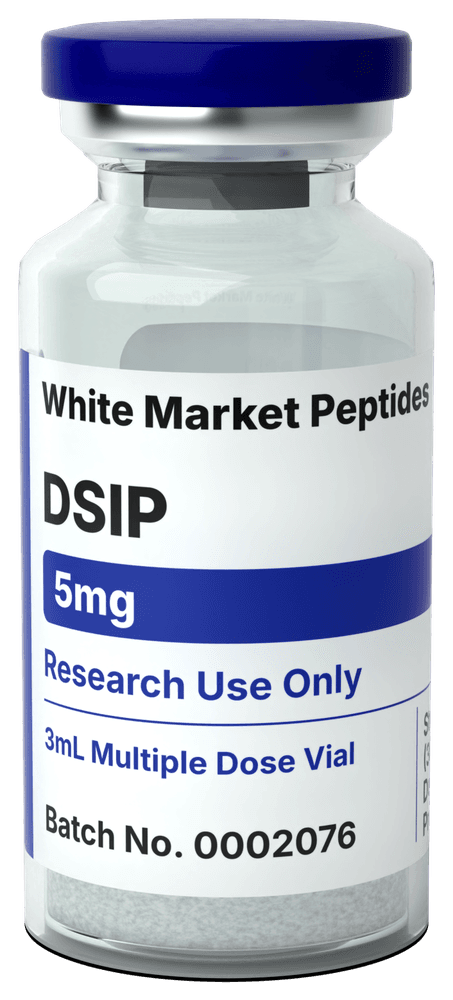
DSIP (Delta Sleep-Inducing Peptide) is a naturally occurring nonapeptide — a nine-amino-acid chain with the sequence Trp-Ala-Gly-Gly-Asp-Ala-Ser-Gly-Glu — first isolated in 1977 from the cerebral venous blood of sleeping rabbits.[1] Originally discovered for its ability to trigger slow-wave (delta) sleep in animals, DSIP has since been studied for a surprisingly broad range of effects: neuroendocrine regulation, withdrawal syndrome relief, neuroprotection, and longevity. This guide covers what DSIP is, what the research actually shows, and what researchers need to know before using it.
Note on research status: DSIP has accumulated more than 500 publications since its discovery, yet its receptor remains unidentified and its precise mechanism of action is still unresolved — making it one of the most-studied and least-understood neuropeptides in the literature. All human studies used intravenous administration; subcutaneous use is extrapolated from animal research.
The Short Answer
DSIP is a naturally occurring nine-amino-acid neuropeptide that promotes delta-wave sleep and modulates the hypothalamic-pituitary-adrenal (HPA) axis. Intravenous DSIP at 25 nmol/kg (≈1.5 mg for a 70 kg person) improved objective sleep parameters in small human trials, with the most rigorous double-blind study showing weak but statistically significant effects on sleep efficiency.[2] Animal studies also document antinociceptive, anticonvulsant, antioxidant, and neuroprotective properties. It is not FDA-approved, has no confirmed receptor, and long-term human safety data are absent.
Key Concepts
Discovery & isolation:
Researchers at the University of Basel (Schoenenberger & Monnier, 1977) perfused rabbit thalami during delta-wave sleep and collected the venous effluent. When injected into awake rabbits, the fraction induced EEG delta-wave activity. The active nonapeptide was sequenced as WAGGDASGE and named Delta Sleep-Inducing Peptide.[1]
Molecular characteristics:
- Sequence: Trp-Ala-Gly-Gly-Asp-Ala-Ser-Gly-Glu (WAGGDASGE)
- Molecular weight: 849 Da
- CAS number: 62568-57-4
- Structure: Structurally unique — no confirmed receptor family
Mechanism of action:
After nearly five decades of research, DSIP's mechanism of action remains genuinely unresolved. The 2006 review by Kovalzon & Strekalova in Journal of Neurochemistry states bluntly: "the link between DSIP and sleep has never been further characterized, in part because of the lack of isolation of the DSIP gene, protein and possible related receptor."[3] What is established:
- No specific receptor identified — unlike most neuropeptides, no DSIP receptor has been cloned or characterized
- BBB penetration: DSIP crosses the blood-brain barrier via both passive diffusion and a high-affinity, saturable transport system[4]
- HPA axis modulation: DSIP levels correlate with cortisol; reduced DSIP-like immunoreactivity is found in Cushing syndrome; elevated levels in suicidal major depression[5]
- Pineal interaction: DSIP modulates pineal N-acetyltransferase activity (the rate-limiting enzyme in melatonin synthesis)[6]
- Opioid receptor activity: Antinociceptive effects in animals are blocked by naloxone, suggesting indirect or direct opioid receptor engagement[7]
- Adrenergic modulation: Proposed as a leading mechanistic hypothesis in the Graf & Kastin review[4]
Human Clinical Evidence
Bottom line: Human evidence is limited, dated (1981–1992), and the best-controlled trial found weak objective effects with no subjective benefit. All published human studies used intravenous administration at 25 nmol/kg; no randomized controlled trials with adequate power have been published.
| Study | Design | N | Key Finding |
|---|---|---|---|
| Schneider-Helmert & Schoenenberger (1981)[8] | Open, IV, 25 nmol/kg | 6 insomniacs | Extended sleep, more REM, no daytime sedation; first hour arousing, sleep effect in second hour |
| Schneider-Helmert et al. (1981) — Lancet[9] | Clinical, IV | Not reported | IV DSIP improves sleep in chronic insomniacs |
| Schneider-Helmert (1984)[10] | Open, IV × 4 injections | Not reported | Cumulative normalization of sleep architecture over 4 doses |
| Bes et al. (1992)[2] | Double-blind, matched-pairs | 16 | Weak but statistically significant improvement in sleep efficiency; no subjective benefit; "not likely to be of major therapeutic benefit" |
| Dick et al. (1984)[11] | Open, IV, 107 patients | 47 alcohol / 60 opiate withdrawal | 87–97% marked improvement in withdrawal symptoms; no controls |
The Bes et al. (1992) double-blind study is the most methodologically rigorous. It used a matched-pairs design with polysomnography across three nights. While sleep efficiency and latency improved statistically vs. placebo, the authors concluded the benefit was clinically weak and that short-term DSIP treatment is "not likely to be of major therapeutic benefit."
Animal & Preclinical Evidence
DSIP has a broader preclinical evidence base than the human data alone suggests. Key findings by domain:
Sleep & EEG: The foundational finding — intraventricular DSIP reliably enhances delta-band (1–4 Hz) EEG activity and sleep spindles in rabbits, rats, and mice. Effects require the precise original sequence; structural analogues are inactive at the same doses.[12]
Pain (antinociception): Intracerebroventricular DSIP produced dose-dependent antinociceptive effects in mice (tail-pinch and hot-plate tests), blocked by naloxone and absent in morphine-tolerant animals — confirming supraspinal opioid-mediated analgesia.[7]
Anticonvulsant: DSIP and its tetrapeptide analogue DSIP(1-4) reduced seizure incidence and severity in rat audiogenic seizure models, and potentiated the anticonvulsant activity of valproate.[13]
Antioxidant: DSIP at 100 µg/kg increased expression of SOD1 and glutathione peroxidase genes during aging, and decreased lipid peroxidation markers in rat liver and brain. Also enhanced antioxidant defense during hypoxia and cold stress in Russian-literature studies.
Neuroprotection / stroke recovery: Intranasal DSIP at 120 µg/kg for 8 days post-focal stroke significantly improved motor performance in rats over 21 days; infarct size was numerically smaller but not statistically significant.[14] The Deltaran formulation (DSIP + glycine) achieved 100% survival in cerebral ischemia vs. 62% in controls.[15]
Longevity & anticancer (Deltaran): Monthly subcutaneous Deltaran (≈100 µg/kg DSIP) in female SHR mice from age 3 months until death extended maximum lifespan 17–24%, reduced spontaneous tumor incidence 2.6-fold (primarily mammary carcinoma and leukemia), and reduced chromosome aberrations in bone marrow 22.6%.[16]
Dosage Reference
Important: All published human research used intravenous administration. Subcutaneous use is extrapolated from animal research and community convention — not established by human clinical trials. The following is for educational reference only.
Published human IV dose: 25 nmol/kg = approximately 1.5 mg for a 70 kg person (25 nmol/kg × 849 g/mol × 70 kg ≈ 1,485 µg). Administered in the afternoon before nighttime sleep; repeated dosing shows cumulative benefit over 3–4 administrations.
Community subcutaneous doses (extrapolated, not validated in humans):
- Starting: 100 mcg subcutaneous once daily, 30–60 minutes before sleep
- Standard: 250–300 mcg subcutaneous once daily, 30–60 minutes before sleep
- Titration: Step up weekly (100 → 150 → 200 mcg) before settling at the 250–300 mcg standard
Reconstitution (5 mg vial): Add 3.0 mL bacteriostatic water → 1.67 mg/mL (1,667 mcg/mL). On a U-100 syringe, 1 unit ≈ 16.7 mcg, so a 250 mcg dose = 15 units / 0.15 mL. See the DSIP 5 mg Dosage Protocol for full syringe units, dosing table, and storage instructions.
Safety Profile
Known side effects from human studies:
- Transient headaches in a small number of patients in the withdrawal study (Dick et al. 1984)[11]
- An initial arousing effect in the first hour post-IV injection, with sleep-promoting effects emerging in the second hour[8]
- No daytime sedation reported in any published human study
- The double-blind Bes et al. (1992) study documented no adverse events[2]
No formal pharmacokinetic or toxicology studies appear in the published literature. The safety profile is characterized only by incidental observations in clinical and animal studies — not by systematic safety-focused assessment.
Contraindications and cautions:
- Pregnancy and lactation: No data; HPA axis and hormonal effects make this precautionary contraindication warranted
- Concurrent opioid use: DSIP shares opioid receptor mechanism; additive CNS/respiratory depression is theoretically possible
- Anticonvulsant therapy (especially valproate): DSIP potentiates valproate in animal models — potential over-medication risk
- U-shaped dose-response curve: Both underdosing and overdosing may produce equivalent or reversed effects[12]
Regulatory status: DSIP is not FDA-approved and is classified as a research chemical in the United States. It is not individually named on the WADA Prohibited List, but WADA's Section S2 catch-all for substances with similar biological effects may apply — athletes should seek written confirmation from their Anti-Doping Organization before use.
Comparison with Related Peptides
| Feature | DSIP | Selank | Epithalon |
|---|---|---|---|
| Sequence length | 9 AA (WAGGDASGE) | 7 AA (tuftsin analogue) | 4 AA (Ala-Glu-Asp-Gly) |
| Primary studied effect | Delta-wave sleep promotion | Anxiolysis, cognitive enhancement | Telomerase activation, sleep/aging |
| Receptor | Unknown — no receptor identified | GABA-A modulation, BDNF upregulation | Telomerase activation |
| Human RCT data | 1 double-blind (Bes 1992); weak effects | Limited; Russian-approved for anxiety | Very limited; Russian-approved for aging |
| BBB penetration | Yes — passive + saturable transport | Yes — nasal administration used | Yes |
| Sleep mechanism | Direct EEG delta-wave enhancement | Indirect — anxiety reduction | Pineal/melatonin modulation |
| Evidence quality | 500+ publications; mechanism unresolved | Moderate; regulatory approval in Russia | Very sparse |
FAQ
Does DSIP actually work for sleep?
In human studies using intravenous administration, DSIP showed objectively measurable but weak improvements in sleep efficiency and onset latency. The best-controlled trial (Bes et al. 1992 double-blind study in 16 insomniacs) found statistically significant effects on polysomnographic parameters but no improvement in subjective sleep quality. The researchers concluded short-term DSIP treatment is "not likely to be of major therapeutic benefit." Earlier uncontrolled studies were more positive but less reliable. Subcutaneous effectiveness in humans is unvalidated.
How does DSIP differ from other sleep supplements like melatonin?
Melatonin directly activates melatonin receptors (MT1/MT2) to signal the circadian system and has extensive clinical trial data. DSIP has no confirmed receptor, works through unknown mechanisms, and has only a handful of human studies. DSIP specifically promotes delta-wave (slow-wave) sleep — the deepest, most physically restorative stage — rather than simply advancing sleep timing as melatonin does. However, melatonin's evidence base is vastly stronger and its safety profile is well-characterized.
What is the correct dose of DSIP?
Published human research used 25 nmol/kg intravenously, equivalent to approximately 1.5 mg for a 70 kg person given DSIP's molecular weight of 849 Da. Community researchers using subcutaneous injection typically extrapolate animal data to arrive at doses of 100–300 mcg per injection, 30–60 minutes before sleep. No peer-reviewed source validates SC dosing or SC bioavailability in humans. See the DSIP 5 mg Dosage Protocol for full reconstitution and dosing guidance.
Is DSIP safe to use?
The safety evidence base is narrow. Published human studies reported only transient headaches and a brief first-hour arousal effect at IV doses. The double-blind Bes et al. (1992) study documented no adverse events. No formal pharmacokinetic or toxicology studies have been published. This means long-term safety is unknown, drug interactions cannot be predicted comprehensively, and individual variation in response is not characterized. People using concurrent opioids or anticonvulsants (especially valproate) should be aware of theoretical interactions.
Is DSIP prohibited in sport?
DSIP is not individually named on the WADA Prohibited List. However, Section S2 (Peptide Hormones, Growth Factors, Related Substances and Mimetics) includes a catch-all for substances with similar chemical structure or biological effect to listed substances. Given DSIP's neuroendocrine and possible HPA axis effects, competitive athletes should obtain written confirmation from their Anti-Doping Organization (ADO) before use rather than assuming it is permitted.
Why has DSIP research stalled?
Despite 500+ publications, DSIP research has not progressed significantly since the 1990s. The primary barrier is the absence of an identified receptor — without a receptor target, it is difficult to design mechanistic studies, screen analogues, or develop drug candidates. DSIP's unique amino acid sequence doesn't resemble any known peptide family, so homology-based receptor identification isn't possible. The peptide also degrades rapidly in vivo, complicating pharmacokinetic studies. These factors combined to shift research focus toward better-characterized sleep peptides.
Related on pep-dose
Sources
- Schoenenberger GA & Monnier M — Proceedings of the National Academy of Sciences (1977)
- Bes F et al. — Neuropsychobiology (1992)
- Kovalzon VM & Strekalova TV — Journal of Neurochemistry (2006)
- Graf MV & Kastin AJ — Peptides (1986)
- Friedman TC et al. — Neuroendocrinology (1994)
- Graf MV & Schoenenberger GA — Journal of Neurochemistry (1987)
- Nakamura H et al. — European Journal of Pharmacology (1988)
- Schneider-Helmert D & Schoenenberger GA — Experientia (1981)
- Schneider-Helmert D et al. — The Lancet (1981)
- Schneider-Helmert D — European Neurology (1984)
- Dick P et al. — European Neurology (1984)
- Graf MV & Kastin AJ — Neuroscience & Biobehavioral Reviews (1984)
- Stanojlović OP et al. — Pharmacology Biochemistry and Behavior (2004)
- Tukhovskaya EA et al. — Molecules (2021)
- Koplik EV et al. — Neuroscience and Behavioral Physiology (2008)
- Popovich IG et al. — Mechanisms of Ageing and Development (2003)