Sexual Health & Tanning
What Is PT-141 (Bremelanotide)?
Sponsored
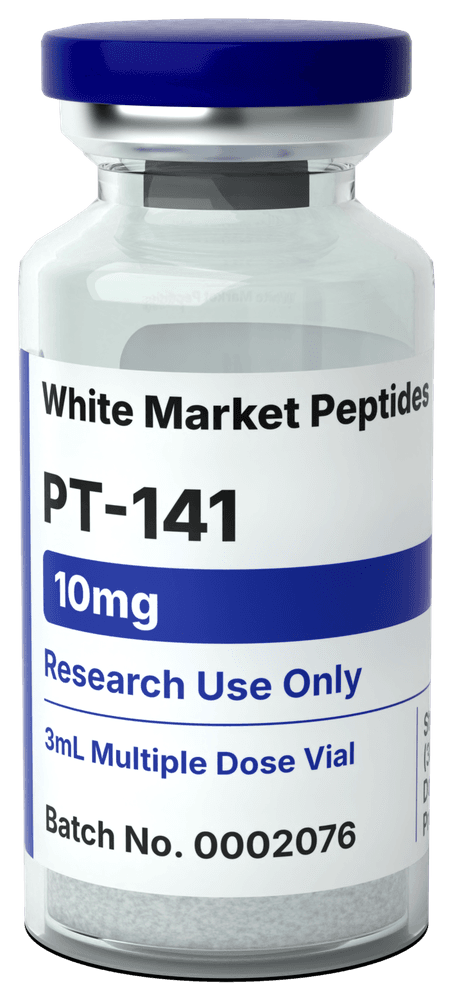
PT-141 (Bremelanotide) is a synthetic cyclic heptapeptide melanocortin receptor agonist — the first peptide approved by the FDA specifically for a disorder of sexual desire. Developed from Melanotan II and approved in 2019 under the brand name Vyleesi, it works through a fundamentally different mechanism than any prior sexual dysfunction treatment: rather than acting on genital blood flow, PT-141 acts centrally in the hypothalamus to increase sexual desire itself.[1] This guide covers the pharmacology, clinical trial data, safety profile, and what researchers need to understand before working with this compound.
Note on research status: PT-141 (Bremelanotide) is FDA-approved as Vyleesi at 1.75 mg subcutaneous for acquired, generalized hypoactive sexual desire disorder (HSDD) in premenopausal women. Research use outside the approved indication — including in men and at titrated doses — is extrapolated from Phase 2 and Phase 3 clinical data. All information here is for educational reference only.
The Short Answer
PT-141 is a melanocortin MC4R agonist that activates dopamine pathways in the hypothalamus to increase sexual desire centrally, independent of the nitric oxide/vascular pathway used by PDE5 inhibitors. In two Phase 3 randomized controlled trials (the RECONNECT studies, n≈1,267 combined), bremelanotide produced statistically significant improvements in sexually satisfying events and desire scores versus placebo in premenopausal women with HSDD, leading to FDA approval in June 2019.[5] The most common side effects are nausea (40%), flushing (20.3%), and injection site reactions (13.2%). It causes transient, clinically relevant blood pressure elevation (peak ≈6 mmHg systolic) that resolves within 12 hours.
Key Concepts
Structure & molecular identity:
PT-141 has the systematic name Ac-Nle-cyclo(Asp-His-D-Phe-Arg-Trp-Lys)-OH. Its cyclic structure was engineered to improve metabolic stability over the linear peptide Melanotan II while reducing the broad pigmentation activity of that parent compound. Molecular weight: 1,025.2 Da. The “cyclic heptapeptide” backbone is the key structural feature that differentiates it from earlier melanocortin peptides.
Molecular characteristics:
- IUPAC name: Ac-Nle-cyclo(Asp-His-D-Phe-Arg-Trp-Lys)-OH
- Molecular weight: 1,025.2 Da
- Brand name (FDA-approved): Vyleesi (Cosette Pharmaceuticals)
- Structure: Synthetic cyclic heptapeptide; melanocortin receptor agonist
- Route: Subcutaneous injection only; autoinjector pen in approved formulation
Mechanism of action:
PT-141 is a non-selective melanocortin receptor agonist with activity at MC1R, MC3R, MC4R, and MC5R, with highest functional relevance at MC4R. MC4R is densely expressed in the medial preoptic area (mPOA) of the hypothalamus — a region with established roles in sexual motivation. MC4R activation in the mPOA triggers dopamine release in the nucleus accumbens, the brain’s primary reward centre.[3] The resulting increase in mesolimbic dopaminergic tone is associated with increased sexual motivation and desire. Crucially, this mechanism is entirely central and independent of the peripheral nitric oxide / cGMP pathway that PDE5 inhibitors target — explaining why PT-141 can increase desire in both sexes and does not require sexual stimulation to be physiologically active.
Human Clinical Evidence
Bottom line: Two Phase 3 RCTs in premenopausal women with HSDD demonstrated statistically significant but modest effect sizes for bremelanotide versus placebo on the co-primary endpoints of sexually satisfying events and desire. An independent re-analysis noted that effect sizes were small and that the clinical significance of the improvements may be limited for individual patients.[4]
| Study | Design | N | Key Finding |
|---|---|---|---|
| Clayton et al. (2016) — RECONNECT[6] | Phase 2b/3 RCT, 24 weeks, 1.75 mg SC PRN | 327 premenopausal women with HSDD | Significant improvement in desire domain of FSFI; foundation for Phase 3 design |
| Portman et al. (2019)[5] | Phase 3 RCT (RECONNECT 301), 24 weeks, 1.75 mg SC PRN | 500 premenopausal women with HSDD | Significant improvement in SSE frequency and FSDS-DAO desire subscale vs. placebo; FDA approval basis |
| Dhillon & Keam (2019)[1] | Regulatory review, Phase 2–3 pooled data | ~1,267 across trials | First FDA approval review; confirmed safety and efficacy profile across both pivotal trials |
| Edinoff et al. (2022)[2] | Narrative review of clinical programme | Pooled | Comprehensive review of mechanism, clinical data, safety; confirms nausea (40%) as primary tolerability limitation |
| Spielmans & Ellefson (2024)[4] | Independent re-analysis of Phase 3 effect sizes | Pooled Phase 3 | Effect sizes characterised as small; questions clinical significance of mean improvements for individual patients |
The Portman et al. (2019) Phase 3 RECONNECT trial is the pivotal dataset. Co-primary endpoints were: (1) change from baseline in the number of sexually satisfying events (SSEs) over 4 weeks, and (2) change in the Female Sexual Distress Scale-Desire/Arousal/Orgasm (FSDS-DAO) item 13 desire score. Both reached statistical significance. A secondary endpoint, the Female Sexual Function Index (FSFI) desire domain, also showed significant improvement. The independent re-analysis by Spielmans & Ellefson (2024) noted that while statistically significant, mean improvements translated to modest clinical effect sizes, and individual patient responses were highly variable.
How PT-141 Works
The melanocortin system evolved primarily to regulate energy balance, pigmentation, and stress responses via five receptor subtypes (MC1R–MC5R). PT-141’s therapeutic relevance arises specifically from MC4R activity in the hypothalamus. Pfaus et al. (2022) provide the most detailed mechanistic review: MC4R activation in the mPOA disinhibits dopaminergic neurons that project to the nucleus accumbens, shifting the motivational state toward sexual pursuit.[3]
Key mechanistic distinctions:
- Central vs. peripheral: PT-141 crosses the blood-brain barrier and acts in the CNS. PDE5 inhibitors (sildenafil, tadalafil) act peripherally in genital vasculature and require sexual stimulation to produce effects.
- Desire vs. mechanics: PT-141 addresses the motivational/desire component of sexual function. PDE5 inhibitors address the mechanical execution (penile erection or vaginal engorgement) but do not increase desire.
- MC4R vs. nitric oxide: The two pharmacological targets are anatomically and biochemically independent, which is why PT-141 can produce additive effects when combined with PDE5 inhibitors in research contexts and explains its efficacy in female HSDD where PDE5 inhibitors have failed.
- Sex-agnostic mechanism: MC4R is present in the mPOA of both sexes. Animal studies demonstrate equivalent MC4R-mediated sexual motivation increases in males and females, consistent with Phase 2 clinical data showing effects in men with erectile dysfunction not responding to PDE5 inhibitors.
Safety Profile
Side effects from Phase 3 trials (n≈1,267):
- Nausea: 40.0% (most common; usually mild-moderate; onset within 1 hour, resolves within 12 hours)
- Flushing: 20.3%
- Injection site reactions: 13.2% (bruising, pain, discomfort)
- Headache: 11.3%
- Vomiting: 4.8%
Blood pressure: Transient, mean systolic BP increase of ≈6 mmHg (peak at 2–4 hours post-dose; fully resolved within 12 hours). This is clinically significant enough that cardiovascular disease and uncontrolled hypertension are formal contraindications. A BP measurement above 130/80 mmHg prior to dosing is a contraindication per prescribing information.[1]
Focal hyperpigmentation: Occurs in approximately 1% of patients with on-demand (PRN) dosing at 1.75 mg. Rates climbed to 38% in studies using daily dosing regimens, confirming that the hyperpigmentation effect is dose- and frequency-dependent and strongly tied to MC1R (melanocyte-stimulating) activity at cumulative exposures.[2]
Gastric emptying: PT-141 slows gastric motility, which reduces the oral bioavailability of co-administered drugs. Notably, oral naltrexone bioavailability is reduced when taken within 8 hours of PT-141 dosing — a clinically important interaction for patients on naltrexone-based therapies.
Contraindications:
- Uncontrolled hypertension or cardiovascular disease
- Pre-dose BP > 130/80 mmHg
- High cardiovascular risk (consider absolute contraindication)
Regulatory status: PT-141 is FDA-approved as Vyleesi at 1.75 mg SC for acquired, generalized HSDD in premenopausal women. Research use at other doses or in other populations is outside the approved indication. It is not WADA-listed individually, but the melanocortin system’s interaction with energy metabolism and the MC1R/MC4R pathway means classification under Section S4 (Hormone and Metabolic Modulators) or S2 is theoretically possible — competitive athletes should confirm status with their Anti-Doping Organization.
Dosage Reference
Important: The FDA-approved dose is 1.75 mg SC on demand, no more than once per 24 hours, maximum 8 doses per month. Research titration protocols starting at lower doses (500 mcg) are derived from Phase 2 dose-ranging data and are not FDA-approved dosing regimens. The following is for educational reference only.
FDA-approved Vyleesi dose: 1.75 mg SC at least 45 minutes before anticipated sexual activity. Do not administer more than once in 24 hours or more than 8 times per month.
Research titration approach (from Phase 2 dose-ranging; extrapolated, not FDA-approved):
- Weeks 1–4 (tolerance phase): 500 mcg SC, injected 30–45 min before activity
- Weeks 5–8: 1,000 mcg SC, same timing
- Weeks 9–12: 1,500 mcg SC, same timing
- Reference FDA dose: 1,750 mcg SC (the approved Vyleesi regimen)
Reconstitution (10 mg vial): Add 3.0 mL bacteriostatic water → 3.33 mg/mL (3,333 mcg/mL). On a U-100 syringe, 1 unit = 0.01 mL = 33.3 mcg. See the PT-141 10 mg Dosage Protocol for full syringe units, dosing table, and storage instructions.
Comparison: PT-141 vs. Melanotan II vs. PDE5 Inhibitors
| Feature | PT-141 (Bremelanotide) | Melanotan II | PDE5 Inhibitors (Viagra / Cialis) |
|---|---|---|---|
| Structure | Cyclic heptapeptide; 1,025 Da | Cyclic heptapeptide; 1,024 Da (parent compound) | Small molecules; 474–516 Da |
| Primary target | MC4R (hypothalamus, mPOA) | MC1R, MC3R, MC4R, MC5R (broad) | PDE5 enzyme (genital vasculature) |
| Primary effect | Increased sexual desire / motivation (central) | Tanning (MC1R) + sexual effects (MC4R) | Increased genital blood flow (peripheral) |
| FDA approval | Yes — Vyleesi (2019) for female HSDD | No — not approved in any jurisdiction | Yes — sildenafil/tadalafil for ED |
| Works in women | Yes — primary approved indication | Studied but not approved | Not approved for female sexual dysfunction |
| Mechanism vs. desire | Increases desire directly via dopamine | Increases desire via MC4R (same pathway) | Does not increase desire; requires arousal |
| Tanning effect | Minimal at PRN dosing (1% hyperpigmentation) | Prominent; intended as primary effect | None |
| BP effect | Transient elevation (≈+6 mmHg systolic) | Similar transient elevation | Hypotensive; contraindicated with nitrates |
| Safety characterisation | Phase 3 data (n≈1,267); FDA-reviewed | No RCT data; uncharacterised safety profile | Extensive post-marketing data; well characterised |
| Drug interactions | Slows gastric emptying; reduces naltrexone absorption | Unknown; likely similar | Nitrates (absolute contraindication); CYP3A4 inhibitors; grapefruit |
FAQ
Is PT-141 the same as Melanotan II?
PT-141 was developed directly from Melanotan II (MT-II) by researchers at the University of Arizona who were exploring the sexual side effects observed during MT-II tanning trials. Both are cyclic heptapeptides and share significant structural homology, but they are not the same compound. Key differences: PT-141 was engineered to reduce MC1R tanning activity while retaining MC4R sexual function activity; MT-II is more promiscuous across all five melanocortin receptor subtypes. PT-141 has undergone full Phase 3 clinical trials and received FDA approval; MT-II has no approved formulation and no published RCT data. For research purposes, PT-141’s better-characterised safety profile, known Phase 3 dose-response data, and regulatory history make it the more tractable compound.
How is PT-141 different from Viagra or Cialis?
PT-141 and PDE5 inhibitors (sildenafil/Viagra, tadalafil/Cialis) work through entirely different mechanisms. PDE5 inhibitors block the enzyme that degrades cGMP in vascular smooth muscle, increasing blood flow to the genitals in response to sexual stimulation — they enhance the physical mechanics of the sexual response but require desire and arousal to already be present. PT-141 acts centrally in the hypothalamus to increase sexual desire and motivation via MC4R-mediated dopamine release. It can be effective in people who have intact vascular function but impaired desire, and it works in both men and women. Additionally, PDE5 inhibitors are contraindicated with nitrates (risk of severe hypotension) and interact with grapefruit via CYP3A4; PT-141 has neither of these interactions, though it produces its own transient blood pressure elevation and should not be used in uncontrolled hypertension.
Does PT-141 work for men?
Phase 2 clinical data showed that PT-141 produced dose-dependent improvement in erectile function in men with erectile dysfunction, including some who had not responded adequately to PDE5 inhibitors, consistent with its central MC4R mechanism. However, the FDA-approved indication is specifically for acquired, generalized HSDD in premenopausal women. The Phase 3 pivotal trials that supported approval enrolled only premenopausal women. Research use in men is extrapolated from Phase 2 data, animal studies, and the mechanism of action; it is not supported by Phase 3 RCT evidence in male populations.
How long does PT-141 take to work?
The FDA-approved prescribing information recommends administration at least 45 minutes before anticipated sexual activity. Pharmacokinetic data show that maximum plasma concentration (Tmax) is reached at approximately 1 hour after subcutaneous injection, with a half-life of approximately 2.7 hours. Subjective onset of effects in clinical trials was typically reported within 45–75 minutes. Effects may persist for several hours beyond Tmax given the downstream dopaminergic mechanism. Most adverse effects (nausea, flushing) also occur in this same 1–3 hour post-dose window and resolve within 12 hours.
What is the most common side effect of PT-141?
Nausea is the most common side effect, occurring in approximately 40% of participants in Phase 3 trials. It is typically described as mild to moderate in severity, onset within 1 hour of dosing, and self-limiting within 12 hours. In trials, pre-treatment with antiemetics (ondansetron) significantly reduced nausea incidence and was incorporated into some research protocols. Flushing (20.3%) and injection site reactions (13.2%) are the next most frequent. Vomiting occurs in approximately 4.8% of users. These rates were observed at the FDA-approved 1.75 mg dose; lower research titration doses (500–1,000 mcg) are expected to produce reduced incidence and severity.
Is PT-141 FDA approved?
Yes. Bremelanotide was approved by the FDA in June 2019 under the brand name Vyleesi (Cosette Pharmaceuticals) for the treatment of acquired, generalized hypoactive sexual desire disorder (HSDD) in premenopausal women. It was the first on-demand pharmacological treatment approved for HSDD and the first melanocortin-based drug to receive FDA approval. The approved formulation is a 1.75 mg/0.3 mL solution in a single-dose autoinjector. Its approval was notable for being the first FDA-approved HSDD treatment with an on-demand (rather than daily) dosing schedule.[1]
Next Steps
For reconstitution math and per-injection syringe units, see the PT-141 10 mg Dosage Protocol. If you are comparing PT-141 to other melanocortin peptides, see the Melanotan II article.