Sexual Health & Tanning
What Is Melanotan II?
Sponsored
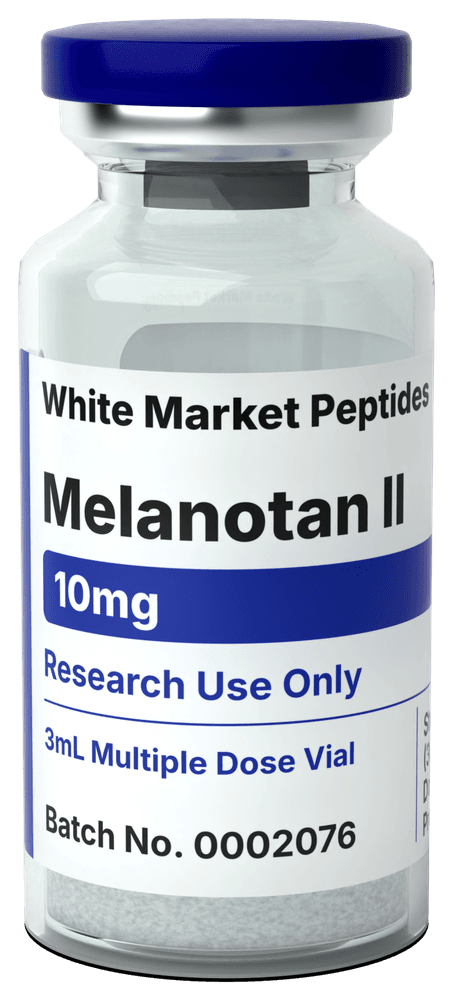
Melanotan II (MT-II) is a synthetic cyclic heptapeptide analog of α-melanocyte-stimulating hormone (α-MSH) developed at the University of Arizona in the 1980s. Unlike sunlight-dependent tanning, MT-II stimulates melanin synthesis directly by activating melanocortin receptors — producing pigmentation without ultraviolet (UV) exposure. Researchers have also studied it for erectile dysfunction, female sexual dysfunction, and appetite suppression. Because MT-II activates multiple receptor subtypes non-selectively, it carries a notably broader side-effect profile than related compounds such as PT-141 (bremelanotide).[1][2]
Important notice: Melanotan II is not approved by the FDA, EMA, or any major regulatory authority for any human use. It is a research compound only. This article discusses published scientific literature for educational purposes. The safety risks are significant and are described in full below — including documented cases of rhabdomyolysis and renal infarction. Do not use without qualified supervision. Seek medical advice before considering any peptide protocol.
The Short Answer
Melanotan II is a laboratory-synthesised peptide that mimics α-MSH, a naturally occurring hormone that regulates skin pigmentation, sexual function, and appetite. It activates four of the five melanocortin receptor subtypes (MC1R, MC3R, MC4R, MC5R), making it broadly active and correspondingly broad in its side effects. Research use cases include photoprotective tanning, erectile dysfunction, female sexual dysfunction, and metabolic modulation. Its narrow safety window — therapeutic effects at doses below 1 mg and serious toxicity documented at 6 mg — requires careful, incremental dosing.
Key Concepts
- Class: Synthetic cyclic heptapeptide analog of α-melanocyte-stimulating hormone (α-MSH)
- Sequence: Ac-Nle4-cyclo[Asp5-His6-D-Phe7-Arg8-Trp9-Lys10]-NH2
- Molecular weight: ≈1,024 Da
- Origin: Developed at the University of Arizona, 1980s
- Regulatory status: Not approved by FDA, EMA, or any major regulator
- Receptor profile: Non-selective MC1R / MC3R / MC4R / MC5R agonist
- Administration: Subcutaneous injection (SC)
- Safety ceiling: Do not exceed 2 mg per day — serious toxicity documented at 6 mg
Research Evidence
| Research Domain | Key Finding | Source |
|---|---|---|
| Erectile dysfunction | Double-blind crossover (n = 20 men with organic ED); 0.025 mg/kg SC → spontaneous erections in 17/20 men; mean 41-min rigidity >80%; increased sexual desire in 13/19 active doses vs 4/21 placebo (P < 0.01); nausea and yawning common | Wessells et al. (2000)[1] |
| Melanogenesis / tanning | Visible skin pigmentation after 5–10 daily injections; pigmentation enhanced and prolonged by UV exposure; tanning persists beyond the dosing period | Hadley & Dorr (2006)[2] |
| Sexual dysfunction — female | MC4R activation associated with central arousal pathways; PT-141 (a closely related compound) shows similar mechanism; MT-II studied in animal and early human models | Ückert et al. (2014)[3] |
| Rhabdomyolysis (toxicity) | Case report: CPK 17,773 IU/L following 6 mg injection; confirmed rhabdomyolysis; highlights narrow safety ceiling | Nelson et al. (2012)[4] |
| Renal infarction (toxicity) | Case report: renal infarction temporally associated with MT-II use; mechanism not fully established; underscores vascular risk | Peters et al. (2020)[5] |
| Melanocytic proliferation | Acral melanocytic proliferations (mole darkening / irregularity) reported in users; theoretical melanoma promotion risk | Langan et al. (2020)[6] |
How Melanotan II Works
MT-II is a cyclic, α-MSH analog stabilised by an internal lactam bridge, giving it greater metabolic stability and potency than native α-MSH. It acts as a non-selective agonist at four of five melanocortin receptor subtypes:[2]
- MC1R — Located on melanocytes in skin and hair follicles. Activation drives the synthesis of eumelanin (brown–black pigment), producing visible skin darkening without requiring UV radiation. UV exposure is not required but does enhance and prolong the effect.
- MC4R — Located in the hypothalamus and limbic system. Activation produces central sexual arousal, spontaneous erections (in men), and appetite suppression. This is the receptor responsible for the sexual side effects observed in tanning research — and the primary target of PT-141 (bremelanotide).
- MC3R — Expressed in the brain, gut, and immune tissue. Associated with energy homeostasis and anti-inflammatory signalling. The role of MC3R activation in MT-II’s effects is less well-characterised than MC1R and MC4R.
- MC5R — Expressed in exocrine glands, immune cells, and other peripheral tissues. Contributes to sebaceous gland function and immune modulation; less studied in the context of MT-II research.
Because MT-II activates all four of these receptors without selectivity, it produces effects across pigmentation, sexual arousal, appetite, and autonomic regulation simultaneously. This promiscuous receptor profile is why it produces a wider side-effect burden than selective analogs such as PT-141, which primarily targets MC4R.[3]
Safety Profile
MT-II has a narrow therapeutic window. The following adverse effects have been documented at research doses; the serious reactions at supratherapeutic doses underscore the importance of strict dose discipline.
Common Side Effects
- Nausea — The most frequently reported adverse effect; most pronounced with the first several injections and tends to attenuate with continued use. Worst at doses ≥500 mcg. Some researchers pre-treat with anti-emetics.
- Facial flushing and skin warmth — Peripheral vasodilation mediated by melanocortin receptors.
- Spontaneous erections — Expected pharmacology via MC4R. In the tanning context this is an unwanted side effect; in sexual dysfunction research it is the primary endpoint.
- Increased libido — Central MC4R activation; may be unwanted outside sexual dysfunction protocols.
- Reduced appetite — Hypothalamic MC4R activation; relevant to metabolic research but may cause unintended weight loss in other contexts.
- Yawning — Reported in clinical studies; mechanism unclear but may relate to hypothalamic or brainstem pathways.
Serious Adverse Events
- Rhabdomyolysis — A case report documented CPK of 17,773 IU/L (reference: <200 IU/L) following a single 6 mg injection, consistent with severe rhabdomyolysis. This represents a dose approximately 6× the upper research ceiling of ≤1,000 mcg/day and well above the absolute safety ceiling of 2,000 mcg. Do not exceed 2,000 mcg per day under any circumstances.[4]
- Sympathomimetic toxicity — At high doses, tachycardia, hypertension, and diaphoresis have been observed, consistent with adrenergic activation.
- Renal infarction — One case report documents renal infarction temporally associated with MT-II use; the vasoconstrictor properties of melanocortin agonists may contribute to vascular events.[5]
Melanoma and Mole Risk
This is among the most important safety concerns for MT-II research. MC1R activation drives proliferation and melanin production in melanocytes. Case-series data document darkening and increased irregularity of existing naevi (moles) in MT-II users, classified as acral melanocytic proliferations.[6] While a direct causal link to melanoma initiation in humans has not been established, the theoretical risk is real and clinically relevant:
- Do not use MT-II if you have a personal or family history of melanoma.
- Do not use MT-II if you have dysplastic naevi (atypical moles).
- Any new or changing mole during or after MT-II use warrants prompt dermatological review.
- Researchers with fair skin (Fitzpatrick types I–II), red or blonde hair, or multiple atypical naevi are at elevated baseline melanoma risk and should treat MT-II as contraindicated.
Contraindications
- Hypertension or cardiovascular disease (sympathomimetic effects)
- Personal or family history of melanoma
- Dysplastic naevi syndrome
- Pregnancy or breastfeeding
- Renal or hepatic impairment (limited pharmacokinetic data)
Dosage Reference
Detailed reconstitution instructions, dosing tables, and unit-to-volume calculations for MT-II are covered in the dedicated protocol page. The general framework is a low-dose loading phase to assess tolerance, followed by maintenance dosing 1–2× per week once the desired pigmentation level is reached.
- Starting dose: 250 mcg once daily (tolerance assessment)
- Loading target: 1,000 mcg once daily (not before Week 4)
- Maintenance: 500–1,000 mcg, 1–2× per week
- Safety ceiling: 2,000 mcg per day absolute maximum — never exceed
- Reconstituted stability: 1–2 weeks at 2–8 °C (shorter than most peptides — note carefully)
For complete step-by-step guidance, see the Melanotan II (10 mg Vial) Dosage Protocol.
Comparison: Melanotan II vs PT-141 vs α-MSH
| Property | Melanotan II (MT-II) | PT-141 (Bremelanotide) | α-MSH (Native) |
|---|---|---|---|
| Receptor selectivity | MC1R, MC3R, MC4R, MC5R (non-selective) | Primarily MC4R / MC3R | MC1R–MC5R (all subtypes) |
| Primary research use | Tanning, ED, female sexual dysfunction, appetite | Female & male sexual dysfunction | Physiological melanogenesis & energy regulation |
| Tanning effect | Strong (MC1R-mediated melanogenesis) | Minimal / not primary use | Yes (endogenous process) |
| Approved? | No — research only | Yes (FDA-approved as Vyleesi®, 2019, for HSDD in premenopausal women) | Endogenous — not a pharmaceutical |
| Half-life / stability | Relatively long (cyclic structure); reconstituted vial: 1–2 weeks | Moderate; longer than native α-MSH | Very short (<10 min plasma half-life) |
| Common side effects | Nausea, flushing, spontaneous erections, appetite suppression, yawning | Nausea, flushing, transient hyperpigmentation | Not applicable (endogenous regulation) |
| Melanoma risk concern | Yes — mole proliferation documented; avoid in high-risk individuals | Lower — less MC1R activity; FDA labelling includes hyperpigmentation warning | Physiological — not a standalone risk factor |
| MW | ≈1,024 Da | ≈1,025 Da | ≈1,665 Da (full 13-AA chain) |
FAQ
Does Melanotan II cause a real tan?
Yes, MT-II produces genuine melanogenesis by activating MC1R on melanocytes, triggering eumelanin (brown–black pigment) synthesis. Visible pigmentation typically appears after 5–10 daily injections. UV exposure is not required to initiate tanning, but it does enhance and prolong the pigmentation response. The tan can persist for weeks after discontinuing injections.
What is the difference between Melanotan I and Melanotan II?
Melanotan I (afamelanotide) is a linear α-MSH analog that targets primarily MC1R and was developed specifically for tanning and photoprotection. It has received regulatory approval in Europe (as Scenesse®) for erythropoietic protoporphyria. Melanotan II is a cyclic analog that activates MC1R, MC3R, MC4R, and MC5R non-selectively — producing tanning alongside sexual arousal and appetite effects due to its MC4R activity. MT-II has broader effects, a higher side-effect burden, and is not approved anywhere.
Is Melanotan II the same as PT-141?
No, though they are closely related. PT-141 (bremelanotide) is a metabolite of MT-II that arose during its development and was found to preferentially activate MC4R and MC3R, producing sexual arousal with less MC1R-driven tanning. PT-141 was subsequently developed into Vyleesi®, FDA-approved in 2019 for hypoactive sexual desire disorder (HSDD) in premenopausal women. MT-II activates four receptor subtypes and is not approved for any use.
What are the biggest safety concerns with Melanotan II?
The most serious documented risks are rhabdomyolysis (severe muscle breakdown with CPK >17,000 IU/L reported at 6 mg), renal infarction, and cardiovascular/sympathomimetic effects including tachycardia and hypertension. At standard research doses, nausea, flushing, spontaneous erections, increased libido, and appetite suppression are common. The absolute safety ceiling is 2,000 mcg (2 mg) per day. Contraindications include hypertension, cardiovascular disease, personal or family history of melanoma, and dysplastic naevi syndrome.
Does Melanotan II cause cancer?
A direct causal link to melanoma in humans has not been established in controlled studies. However, MC1R activation drives melanocyte proliferation, and case-series data document darkening and irregularity of existing naevi (moles) in MT-II users — a pattern consistent with melanocytic stimulation. The theoretical risk of promoting dormant or pre-cancerous melanocytic lesions is considered real and clinically important. MT-II is contraindicated in anyone with a personal or family history of melanoma or with dysplastic naevi. New or changing moles in users should be evaluated promptly by a dermatologist.
How long does it take for Melanotan II to start working for tanning?
Most research subjects and case reports describe visible skin darkening after approximately 5–10 daily injections during a loading phase. The speed and degree of response depend on baseline skin type (Fitzpatrick phototype), with darker baseline types (III–IV) responding more visibly. UV exposure is not required to initiate pigmentation but enhances and deepens the response. Once pigmentation is established, maintenance doses of 1–2 injections per week are typically used to sustain it.