Growth Hormone & Anti-Aging
What Is Ipamorelin?
Sponsored
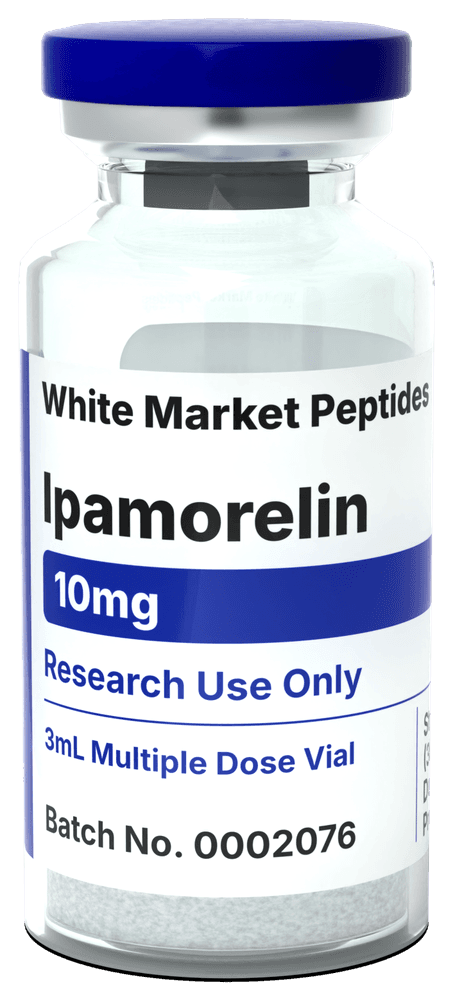
Ipamorelin (sometimes listed as NNC 26‑0161) is a selective growth hormone secretagogue (GHS). It binds the ghrelin receptor (GHSR‑1a) to trigger pulsatile GH release, and in preclinical models it barely touches ACTH or cortisol. What follows: a short answer, a properties table, the mechanism, research-handling steps, how it compares to similar peptides, a checklist, and FAQs. (PubMed)
The Short Answer
Ipamorelin is a pentapeptide ghrelin‑receptor agonist that selectively stimulates pulsatile growth hormone (GH) release without measurably raising ACTH/cortisol in animal models, and produces a short‑acting GH pulse in humans (peak ≈ 40 minutes; peptide t½ ≈ 2 hours). It pushes GH output through GHSR‑1a and works alongside the GHRH pathway. Educational use only. (PubMed)
| Property | Detail |
|---|---|
| Aliases / Synonyms | Ipamorelin; NNC 26‑0161; UNII: Y9M3S784Z6 |
| Family / Pathway | Ghrelin receptor (GHSR‑1a) agonist; growth hormone secretagogue (GHS) |
| Sequence (AA) | Aib–His–D‑2‑Nal–D‑Phe–Lys–NH₂ (pentapeptide) |
| Molecular Weight (Da) | ~711.9 |
| CAS | 170851‑70‑4 |
| Typical Diluent(s) (educational) | Bacteriostatic Water for Injection, USP (sterile water with 0.9–1.1% benzyl alcohol; multi‑dose). Use per lab SOPs. |
| Example Concentration(s) (educational) | Reconstitute 10 mg vial with 3.0 mL → 3.33 mg/mL; 5 mg with 1.5 mL → 3.33 mg/mL (math example; not medical dosing). |
| Storage (lyophilized / after reconstitution) | Lyophilized peptides often stored at ≤ −20 °C protected from light; solutions are less stable. Short‑term 2–8 °C; for longer storage, freeze aliquots per SOPs to avoid freeze–thaw cycles. |
Sources: chemical identity from PubChem/DrugBank; diluent identity from DailyMed (USP); general peptide stability practices from peer‑reviewed reviews on peptide stability. (PubChem)
Key Concepts
What is Ipamorelin, precisely? Ipamorelin is a selective GHS that activates GHSR‑1a (the ghrelin receptor) to induce GH release while sparing other pituitary axes (ACTH/cortisol) in animal models. Early pharmacology work benchmarked this selectivity against GHRP‑6 and GHRP‑2. Only ipamorelin avoided ACTH/cortisol elevations even at very high doses in swine. (PubMed)
How does Ipamorelin generate a GH "pulse"? In healthy volunteers, short infusions produced a single GH episode peaking around 0.67 hours (~40 minutes) with a peptide terminal half‑life near 2 hours. That's a brief, physiologic-like pulse that returns to baseline, which is why research protocols tend to time it around GH's natural pulsatility. (PubMed)
Where does GHSR‑1a fit in GH physiology? GHSR‑1a is a GPCR found in pituitary somatotrophs and hypothalamic circuits. Endogenous ghrelin raises GH two ways: it works with GHRH, and it counters somatostatin's inhibitory tone. So GHSs add to physiologic pulsatility instead of replacing it. Ipamorelin acts on the same receptor. (PMC)
Why timing matters. In adults, 60–70% of daily GH secretion clusters after sleep onset with slow‑wave sleep, so researchers sometimes schedule a short‑acting GHS at times that don't blunt natural nocturnal pulses (educational perspective). The point in a research design is to work with those rhythms, not flatten them. (JAMA Network)
Selectivity vs. older GHRPs. Classic GHRPs (e.g., GHRP‑6, hexarelin) can raise ACTH, cortisol, and prolactin, especially with intravenous or high exposure. Ipamorelin showed minimal ACTH/cortisol effects in animal tests at doses >200× its GH ED50. That difference matters when you're trying to read endocrine "side‑signal" noise in an experiment. (OUP Academic)
The practical takeaway. GHRP‑6 hits GH and spills over into other neuroendocrine signals. Ipamorelin produces brief, focused GH pulses with less off‑target pituitary noise. That distinction usually gets flattened in "all GHSs are the same" blog summaries, and it's worth keeping straight. (PubMed)
How to Use
Note: For research use only. Follow your institution's SOPs, the product's COA, and applicable regulations. The steps below are educational and not medical advice.
1) Verify identity & integrity
Confirm peptide name, lot, mass, and purity on the COA; inspect the lyophilized cake and vial seals. Cross‑check identifiers (CAS 170851‑70‑4, UNII Y9M3S784Z6). (PubChem)
2) Plan concentration math
Decide on an educational working concentration before opening the vial. Example: 10 mg + 3.0 mL → 3.33 mg/mL (or 5 mg + 1.5 mL → 3.33 mg/mL). Keep the math separate from any hypothetical dosing discussions.
3) Choose an appropriate diluent (per SOP)
For many injectable research formats, labs use Bacteriostatic Water for Injection, USP (sterile water plus 0.9–1.1% benzyl alcohol preservative) as a multi‑dose diluent. Validate compatibility with your application and SOP; do not use bacteriostatic diluents in neonates. (DailyMed)
4) Reconstitute carefully
Warm vial/diluent to room temperature; swab stoppers; inject diluent gently along the glass wall; swirl (avoid foaming). Don't shake vigorously. Peptide solutions can aggregate under stress. (PMC)
5) Label clearly
Record compound, lot, concentration, diluent, date/time of reconstitution, and storage conditions. Maintain chain‑of‑custody and usage logs per QA.
6) Store to keep it stable
General educational guidance from peer‑reviewed peptide‑stability literature: lyophilized peptides are typically stable at ≤ −20 °C protected from light. Solutions degrade faster. Use 2–8 °C short‑term, and freeze aliquots (≤ −20/−80 °C) to limit freeze–thaw cycles when longer storage is required. Your SOP governs specifics. (PMC)
7) Dispose responsibly
Follow hazardous waste and bio‑safety procedures. Document disposal in your lab's records.
Comparison / Alternatives
Bottom line: Ipamorelin is the most selective GH‑centric secretagogue among first‑generation GHRPs tested preclinically, producing brief, targeted GH pulses in humans. Longer‑acting options (e.g., CJC‑1295) change the timing of GH/IGF‑1 exposure, while oral MK‑677 (ibutamoren) increases 24‑h GH/IGF‑1 with appetite and mild metabolic effects reported. (PubMed)
| Feature | Ipamorelin | GHRP‑6 / GHRP‑2 | CJC‑1295 (DAC) | MK‑677 (Ibutamoren) |
|---|---|---|---|---|
| Class / Target | GHS; GHSR‑1a agonist | GHS; GHSR‑1a agonists | GHRH analogue (long‑acting) | Oral GHS mimetic |
| GH Profile | Short, pulse‑like GH burst; peak ≈ 0.67 h | Pulsatile; often broader endocrine signal | Sustained GH/IGF‑1 elevation days–weeks | Elevated 24‑h GH/IGF‑1 over months |
| Selectivity (ACTH/cortisol) | Minimal ACTH/cortisol in animal tests, even at high doses | Often increases ACTH/cortisol & prolactin (esp. IV/high dose) | GH‑centric (via GHRH receptor) | Cortisol ↑ modestly; appetite ↑ |
| Approx. Half‑life | ~2 h (peptide t½) | Short | ~6–9 days (effective t½) | Oral daily; long PD |
| Notable Considerations | Targeted GH pulse; selective profile | Appetite stimulation common; broader pituitary effects | Long persistence; align with study aims | ↑ FFM but also ↑ weight; glucose/insulin sensitivity shifts in older adults |
| Key Evidence | Selectivity (animal); PK/PD in humans | Endocrine spillover (ACTH/PRL) | Human PK/PD and IGF‑1 dynamics | 12‑month RCT in older adults |
Sources: Ipamorelin selectivity and human PK/PD; GHRP endocrine effects; CJC‑1295 half‑life; MK‑677 effects. (PubMed)
Quick Reference
Copy‑ready Research Checklist (educational)
- Confirm compound identity (ipamorelin; CAS 170851‑70‑4; UNII Y9M3S784Z6) and inspect packaging. (PubChem)
- Align study aims with GH pulsatility (short pulse vs. sustained exposure). (JAMA Network)
- Select a diluent that matches SOPs (e.g., Bacteriostatic Water for Injection, USP, multi‑dose). (DailyMed)
- Plan a target concentration (e.g., 10 mg in 3.0 mL → 3.33 mg/mL) and document calculations.
- Reconstitute gently; avoid foaming/shaking; mix patiently to limit aggregation. (PMC)
- Label vial with compound, lot, concentration, diluent, date/time, storage.
- Store lyophilized at ≤ −20 °C (protected from light); use 2–8 °C short‑term for solutions; freeze aliquots to minimize freeze–thaw. (PMC)
- Monitor any co‑measured endocrine endpoints (e.g., ACTH/cortisol) when comparing different GHSs. (OUP Academic)
- Record usage, stability observations, and disposal per QA requirements.
FAQ
What is Ipamorelin?
Ipamorelin is a selective growth hormone secretagogue that activates the ghrelin receptor (GHSR‑1a) to produce a brief, physiologic‑like GH pulse. It is a pentapeptide (Aib‑His‑D‑2‑Nal‑D‑Phe‑Lys‑NH₂) developed to maximize GH selectivity relative to older GHRPs. Educational use only. (PMC)
How long does Ipamorelin last?
Ipamorelin's GH effect in humans peaks at ~0.67 hours (~40 minutes) with a peptide half‑life of ~2 hours, based on infusion PK/PD modeling. The GH rise is episodic and declines back to baseline thereafter. (PubMed)
Does Ipamorelin affect cortisol or prolactin like GHRP‑6?
Ipamorelin did not increase ACTH/cortisol above GHRH‑like levels in animal studies even at >200× its GH ED50, whereas GHRP‑6 and related agents can raise ACTH/cortisol and prolactin depending on exposure and route. (PubMed)
Can Ipamorelin be combined with a GHRH analogue (e.g., CJC‑1295) in research?
Ghrelin‑pathway agonism (GHSR‑1a) and GHRH signaling are mechanistically complementary, and literature describes synergy between ghrelin and GHRH on GH release; CJC‑1295 provides long‑lasting GHRH‑receptor stimulation. Research designs must weigh pulse timing vs. sustained exposure. (PMC)
What outcomes are associated with GHS exposure in human trials?
Outcomes depend on the agent and exposure pattern. For example, oral MK‑677 increased fat‑free mass and IGF‑1 in older adults but also increased appetite, body weight, fasting glucose, and cortisol modestly. That's useful context when comparing short‑pulse (ipamorelin) vs. chronic (oral) exposure designs. (PMC)
Is Ipamorelin permitted in sport?
No. Growth‑hormone‑releasing factors and secretagogues, including ipamorelin, are on the WADA Prohibited List at all times. Researchers working with athlete populations must refer to current antidoping rules. (Wada-Ama)
What risks should researchers monitor when studying GH modulation?
GH pathway modulation can relate to fluid retention, paresthesias, arthralgia, insulin sensitivity shifts, and lipid changes, particularly when exposure is sustained. These effects are documented in GH‑therapy literature and are relevant context when designing or interpreting GHS studies. (PMC)
Next Steps
For research‑grade ipamorelin from a supplier that tests its material, get Ipamorelin (10 mg) at White Market Peptides (for research use where permitted). If you're pairing it with a GHRH analog, look at the CJC-1295 No DAC + Ipamorelin blend.
Key takeaway: Ipamorelin is a short‑acting, GH‑selective secretagogue at GHSR‑1a. It's useful for research questions where pulse timing and endocrine selectivity matter. Educational content only; no medical advice. (PubMed)
Related on pep-dose
- Protocol
Ipamorelin (10 mg)
Ipamorelin 10mg vial dosage protocol. Reconstitution, subcutaneous dosing, syringe units, and selective GH secretagogue guide for research use only.
- Blend
CJC-1295 No DAC + Ipamorelin (10 mg)
CJC-1295 No DAC + Ipamorelin 10mg blend vial dosage protocol. Reconstitution, subcutaneous dosing, syringe units, and dual-receptor GH secretagogue guide for research use only.
Sources
- Ipamorelin, the first selective growth hormone secretagogue - PubMed
- Ipamorelin | C38H49N9O5 | CID 9831659
- Pharmacokinetic-pharmacodynamic modeling of ipamorelin, a growth hormone releasing peptide, in human volunteers - PubMed
- The Growth Hormone Secretagogue Receptor
- Age-Related Changes in Slow Wave Sleep and REM ...
- Effects of Growth Hormone Secretagogues on Prolactin ...
- Label: BACTERIOSTATIC WATER injection, solution
- Strategies for overcoming protein and peptide instability in ...
- Ghrelin as a Regulatory Peptide in Growth Hormone ...
- Effects of an Oral Ghrelin Mimetic on Body Composition and Clinical Outcomes in Healthy Older Adults: A Randomized, Controlled Trial - PMC
- international standard - prohibited list
- Adult Growth Hormone Deficiency – Benefits, Side Effects ...