Growth Hormone & Anti-Aging
What Is the CJC-1295 No DAC + Ipamorelin Blend?
Sponsored
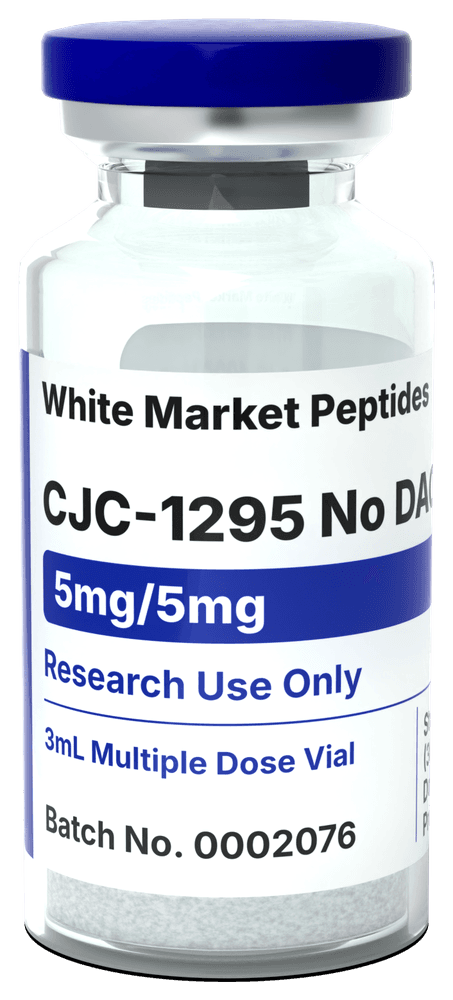
The CJC-1295 No DAC + Ipamorelin blend puts two growth-hormone secretagogues in one vial: a GHRH-receptor analog and a selective ghrelin-receptor agonist. They hit different receptors on the same axis, which is why researchers study them together. This guide covers what each half does, how the combination shows up in the literature, the reconstitution math, and the limits of what's actually known. Research use only. (Bowers 1990)
Composition: A single 10 mg lyophilized vial holds CJC-1295 No DAC (Mod GRF 1-29), 5 mg plus Ipamorelin, 5 mg. CJC-1295 No DAC binds the GHRH receptor; Ipamorelin binds the ghrelin receptor (GHSR-1a). Two receptors, one growth-hormone axis.
The Short Answer
This blend combines a short-acting GHRH analog (CJC-1295 No DAC, also called Mod GRF 1-29) with a selective GHRP-class ghrelin-receptor agonist (Ipamorelin). GHRH-receptor signaling and ghrelin-receptor signaling drive growth-hormone release through separate pathways. Reports say the two together produce a larger combined GH response than either input alone. The "No DAC" form is short-acting, so its profile sits closer to native GHRH than the longer-lasting DAC version. Educational content only. (Bowers 1990)
| Property | Detail |
|---|---|
| Components | CJC-1295 No DAC (Mod GRF 1-29) 5 mg + Ipamorelin 5 mg |
| Total per vial | 10 mg lyophilized powder |
| Targets | GHRH receptor (CJC-1295 No DAC) + GHSR-1a / ghrelin receptor (Ipamorelin) |
| CAS | CJC-1295 No DAC: 863288-34-0; Ipamorelin: 170851-70-4 |
| CJC-1295 No DAC formula | C152H252N44O42 (~3368 g/mol) |
| Ipamorelin formula | C38H49N9O5 (~711.9 g/mol) |
| Typical diluent (educational) | Bacteriostatic Water for Injection, USP (0.9–1.1% benzyl alcohol; multi-dose) |
| Example concentration (educational) | 10 mg vial + 3.0 mL → 3.33 mg/mL total (1.67 mg/mL of each component); math example, not dosing |
| Storage | Lyophilized at ≤ −20 °C, protected from light; reconstituted solution at 2–8 °C short-term, per SOP |
Sources: chemical identity from PubChem; receptor pharmacology from peer-reviewed GH literature; diluent identity from DailyMed (USP). (PubChem)
Key Concepts
The Two Components
CJC-1295 No DAC is a stabilized analog of GHRH(1-29), the active fragment of growth-hormone-releasing hormone. It carries four amino-acid substitutions (D-Ala2, Gln8, Ala15, Leu27) that slow enzymatic breakdown by DPP-IV, so it survives longer than native GRF(1-29) while keeping a short overall action. It binds the GHRH receptor and works through the cAMP pathway in pituitary somatotrophs. The alternate name you'll see is Mod GRF 1-29. One point matters for reading the evidence. Most published human pharmacology covers the DAC version (the one with Drug Affinity Complex, which extends the half-life to days), not the No-DAC form. Teichman and colleagues studied DAC CJC-1295 in a randomized trial and reported prolonged GH and IGF-I elevation. (Teichman 2006)
Ipamorelin is a selective ghrelin-receptor (GHSR-1a) agonist from the GHRP class. It triggers a brief, pulse-like GH release and, in the original pharmacology, did so without the ACTH and cortisol bumps seen with older GHRPs like GHRP-6. It's a pentapeptide (Aib-His-D-2-Nal-D-Phe-Lys-NH2) with a peptide half-life near two hours. (Raun 1998)
How the Combination Is Described
The case for pairing a GHRH analog with a GHRP goes back to Bowers and colleagues, who showed that GHRH and a GHRP acting together release more growth hormone than the sum of each given alone. The two signals work differently. GHRH raises cAMP; the ghrelin receptor works through phospholipase-C and calcium, and ghrelin-pathway activity also blunts somatostatin's inhibitory tone. Hitting both at once is why these two share a vial. (Bowers 1990)
A caution on framing. The supra-additive GH response is well documented for the GHRH-plus-GHRP class. Human data on the No-DAC CJC-1295 paired with Ipamorelin is thin. So the mechanism is the honest basis for interest here. Treat it as a hypothesis that still needs finished clinical proof. (GHS receptor review)
Step-by-Step: How to Work With the Blend
Educational note: This is a research peptide blend, not approved for human therapeutic use. The steps below are educational and not medical advice. Follow your institution's SOPs, the product COA, and applicable regulations.
1) Verify identity and integrity
Check the COA for both components, lot, mass, and purity. Inspect the lyophilized cake and the vial seal. Cross-check identifiers: CJC-1295 No DAC CAS 863288-34-0, Ipamorelin CAS 170851-70-4. Get the No-DAC CAS right; the with-DAC form (446036-97-1) is a different compound. (PubChem)
2) Plan the concentration math
Decide a working concentration before opening the vial. Example: 10 mg total in 3.0 mL bacteriostatic water gives 3.33 mg/mL, which is 1.67 mg/mL of CJC-1295 No DAC and 1.67 mg/mL of Ipamorelin. On a U-100 insulin syringe, one unit (0.01 mL) draws 33.3 mcg of total blend, split 16.7 mcg / 16.7 mcg. This is reconstitution arithmetic, kept separate from any dosing discussion.
3) Choose the diluent
Bacteriostatic Water for Injection, USP (sterile water with 0.9–1.1% benzyl alcohol) is the common multi-dose diluent for injectable research formats. Validate it against your application and SOP; bacteriostatic diluents are not for neonatal use. (DailyMed)
4) Reconstitute gently
Bring vial and diluent to room temperature, swab the stopper, and add the water slowly down the inside glass wall. Swirl; don't shake. Peptide solutions aggregate under mechanical stress, and two peptides in one vial only raises the stakes.
5) Label and store
Record both compounds, lot, concentration, diluent, and the date and time of reconstitution. Store lyophilized material at ≤ −20 °C away from light. Keep the reconstituted solution at 2–8 °C for short-term use and limit freeze-thaw cycles, per SOP.
6) Dispose responsibly
Follow biosafety and hazardous-waste procedures and log the disposal.
Comparison & Alternatives
| Option | What it is | Profile |
|---|---|---|
| CJC-1295 No DAC + Ipamorelin | GHRH analog + selective GHRP | Two complementary inputs; short-acting GHRH half, brief GH pulse from the GHRP half |
| Ipamorelin alone | Selective GHSR-1a agonist | Single short GH pulse; the most GH-selective first-generation GHRP |
| CJC-1295 No DAC alone | Short-acting GHRH analog | GHRH-receptor input without the ghrelin-pathway component |
| CJC-1295 DAC | Long-acting GHRH analog | Days-long GH/IGF-I elevation; shifts the timing while leaving pulse shape alone (Teichman 2006) |
The blend's appeal is the two-receptor design. Ipamorelin on its own gives a clean, selective pulse; the No-DAC GHRH half adds a second, independent push on the same axis. The DAC version is a separate research question. Its long half-life shifts the study from "pulse shape" to "sustained exposure."
FAQs
What is the CJC-1295 No DAC + Ipamorelin blend?
It is a research-grade combination of two growth-hormone secretagogues in one 10 mg vial: 5 mg of CJC-1295 No DAC (a GHRH-receptor analog) and 5 mg of Ipamorelin (a selective ghrelin-receptor agonist). The two act on separate receptors of the same growth-hormone axis. It is sold for laboratory research only and is not an approved medication.
Why combine a GHRH analog with a GHRP?
Because they work through different receptors. CJC-1295 No DAC signals through the GHRH receptor and the cAMP pathway; Ipamorelin signals through the ghrelin receptor and the calcium pathway, and also reduces somatostatin's braking effect. Bowers and colleagues showed that a GHRH plus a GHRP together release more growth hormone than either alone, which is the documented basis for pairing this class.
What does "No DAC" mean?
DAC stands for Drug Affinity Complex, a modification that binds CJC-1295 to albumin and stretches its half-life to several days. The No-DAC form (Mod GRF 1-29) omits that, so it acts over a short window closer to native GHRH. Most published human trials used the DAC version, so No-DAC claims should lean on the shared GHRH-analog mechanism; the No-DAC-specific human data isn't there.
How is the blend reconstituted?
A common educational example: add 3.0 mL of bacteriostatic water to the 10 mg vial for 3.33 mg/mL total, which is 1.67 mg/mL of each component. On a U-100 syringe, one unit draws 33.3 mcg of total blend. This is reconstitution math for reference, not a dosing recommendation.
Is the blend approved for human use?
No. Both components are research compounds, not approved drugs. Growth-hormone secretagogues, including Ipamorelin and GHRH analogs, are also on the WADA Prohibited List at all times, so anyone working with athlete populations must check current antidoping rules.
How is it stored?
Keep the lyophilized vial at or below −20 °C, protected from light. After reconstitution, hold the solution at 2–8 °C for short-term use and minimize freeze-thaw cycles. The benzyl alcohol in bacteriostatic water limits microbial growth during multi-day handling, but the COA and your SOP govern the specifics.
Next Steps
- What Is Ipamorelin?: the selective GHRP half of the blend, in detail
- What Is Tesamorelin?: a related GHRH analog for mechanism comparison
The mechanism behind this blend is well grounded. The human data on the No-DAC pairing is still thin, so read the claims with that in mind. Educational content only, no medical advice. (Bowers 1990)
Sources
- On the actions of the growth hormone-releasing hexapeptide, GHRP (Bowers CY et al., 1990) — PubMed
- Prolonged stimulation of growth hormone and insulin-like growth factor I secretion by CJC-1295 (Teichman SL et al., 2006) — PubMed
- Ipamorelin, the first selective growth hormone secretagogue (Raun K et al., 1998) — PubMed
- Ipamorelin | C38H49N9O5 | CID 9831659 — PubChem
- The Growth Hormone Secretagogue Receptor — PMC
- Label: BACTERIOSTATIC WATER injection, solution — DailyMed