Single-peptide protocol
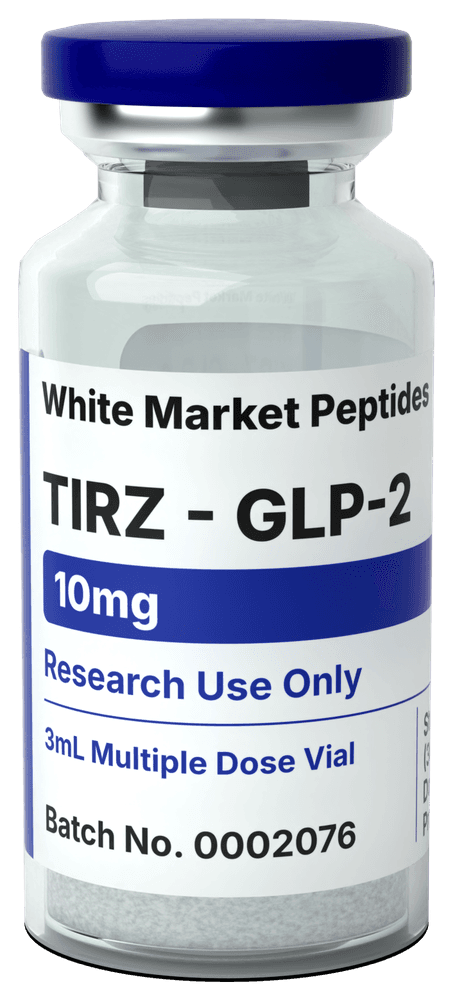
Tirzepatide (10 mg)
Tirzepatide 10mg vial dosage protocol. Reconstitution, weekly dose titration schedule, syringe measurements, and guidance.
- Peptide
- tirzepatide
- Vial
- 10 mg
- Water
- 2 mL
- Concentration
- 5.00 mg/mL
Sponsored
At a Glance
Tirzepatide is a first-in-class dual GIP/GLP-1 receptor agonist that simultaneously activates both incretin pathways to suppress appetite, slow gastric emptying, and improve insulin sensitivity. In the SURMOUNT-1 trial, participants receiving tirzepatide achieved up to 22.5% mean body-weight reduction over 72 weeks.[1] It is administered as a once-weekly subcutaneous injection following a gradual dose escalation.
- Reconstitute: Add 2.0 mL bacteriostatic water → 5.0 mg/mL concentration.
- Starting dose: 2.5 mg once weekly (50 units / 0.50 mL) for the first 4 weeks.
- Easy measuring: At 5.0 mg/mL on a U-100 syringe, 1 unit = 0.01 mL = 50 mcg.
- Storage: Lyophilised: freeze at −20 °C; reconstituted: refrigerate at 2–8 °C; use within 4 weeks.
Overview
- Goal: Progressive weight loss and metabolic improvement via dual GIP/GLP-1 receptor agonism — appetite suppression, enhanced insulin sensitivity, and reduced caloric intake.[1]
- Schedule: Once-weekly subcutaneous injection; dose escalated every 4 weeks.
- Dose range: 2.5 mg (initiation) → 10 mg (maintenance target).
- Reconstitution: 2.0 mL BAC water per 10 mg vial → 5.0 mg/mL.
- Storage: Lyophilised at −20 °C; reconstituted at 2–8 °C; use within 4 weeks.
What You’ll Need
Plan based on a 12-week titration (Weeks 1–4: 2.5 mg; 5–8: 5 mg; 9–12: 7.5 mg). Total dose = 60 mg.
- Tirzepatide Vials (10 mg each): 60 mg cumulative → 6 vials.
- Insulin Syringes (U-100, 1 mL): 12 weekly injections (some split into 2) → 16–20 syringes.
- Bacteriostatic Water (10 mL bottles): 2.0 mL per vial → 2 × 10 mL bottles.
- Alcohol Swabs: 2 per injection → 40 swabs per 12-week course.
How to Reconstitute
- Allow frozen lyophilised vial to reach room temperature (10–15 minutes).
- Draw 2.0 mL bacteriostatic water with a sterile syringe.
- Inject slowly down the inner vial wall; do not inject directly onto the powder cake.
- Gently swirl or roll until fully dissolved — do not shake. Solution should be clear and colourless.
- Label with reconstitution date; refrigerate at 2–8 °C, protected from light. Use within 4 weeks.
Dosing Schedule
| Weeks | Dose | Units (U-100) | Volume |
|---|---|---|---|
| Weeks 1–4 (initiation) | 2.5 mg | 50 units | 0.50 mL |
| Weeks 5–8 | 5 mg | 100 units | 1.00 mL |
| Weeks 9–12 | 7.5 mg | 75 units × 2 injections | 0.75 mL × 2 |
| Weeks 13+ (maintenance) | 10 mg | 100 units × 2 injections | 1.00 mL × 2 |
Frequency: Inject once weekly on the same day each week. The 10 mg vial provides 1 dose at the 10 mg maintenance level or 4 doses at the 2.5 mg initiation level. For doses above 5 mg, split into two separate injections at different sites. Slow titration minimises nausea, vomiting, and diarrhoea — the most common adverse effects.[1]
Protocol Details
- Weeks 1–4: 2.5 mg (50 units / 0.50 mL) once weekly — initiation and tolerability assessment.
- Weeks 5–8: 5 mg (100 units / 1.00 mL) once weekly.
- Weeks 9–12: 7.5 mg (split: 75 units × 2 injections at different sites) once weekly.
- Weeks 13+: 10 mg (split: 100 units × 2 injections) once weekly — maintenance.[2]
Storage
- Lyophilised: Store at −20 °C (−4 °F) or below; protect from moisture and light.
- Reconstituted: Refrigerate at 2–8 °C. Do not freeze. Use within 4 weeks.
- Appearance: Clear and colourless. Discard if cloudy, coloured, or particulate.
How Tirzepatide Works
Tirzepatide is a 39-amino acid synthetic peptide featuring a C20 fatty diacid moiety that promotes albumin binding, extending its half-life to approximately 5 days and enabling once-weekly dosing. Unlike pure GLP-1 agonists such as semaglutide, tirzepatide simultaneously activates both the GIP and GLP-1 receptors, producing synergistic metabolic effects.[1]
GIP receptor activation enhances pancreatic beta-cell insulin secretion in a glucose-dependent manner and promotes lipid metabolism in adipose tissue. GLP-1 receptor activation suppresses appetite centrally, slows gastric emptying, and inhibits glucagon secretion. The dual-agonist mechanism delivers greater insulin sensitivity improvement and more pronounced weight loss compared to selective GLP-1 receptor agonists alone, as demonstrated in head-to-head trials.[2]
Good to Know
- Inject on the same day each week to maintain stable plasma levels (half-life ≈ 5 days).
- If a dose is missed by ≤4 days, administer as soon as possible; otherwise skip and resume the next scheduled day.
- Do not advance to the next dose tier if GI side effects are poorly tolerated — hold at the current dose for an additional 4 weeks.
- For doses above 5 mg from a 5.0 mg/mL solution, split into two separate subcutaneous injections at different sites (each ≤1 mL).
- Monitor blood glucose when used alongside other glucose-lowering agents.
- Weight reduction: SURMOUNT-1 (n=2539): up to 22.5% mean weight loss at 72 weeks with 15 mg/week tirzepatide vs. 3.1% placebo.[1]
- Glycaemic control: SURPASS trials demonstrated superior HbA1c reductions compared to insulin glargine, semaglutide 1 mg, and other comparators.[2]
- Insulin sensitivity: Dual GIP/GLP-1 agonism improves whole-body insulin sensitivity to a greater degree than GLP-1 agonism alone.
- GI side effects: Nausea (up to 29%), diarrhoea (~17%), vomiting (~9%) — dose-dependent and typically transient; slow titration mitigates severity.
- Contraindications: Personal or family history of medullary thyroid carcinoma or MEN2 (boxed warning); history of pancreatitis warrants caution.
- For background on Tirzepatide's mechanism, evidence, and safety profile, see What Is Tirzepatide?.
Tips for Best Results
- Pair with a reduced-calorie diet and regular physical activity (both resistance and aerobic) to maximise fat loss while preserving lean mass.
- Eat smaller, more frequent meals to minimise nausea — particularly during early titration phases.
- Prioritise protein intake (1.2–1.6 g/kg/day) to counteract lean-mass loss during caloric deficit.
- Stay well hydrated; GI side effects can increase dehydration risk.
- Track weekly body weight, waist circumference, and fasting glucose to assess response.
Injection Tips
- Clean the vial stopper and injection site with separate alcohol swabs; allow both to air-dry fully before proceeding.
- Using a 29–31 gauge insulin syringe (5/16″ to 1/2″ needle), draw the calculated dose precisely.
- Pinch a fold of skin and insert the needle at 45° into subcutaneous fat (90° is acceptable with a short needle into a well-pinched fold).
- Inject slowly over 2–3 seconds; do not aspirate. Withdraw the needle, apply gentle pressure, and do not rub the site.
- Rotate injection sites (abdomen, thighs, upper arms) and dispose of each syringe in a sharps container immediately after use.
Related on pep-dose
- Article
What Is Tirzepatide (Mounjaro/Zepbound) & How Does It Work?
What is Tirzepatide (Mounjaro/Zepbound)? Dual GIP/GLP-1 agonist mechanism, weight loss results, dosing schedule, and side effects.
- Protocol
Tirzepatide (30 mg)
Tirzepatide 30mg vial dosage protocol. Reconstitute with 3.0 mL BAC water for 10.0 mg/mL. Weekly SC injection, 2.5–15 mg titration over 20+ weeks.