Single-peptide protocol
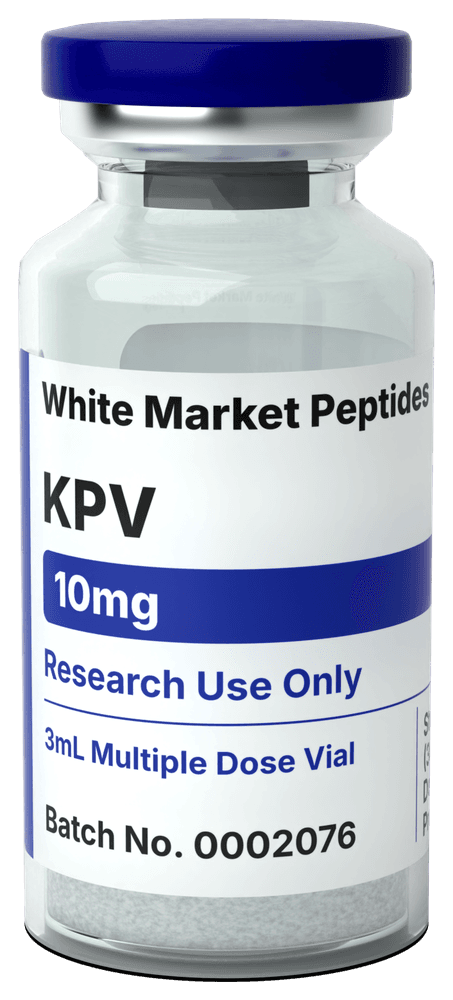
KPV (10 mg)
KPV 10mg vial dosage protocol. Reconstitute with 3.0 mL BAC water for 3.33 mg/mL. Titrate 200–500 mcg/day SC. 20 doses per vial at maintenance.
- Peptide
- kpv
- Vial
- 10 mg
- Water
- 3 mL
- Concentration
- 3.33 mg/mL
Sponsored
At a Glance
KPV (Lys-Pro-Val) is a naturally occurring tripeptide — the C-terminal fragment of α-MSH — that retains the anti-inflammatory activity of the full melanocortin hormone without any melanotropic effects. Research focuses on its ability to suppress gut inflammation, accelerate wound healing, and reduce systemic inflammatory signalling. Unlike full α-MSH, KPV does not alter skin pigmentation and is well tolerated in animal models of IBD.[1]
- Reconstitute: Add 3.0 mL bacteriostatic water → 3.33 mg/mL (3,333 mcg/mL) concentration.
- Starting dose: 200 mcg once daily (6 units / 0.06 mL) subcutaneous for the first week.
- Easy measuring: At 3.33 mg/mL on a U-100 syringe, 1 unit = 0.01 mL = 33.3 mcg.
- Doses per vial: 20 doses at the 500 mcg maintenance level; use within 30 days of reconstitution.
- Storage: Lyophilised: freeze at −20 °C; reconstituted: refrigerate at 2–8 °C; use within 30 days.
Overview
- Goal: Suppress gut and systemic inflammation via inhibition of NF-κB and MAP kinase signalling, reducing TNF-α, IL-6, and IL-1β production.[1]
- Schedule: Once-daily subcutaneous injection; dose escalated weekly over 3 weeks.
- Dose range: 200 mcg (initiation) → 500 mcg (maintenance).
- Reconstitution: 3.0 mL BAC water per 10 mg vial → 3.33 mg/mL.
- Storage: Lyophilised at −20 °C; reconstituted at 2–8 °C; use within 30 days.
What You’ll Need
Plan based on an 8-week course titrated from 200 mcg to 500 mcg once daily (total ≈ 26,600 mcg / 26.6 mg).
- KPV Vials (10 mg each): 26.6 mg cumulative → 3 vials (with buffer).
- Insulin Syringes (U-100, 1 mL): 1 per injection → 56 syringes for the 8-week course.
- Bacteriostatic Water (10 mL bottles): 3.0 mL per vial → 1 × 10 mL bottle covers all three vials.
- Alcohol Swabs: 2 per injection → 112 swabs for the course.
How to Reconstitute
- Allow frozen lyophilised vial to reach room temperature (10–15 minutes).
- Draw 3.0 mL bacteriostatic water with a sterile syringe.
- Inject slowly down the inner vial wall; do not inject directly onto the powder cake.
- Gently swirl or roll until fully dissolved — do not shake. Solution should be clear and colourless.
- Label with reconstitution date; refrigerate at 2–8 °C. Use within 30 days.
Dosing Schedule
| Week(s) | Dose | Units (U-100) | Volume |
|---|---|---|---|
| Week 1 (initiation) | 200 mcg | 6 units | 0.06 mL |
| Week 2 | 300 mcg | 9 units | 0.09 mL |
| Week 3 | 400 mcg | 12 units | 0.12 mL |
| Weeks 4–8 (maintenance) | 500 mcg | 15 units | 0.15 mL |
Frequency: Inject once daily subcutaneously. Gradual titration over the first three weeks helps establish tolerability before reaching the 500 mcg maintenance dose. At 500 mcg/day, a 10 mg vial (3.33 mg/mL, 3.0 mL total) yields 20 doses. Doses are calculated at 33.3 mcg per unit for convenient measurement on a standard U-100 insulin syringe.[2]
Protocol Details
- Week 1: 200 mcg (6 units / 0.06 mL) once daily — initiation and tolerability.
- Week 2: 300 mcg (9 units / 0.09 mL) once daily.
- Week 3: 400 mcg (12 units / 0.12 mL) once daily.
- Weeks 4–8: 500 mcg (15 units / 0.15 mL) once daily — maintenance.[2]
- Injection site: Abdomen, thigh, or upper arm. Rotate sites between injections.
Storage
- Lyophilised: Store at −20 °C (−4 °F) or below; protect from moisture and light.
- Reconstituted: Refrigerate at 2–8 °C. Do not freeze. Use within 30 days.
- Appearance: Clear and colourless. Discard if cloudy, coloured, or particulate.
How KPV Works
KPV is the C-terminal tripeptide (Lys-Pro-Val) of α-melanocyte-stimulating hormone (α-MSH). While full α-MSH exerts its anti-inflammatory effects primarily through MC1R signalling, KPV appears to work through both melanocortin receptor-dependent and receptor-independent mechanisms. Critically, KPV inhibits nuclear factor-kappa B (NF-κB) activation — the master transcription factor governing pro-inflammatory cytokine production — and suppresses MAP kinase signalling pathways, reducing downstream expression of TNF-α, IL-6, and IL-1β.[1]
In experimental colitis models, KPV reduces macrophage infiltration and epithelial barrier disruption. A key pharmacological advantage is that KPV enters inflamed intestinal epithelial cells via the PepT1 transporter — a di/tripeptide uptake system that is up-regulated in inflammatory bowel disease — making the gut lumen itself a preferential site of KPV accumulation during active inflammation.[2][3] This biology underpins efforts to develop oral and nanoparticle-based KPV delivery systems for Crohn’s disease and ulcerative colitis.
Good to Know
- KPV is a tripeptide with a very small molecular weight (≈340 Da) and is absorbed via the intestinal PepT1 di/tripeptide transporter — which means oral and nanoparticle-encapsulated formulations are actively investigated for IBD.[3]
- Unlike full α-MSH, KPV does not activate MC1R in melanocytes and therefore does not cause skin darkening or melanotropic side effects.
- If GI side effects (nausea, loose stool) occur during titration, hold at the current dose for an additional week before advancing.
- KPV has no known melanotropic activity, but it does bind MC3R and MC5R in addition to showing NF-κB inhibition via non-receptor cytoplasmic mechanisms.[1]
- Mild injection site redness or swelling is the most commonly reported side effect in animal studies; this typically resolves within 24 hours.
- IBD & colitis (animal data): KPV significantly reduced macroscopic and histological colitis scores in murine DSS- and TNBS-induced colitis models, outperforming vehicle controls on inflammatory markers.[2]
- Oral delivery feasibility: Nanoparticle-encapsulated KPV administered orally reduced colitis severity in mice, demonstrating gut epithelial absorption via PepT1 even at low doses.[3]
- Wound healing (animal data): Topical and subcutaneous KPV reduced wound-induced inflammatory cytokines and accelerated healing in murine wound models.[4]
- No melanotropic activity: No skin pigmentation changes observed in any published animal study, differentiating KPV from full α-MSH.
- Side effects: Mild, transient injection site reactions are the predominant reported effect; no systemic toxicity at studied doses in rodent models.
- Human data: No published human clinical trial data exist for subcutaneous KPV. All efficacy conclusions are extrapolated from preclinical models.
- For background on KPV's mechanism, evidence, and safety profile, see What Is KPV?.
Tips for Best Results
- For gut-focused research protocols, some researchers administer KPV 30–60 minutes before meals to align peptide absorption with active PepT1 upregulation in the gut epithelium.
- Minimise dietary triggers of gut inflammation (ultra-processed foods, alcohol, NSAIDs) during the protocol to avoid confounding KPV’s anti-inflammatory effects.
- If stacking with BPC-157 for gut repair protocols, consider alternating injection sites and timing — both peptides are well tolerated in animal models when combined.[2]
- Track gut symptom severity (frequency, urgency, stool consistency) with a daily log to assess response across the titration phase.
- Refrigerate reconstituted vials promptly and adhere to the 30-day use window — tripeptides are stable but not indefinitely so.
Injection Tips
- Clean the vial stopper and injection site with separate alcohol swabs; allow both to air-dry fully before proceeding.
- Using a 29–31 gauge insulin syringe (5/16″ to 1/2″ needle), draw the calculated dose precisely.
- Pinch a fold of skin and insert the needle at 45° into subcutaneous fat (90° is acceptable with a short needle into a well-pinched fold).
- Inject slowly over 2–3 seconds; do not aspirate. Withdraw the needle, apply gentle pressure, and do not rub the site.
- Rotate injection sites (abdomen, thighs, upper arms) and dispose of each syringe in a sharps container immediately after use.
Related on pep-dose
- Article
What is KPV?
What is KPV? Anti-inflammatory peptide for gut health, skin conditions, and immune modulation. Mechanism, benefits, and dosing.
- Blend
KLOW (80 mg)
KLOW 80mg peptide blend dosage protocol. GHK-Cu + TB-500 + BPC-157 + KPV reconstitution, escalating 8–12 week dosing schedule, and syringe guide.
- Article
What Is the KLOW Peptide Blend?
What is the KLOW peptide blend? GHK-Cu + TB-500 + BPC-157 + KPV stack. Components, anti-inflammatory benefits, and dosing.
Sources
- Catania A et al. — Pharmacol Rev (2004) — PMID 15169929
- Kannengiesser K et al. — Inflamm Bowel Dis (2008) — PMID 17712842
- Haas E et al. — Biomaterials (2021) — PMID 34225059
- Zgheib C et al. — Wound Repair Regen (2018) — PMID 29516505
- Bachem Peptide Technical Guide
- CDC — General Best Practice Guidelines for Immunization